
Table of Contents
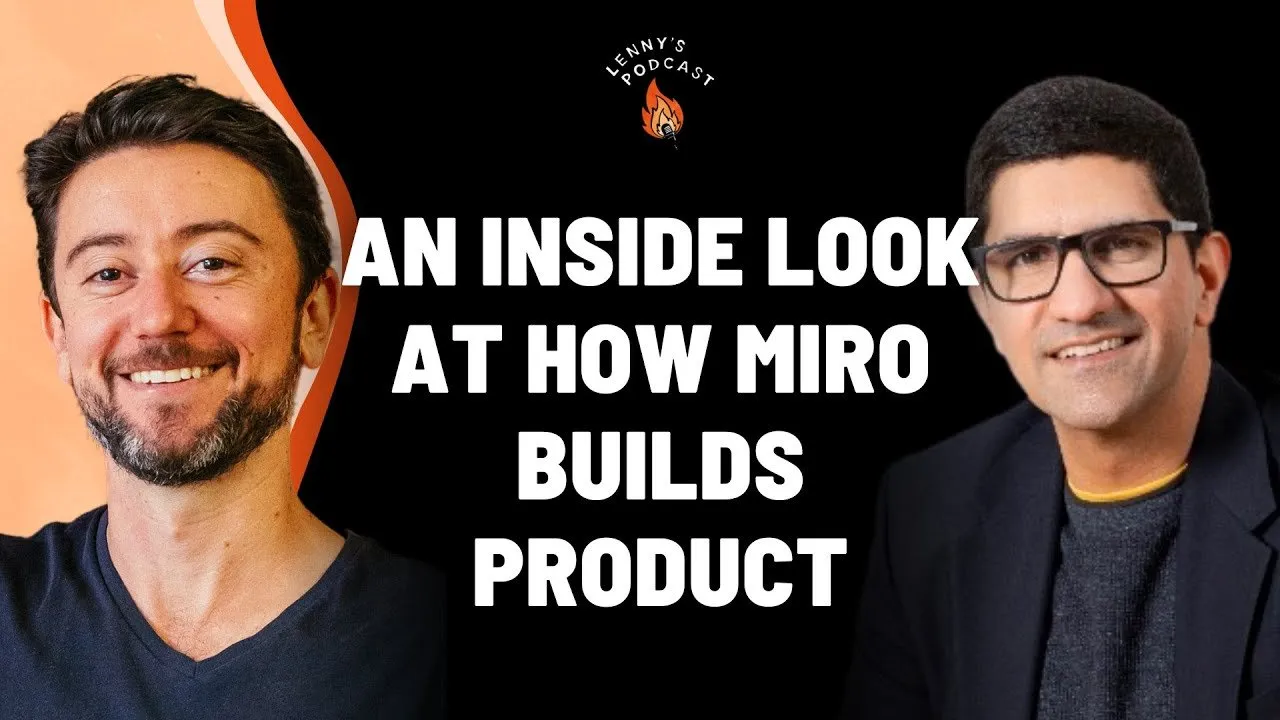
Miro has become a dominant force in the collaborative whiteboard space, thriving in a market crowded with tech giants and nimble startups alike. How does a company maintain its edge, innovate consistently, and build a product loved by over 50 million users? The secret lies in a unique and intentional product culture that blends disciplined processes with a deep understanding of human collaboration. In a revealing conversation, Miro's Chief Product Officer, Varun Parmar, pulls back the curtain on the philosophies, frameworks, and rituals that power one of the world's most successful product-led growth companies.
Key Takeaways
- Competition Defines Your Trajectory: Miro operates on the principle that your success is directly related to what your competition allows you to do. Every product release either makes you better or worse in the customer's eyes; you never stay the same.
- The "Amped" Framework: Miro's product organization, called "Amped," is a truly cross-functional unit that embeds Analytics, Marketing, Product, Engineering, and Design into every team, ensuring a holistic perspective from day one.
- Speed is About Learning Faster: The goal isn't just to move fast, but to be the "first one to hit the brick wall." This philosophy prioritizes rapid learning and iteration, allowing teams to adapt more quickly than competitors.
- Rituals Foster Innovation: A bi-monthly, company-wide demo day called "Miro Connect" creates moments of serendipity, once saving a team three months of engineering work after a single conversation.
- Quality is Taught, Not Just Defined: Instead of writing long documents about quality, Miro's design leadership team reviews every feature shipped monthly and gives it a binary "high quality" or "not high quality" rating to build a shared, practical understanding of excellence.
Miro's Product Culture: Empathy and Teamwork at Scale
Miro’s global footprint, with product teams primarily in Europe and go-to-market teams spread worldwide, could easily create silos. Instead, this distributed nature has forced the company to build a culture founded on two core principles: empathy and teamwork. Parmar emphasizes that empathy isn't just about understanding customer pain points; it's a critical internal practice.
Practicing Empathy to Gain Insights
For Miro's product teams in Europe, understanding the perspective of a salesperson meeting with large customers in San Francisco is crucial. This internal empathy is cultivated by encouraging questions and assuming good intent. Instead of challenging a decision, the default is to ask about the insights that led to it. Was it informed by customer feedback, competitive analysis, or internal conversations? This approach ensures that decisions are rooted in a collective understanding rather than an individual's opinion.
Every single move that you're making the customer has that sort of in their mind if not explicitly implicitly that they are actually comparing these things.
Teamwork Over Silos
The second cultural pillar is a relentless focus on teamwork. Miro believes that genuine innovation happens at the intersection of diverse, cross-functional perspectives. This isn't just a poster on the wall; it's embedded in their organizational structure. By bringing different functions together to solve problems, they avoid the tunnel vision that can occur when teams are organized around a single persona or department. This philosophy is the foundation of their unique "Amped" framework.
The "Amped" Framework: A Cross-Functional Approach to Product
At Miro, the "product org" isn't just product managers, designers, and engineers. They use a structure called "Amped," which stands for Analytics, Marketing, Product, Engineering, and Design. This integrated unit ensures that every product stream benefits from a wide range of expertise, building a more robust and market-aware product.
Why Marketing Sits at the Core
Including marketing, and specifically product marketing, within the core product team is a game-changer. It forces teams to think about positioning, competitive differentiation, and packaging from the very beginning. This prevents the common scenario where a great feature is built but fails to capture the market's imagination because its value isn't communicated effectively. By embedding this perspective, Miro ensures that what they build is not only functional but also strategically positioned to win in a competitive environment.
Maintaining a Holistic Experience
While Miro's product teams are organized into "streams" focused on key personas like Enterprise Admins or Developers, the Amped structure provides a crucial counterbalance. The presence of cross-functional members prevents teams from becoming too insular. For example, a product marketer can raise concerns about the end-user experience, while an analytics expert can provide data on how a new feature might impact overall engagement. This built-in system of checks and balances helps maintain a cohesive and consistent product experience across the entire platform.
Navigating a Hyper-Competitive Landscape
Many product leaders advise ignoring the competition and focusing solely on the customer. Varun Parmar offers a more pragmatic view, arguing that competition is a powerful, defining force that cannot be overlooked.
Your Product is Never Static
A core philosophy at Miro is that products never remain the same—they either get better or they get worse. Every time you ship a feature and every time a competitor ships one, the landscape shifts. From the customer's perspective, they are constantly, if subconsciously, comparing the options available to them.
Products either get better over a period of time or they get worse products never remain the same.
This mindset creates an "insane amount of clarity." It frames every product decision as a strategic move in a chess match. Is this release advancing our position, or are we falling behind? This constant awareness drives focus and ensures that resources are invested in work that truly moves the needle.
Competing Through Differentiation
To succeed, Parmar stresses the importance of having a clear, unique place in the customer's mind. This involves more than just features; it's about the fundamental architecture of the solution. Miro's differentiation comes from its team-centric lens, serving cross-functional collaboration rather than a single persona. They combine this with broad applicability across industries and a set of unique capabilities, like advanced workshop facilitation tools, that competitors struggle to replicate. The key is to clearly define this value and build a moat around it through continuous investment and clear positioning.
Inside Miro's Product Development Machine
To execute on its strategy, Miro has built a product development process designed for speed, learning, and serendipity. It combines long-term planning with the agility to react to market changes and internal breakthroughs.
Velocity as a Core Principle: Hit the Brick Wall First
For Parmar, speed is the single biggest determinant of success in a competitive market. The philosophy isn't just about shipping faster, but about learning faster. He encourages teams to be the "first one to hit the brick wall," meaning they should accelerate towards discovery and uncover critical insights before anyone else. This allows them to quickly pivot or double down, ensuring they stay one step ahead of the pack.
The Rolling Six-Month Roadmap
To balance the enterprise need for visibility with the team's need for agility, Miro uses a rolling six-month roadmap updated quarterly.
- Months 1-3: Have an 80% precision level. This provides a high degree of confidence for near-term planning.
- Months 4-6: Have a 50% precision level. This lower resolution gives teams the flexibility to pivot based on new learnings, competitive moves, or technological breakthroughs.
This structure provides customers with the visibility they need while empowering product teams to remain nimble and responsive.
Miro Connect: Engineering Serendipity
One of Miro's most unique rituals is "Miro Connect," a bi-monthly event where product teams set up tables—like an internal trade show—and demo what they're working on. Parmar shared a powerful story where an engineer, while walking around with a beer, stopped at a table and learned about a problem another team was struggling with. Having solved a similar problem in a past role, he went home and coded a solution in a few hours, pushing a pull request that saved the other team three months of work. These are the magical moments Miro seeks to create, fostering a culture of organic collaboration and knowledge sharing.
Delivering Customer Value, Faster, with High Quality
The product organization at Miro operates under a simple but powerful motto: "Deliver customer value faster with high quality." This isn't just a slogan; it's a framework that is measured and integrated into their performance and reward systems.
Measuring "Faster": A Game of Golf
Miro tracks cycle times across the entire product development process, from an initial idea (P-Strat) to problem definition (P0), solution definition (P1), and finally, measuring impact after shipping (P2). However, the philosophy is that velocity is like a game of golf—you're only competing against yourself. Data on cycle times for small, medium, and large projects is made available to everyone, allowing teams to benchmark their own performance and identify areas for improvement without creating unhealthy competition.
Defining "High Quality": A Practical Approach
Defining "quality" can lead to endless debates and lengthy documents. Miro took a different approach. Every month, the design leadership team conducts a review of everything that shipped and assigns a simple, binary classification: "high quality" or "not high quality." They then document the reasoning behind each classification. This process has been far more effective at building an organizational muscle for quality than any abstract definition could be. By showing concrete examples of what good looks like, they create a shared understanding and continuously raise the bar for the entire team.
Conclusion: Building a Resilient Product Organization
Miro's success isn't an accident. It's the result of a deeply intentional culture that views competition as a catalyst, embeds cross-functional collaboration into its DNA, and relentlessly pursues faster learning. By combining disciplined frameworks like rolling roadmaps and the "Amped" structure with unique cultural rituals like Miro Connect, they have built a product engine that is both resilient and innovative. Their journey offers a powerful lesson for any leader: building a great product is as much about how you work together as it is about what you build.



)