Table of Contents
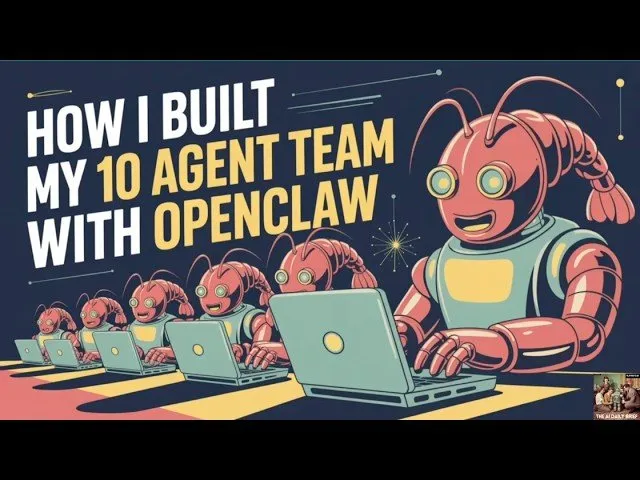
The transition from passive AI chatbots to autonomous "digital employees" has reached a functional tipping point, demonstrated by a recent comprehensive case study from the AI Daily Brief. By leveraging the open-source framework OpenClaw, the show's host successfully deployed a team of 10 autonomous agents capable of performing research, project management, and coding tasks without direct human supervision. This development highlights a shift in generative AI from simple content creation to persistent, system-integrated labor that operates continuously, even when the user is offline.
Key Points
- Autonomous Operations: Unlike standard chatbots, OpenClaw agents utilize "heartbeat" protocols to wake up, execute tasks, and make decisions independently on a set schedule.
- Zero-Code Deployment: The 10-agent team was built by a non-technical user relying entirely on AI coding assistants like Claude Code to handle the programming and terminal commands.
- Local Infrastructure: The system runs locally on a Mac Mini using TailScale for remote access, ensuring data privacy and persistent server capabilities.
- Agent Specialization: The workforce consists of distinct roles, including persistent researchers, project managers, and a "Chief of Staff" for triage.
Defining the Digital Employee
The core innovation driving this deployment is OpenClaw, a framework billed as "the AI that actually does things." Unlike web-based LLMs that live in a browser tab, OpenClaw operates directly on the user's hardware. It possesses the ability to read and write files, execute scripts, and maintain persistent memory of past interactions.
The architecture relies on a series of markdown files that define each agent's identity and operational parameters:
- Identity.md: Establishes the agent's name and basic description.
- Soul.md: Defines personality, communication style, and behavioral constraints.
- Agents.md: Acts as the "employee handbook," outlining protocols for interacting with other systems.
- Heartbeat.md: The critical component that allows for autonomy. This file dictates tasks the agent runs on autopilot—typically every 30 minutes—allowing it to work while the human user sleeps.
"The promise of digital employees—not just AI assistants, but actual workers who can be doing things for you when you are not working—is a level-up goal of AI that we've been trying to achieve for a number of years. It felt like this might be the first time that we actually had something like that."
The "Vibe Coding" Revolution
A significant aspect of this case study is the methodology used to build the system. The developer, identifying as "non-technical," utilized a method often referred to as "Vibe Coding." Instead of learning syntax or studying documentation, the user established a dedicated project within Anthropic’s Claude to act as a build partner.
By granting the AI access to documentation and context, the AI generated the necessary command-line instructions and code blocks. This suggests a lowering barrier to entry for complex system architecture, where natural language prompting replaces traditional software engineering skills.
"To get from zero to this mission control center with 10 agents running actively, I watched exactly zero YouTube videos... I still think the big thing that has changed... is that the best way to learn some new thing in AI or to build some new thing in AI is to just let the AI help."
Operational Successes and Failures
The deployment revealed distinct patterns regarding which tasks are currently suitable for autonomous agents. The most successful implementations involved persistent research and task management.
Research and Intelligence
Two agents were dedicated to compiling "Maturity Maps" and "Opportunity Radars" for the AI Daily Brief. These agents run 24/7, surfacing new studies and data, cataloging them, and proposing updates to the datasets. While some quality calibration was required regarding the agents' judgment of sources, they successfully automated the ingestion of vast amounts of information.
The Limitations of Autonomous Coding
Conversely, the "Builder" agent intended for coding was the least utilized. The case study found that development work remains highly iterative and requires frequent human feedback, making it ill-suited for the "set and forget" nature of the current OpenClaw configuration.
Market Implications
The move toward locally hosted, autonomous agents signals a fragmentation in the AI market. While major providers offer centralized assistants, open-source tools like OpenClaw allow for high customization and privacy. However, the report noted that the "Mission Control" aspect—a dashboard to monitor all agents—was the most technically demanding part of the build.
Currently, the Return on Investment (ROI) for such a setup is negative regarding time spent on configuration versus time saved on tasks. However, the rapid maturity of these tools suggests that "Mission Control" dashboards and pre-configured agent teams will likely become off-the-shelf software products in the near future.
As security protocols improve—addressing early concerns regarding malware in third-party skills—the integration of these agents into broader systems like Slack and email is the anticipated next phase of the digital workforce evolution.