Table of Contents
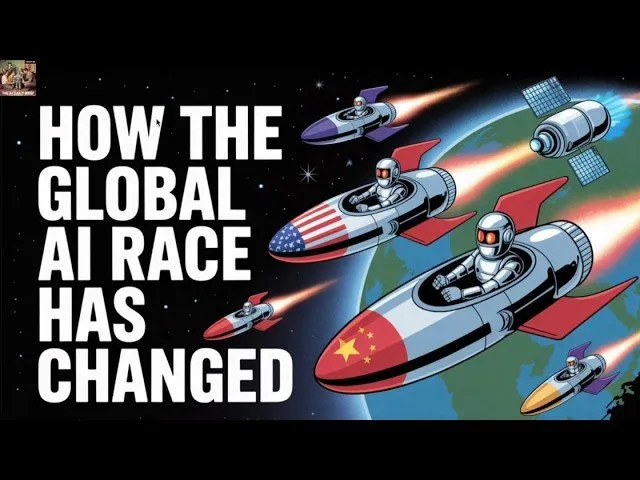
The global artificial intelligence landscape has shifted dramatically in early 2026, evolving from a bilateral contest between the United States and China into a complex, multipolar race involving new sovereign actors and orbital infrastructure. As Chinese laboratories demonstrate capabilities that rival Western frontiers and the UAE stakes its claim as a neutral "third power," the geopolitical and financial stakes of AI development have reached unprecedented heights.
Key Developments in the Global AI Race
- China Closes the Gap: New models from Deepseek, Moonshot, and ByteDance are challenging the notion that Chinese AI lags significantly behind the US, with innovations in reasoning and multimodal generation driving market volatility.
- Hardware Sovereignty: Huawei has successfully trained models on domestic chips, while US lawmakers prepare bipartisan legislation to ban the export of advanced Nvidia architecture like Blackwell to China.
- The Rise of the UAE: G42 is positioning the Emirates as a neutral broker, leveraging massive compute resources and data center diplomacy to bridge Western and Eastern markets.
- Orbital Infrastructure: A "second space race" has emerged, with both Elon Musk and the Chinese state announcing competing plans for gigawatt-class data centers in orbit.
China's Innovation Surge Disrupts Markets
The narrative that Chinese AI labs are merely producing discount versions of Western models has been effectively dismantled in the opening months of 2026. The shift became undeniable when Deepseek released its R1 reasoning model, a move that wiped nearly $600 billion from Nvidia’s market cap in a single day—the largest dollar-value loss in history. This market reaction underscored a critical realization: Chinese competition is now capable of shaping global financial outcomes.
Recent releases have reinforced this trend. Moonshot’s Kimmy K 2.5 and ByteDance’s Seed Dance 2.0 have demonstrated performance parity with top Western models. ByteDance’s video model, in particular, has achieved a technical breakthrough by generating high-quality visuals and naturalistic sound effects simultaneously, rather than as a post-process. This surge in innovation has forced a reevaluation of previous assumptions regarding the technical gap.
"The question is, can they innovate something new beyond the frontier? I don't think that's been shown yet."
While Google DeepMind CEO Demis Hassabis posed that question earlier in the year, the rapid deployment of agentic workflows and multimodal capabilities by Chinese firms suggests the window of Western dominance is narrowing faster than anticipated. Consequently, Wall Street has begun issuing buy signals for Chinese AI firms like Z.AI (formerly Jepu), noting that unlike in the US, where AI releases often disrupt software stocks, cutting-edge releases in China are currently lifting the broader sector.
The Battle for Silicon and Export Controls
While software capabilities converge, the hardware landscape remains the primary choke point of the AI race. Huawei recently marked a significant milestone by training a model exclusively on its own chip stack. Although the model itself was not state-of-the-art, the training run served as a proof of concept that a completely domestic Chinese supply chain is now viable.
Simultaneously, the flow of Western technology continues under scrutiny. Nvidia’s H200 chips have been approved for export to China, with reports indicating orders in the hundreds of thousands. This influx of compute power is expected to facilitate the training of Chinese models on Western-style mega-clusters later this year.
However, regulatory headwinds are strengthening in Washington. Senators Elizabeth Warren and Jim Banks are preparing bipartisan legislation to implement a two-year ban on exports of next-generation Blackwell chips and grant Congress veto power over export licenses.
"A strong bipartisan showing on the need to protect our defense is key. Selling these chips to the Chinese is bad in the short run and worse in the long run."
Reportedly supported by industry figures such as Anthropic CEO Dario Amodei, this legislation represents a hardening of the US stance, prioritizing long-term strategic defense over short-term commercial gains.
New Power Brokers and The Space Frontier
Beyond the Sino-American dynamic, the United Arab Emirates is aggressively carving out a role as a third pole in the AI ecosystem. G42 CEO Peng Xiao recently unveiled the world's largest AI chip, utilizing Cerebras wafer-scale technology, and outlined a vision to serve compute to the 4 billion people living between Milan and Singapore. The UAE’s strategy includes "data center diplomacy," evidenced by a planned $1 billion project in Vietnam and ongoing talks with OpenAI to develop regionally compliant models.
Perhaps the most ambitious expansion of the AI race is occurring above the atmosphere. Following Elon Musk’s declaration of intent to build data centers in space, Chinese state media confirmed that the China Aerospace Science and Technology Corporation plans to construct "gigawatt-class space digital intelligence infrastructure" by 2045. This move transforms the theoretical concept of orbital compute into a tangible front in the global power struggle, with both Musk and the CCP looking to leverage their respective industrial bases to bypass terrestrial limitations.
As the Lunar New Year approaches, the industry anticipates a wave of new model releases from Alibaba, Baidu, and potentially Deepseek’s V4. With domestic US politics complicating local data center buildouts through proposed moratoriums, the ability of nations to deploy physical infrastructure—whether on the ground or in orbit—will likely determine the next leaders in the global AI economy.