Table of Contents
Imagine watching a video of light traveling through a bottle. In this footage, captured at 250 billion frames per second, the camera sweeps across the scene faster than the laser pulse itself. This feat seems physically impossible—breaking the universal speed limit—yet it is a reality of modern imaging. By pushing the boundaries of photography, scientists are now able to visualize phenomena that were previously theoretical, from light wavefronts reflecting off mirrors to electrons orbiting molecules.
To understand how we reached this point, we must look back at the history of stopping time. The journey spans from a century-old technique that still outperforms modern high-speed cameras in clarity, to massive particle accelerators that generate movies at a quadrillion frames per second.
Key Takeaways
- The Strobe Revolution: Harold "Doc" Edgerton invented the modern strobe to troubleshoot industrial motors, realizing that ultra-short flashes of light could freeze motion more effectively than fast mechanical shutters.
- The Resolution Trade-off: High-speed photography typically forces a compromise between spatial resolution (pixel count) and temporal resolution (frame rate).
- Single-Pixel Cameras: By scanning a scene one pixel at a time over millions of repeatable events, scientists can visualize light propagation at a trillion frames per second.
- Filming Electrons: Using the 3.2km-long accelerator at SLAC, researchers utilize X-ray free-electron lasers to create "movies" of electron densities shifting within molecules.
The Origins of High-Speed Photography: Doc Edgerton’s Strobe
In the 1920s, the industrial world faced a problem. Electric motors, the new standard for powering factories, were sensitive to fluctuations in the electrical grid. Engineers struggled to diagnose the issues because the machines spun too fast for the human eye to track. Harold "Doc" Edgerton, an engineer at MIT, sought a solution.
Edgerton noticed that power surges in his lab equipment created bright flashes of light. When these flashes coincided with the movement of a motor, the machinery appeared to stand perfectly still. This observation led to a fundamental realization: you don’t need a fast camera shutter to freeze time; you simply need a very brief, very bright light in a dark room.
How the Strobe Works
Edgerton’s design relied on overcoming the natural resistance of gas. He built a circuit that piled electrons onto a capacitor, separated from the positive side by a glass tube filled with non-conducting gas like argon or xenon. On their own, the electrons could not bridge the gap.
To trigger the flash, Edgerton sent a high-voltage pulse through a wire wrapped around the tube. This ionized the gas, turning it into a conductor. In that instant, the stored charge surged through the tube, heating the gas to approximately 10,000 Kelvin—nearly twice the surface temperature of the sun. This produced a brilliant flash lasting just 10 microseconds.
He was one of the first to really start using strobes to communicate what's happening at these time scales we can't see.
This technology did more than fix motors. During World War II, the US Army utilized Edgerton’s massive strobe units to take night reconnaissance photos of Normandy before D-Day. Later, Edgerton applied his "eye for composition" to capture iconic images, such as a bullet piercing an apple or a milk drop forming a coronet, blending physics with art.
Spatial vs. Temporal Resolution
Remarkably, Edgerton’s 1930s photos often appear sharper than footage from modern research-grade cameras shooting at 20,000 frames per second (FPS). This discrepancy highlights a fundamental limit in imaging hardware: the trade-off between spatial and temporal resolution.
To capture video at high frame rates, a modern sensor must read out data incredibly fast. The only way to increase speed is often to read fewer pixels, resulting in lower-resolution images. Edgerton’s method circumvented this by using a standard open shutter in a dark room. The "shutter speed" was effectively determined by the duration of the flash, allowing for full-resolution film recording that captured a single, perfect moment.
Breaking the Speed of Light: The Trillion FPS Camera
If modern sensors are limited by how fast they can read pixels, how do researchers capture light itself in motion? The answer lies in a counter-intuitive technology: the single-pixel camera.
Researchers at institutions like MIT and the University of Toronto have developed cameras that see only one pixel but operate at roughly one trillion frames per second. This technique, effectively a highly advanced version of LiDAR, measures individual photons.
The Repeatability Hack
Because the sensor captures only one point in space, it cannot take a full picture instantly. Instead, the camera relies on the event being perfectly repeatable. The process works as follows:
- A laser pulse is fired into a scene.
- The sensor records the photon return from a specific point at a trillion FPS.
- Mirrors adjust the camera's view slightly to a neighboring point.
- The laser is fired again, and the process repeats.
By scanning millions of points across a grid and stitching the data together, scientists construct a video that appears to show a single pulse of light moving through a bottle or reflecting off mirrors. This method allows for "unlimited" spatial resolution, provided the researcher has enough time to scan the entire scene.
My first impression was, 'Oh, these are just simulations from Unreal Engine 5,' but this is like real data. It's like the bullet time video in Matrix.
The resulting footage reveals wavefronts of light propagating, scattering, and diffracting, visualizing physics in a way that feels almost simulated due to its clarity.
The Quadrillion-Frame Limit: Filming Electrons at SLAC
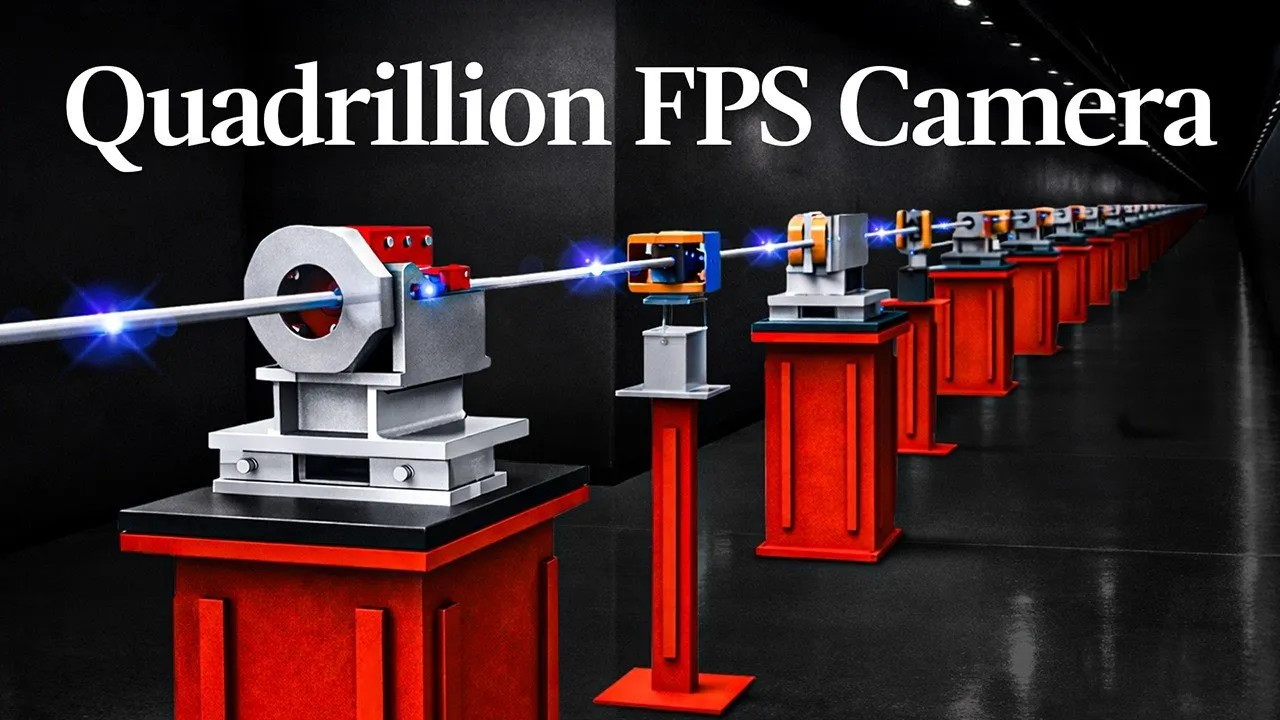
To see even smaller and faster phenomena—specifically, the movement of electrons around molecules—scientists must utilize the world's largest "strobe light." Located at the SLAC National Accelerator Laboratory, this 3.2-kilometer-long facility accelerates electrons to over 99.999992% of the speed of light.
Generating X-Ray Pulses
The accelerator feeds relativistic electron pulses through devices called undulators—stacks of magnets with alternating poles. As electrons pass through these magnetic fields, they follow a wiggling path. This oscillation causes them to emit electromagnetic radiation.
Due to the immense speed of the electrons, the emitted light is blueshifted into the X-ray spectrum. Furthermore, the interaction between the X-rays and the electrons causes the electrons to "microbunch" into thin sheets. these sheets emit light in unison, creating a coherent X-ray laser pulse lasting only a few femtoseconds (quadrillionths of a second).
The Pump-Probe Method
Because there is no camera shutter fast enough to record electron motion directly, scientists use a technique similar to Edgerton’s strobe, adapted for the quantum scale:
- The Pump: A traditional laser hits a molecule, triggering a reaction (e.g., breaking a bond or shifting electron density).
- The Probe: The X-ray pulse hits the molecule after a specific, tiny delay.
- Measurement: The X-ray ejects an electron from the molecule. By measuring the kinetic energy of this ejected electron, scientists can infer the electron density around the atom at that exact moment.
By repeating this experiment and increasing the delay by a few hundred attoseconds each time, researchers construct a "molecular movie." These images confirm theoretical simulations, showing electron densities shifting across molecules like Para-aminophenol.
Conclusion
The history of high-speed photography is defined by a desire to see what happens in the spaces between seconds. From Doc Edgerton utilizing capacitors to fix factory motors, to modern physicists utilizing kilometers-long particle accelerators to validate quantum mechanics, the principle remains the same. By slicing time into ever-thinner slivers, we expose the fundamental machinery of our universe, proving that if you look closely enough, even the most chaotic events follow a predictable, beautiful order.