
Table of Contents
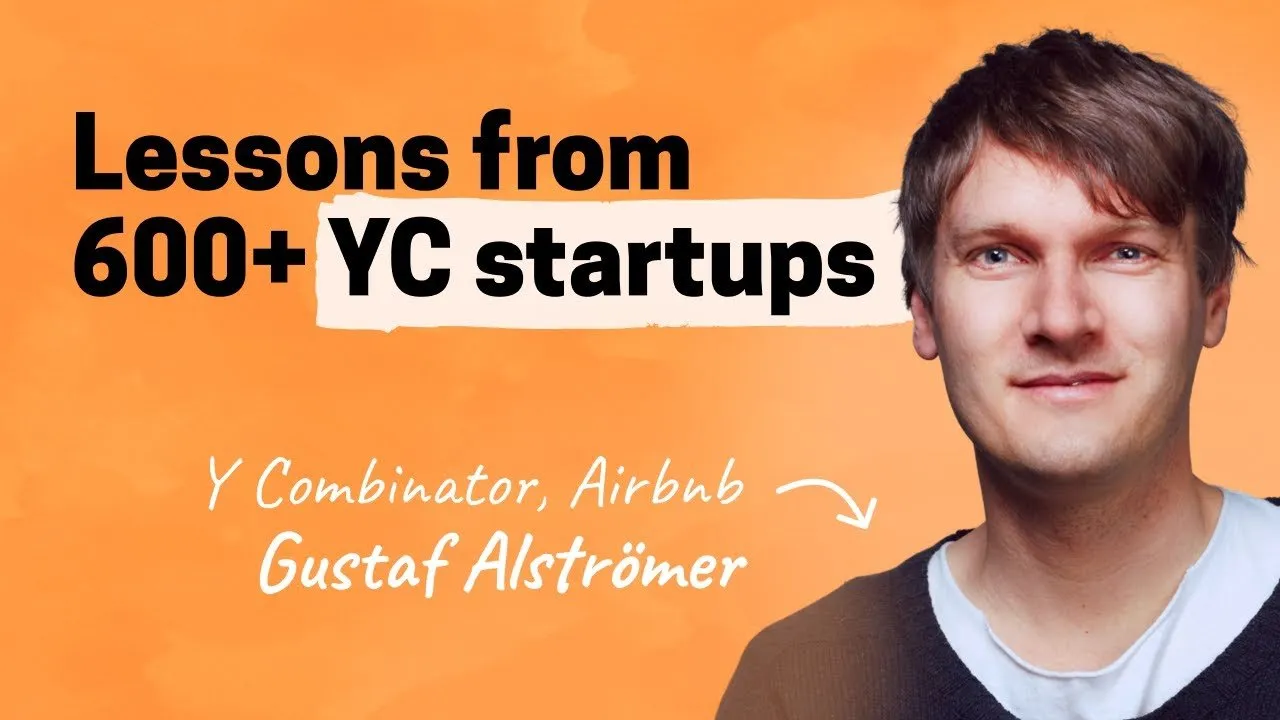
With experience guiding over 600 startups at Y Combinator and helping build Airbnb’s original growth team, Gustaf Alströmer has a dataset on startup success that few can rival. His vantage point allows him to see beyond the survivorship bias that often clouds the tech industry, identifying the specific, repeatable patterns that cause companies to flatline or skyrocket. Whether it is the psychology of founders, the mechanics of early-stage execution, or the burgeoning opportunities in climate tech, Alströmer’s insights offer a tactical roadmap for navigating the chaos of building a company.
In this deep dive, we explore the recurring mistakes that kill early-stage ventures, the reality of what happens inside Y Combinator’s legendary office hours, and why the next decade’s biggest opportunities lie in the decarbonization of the global economy.
Key Takeaways
- The number one cause of failure is avoiding customers: Most startups fail simply because they build in isolation. Without talking to users, you cannot find product-market fit, and without that, nothing else matters.
- Technical DNA is critical: Viewing engineering as a commodity to be outsourced is a fatal error. Successful startups almost always have technical founders who can iterate on the product instantly.
- Execution trumps strategy: Early-stage companies do not need complex strategy sessions; they need to execute on one priority at a time. Strategy assumes you have product-market fit—until you do, your only strategy is survival.
- Climate tech is the new internet-scale opportunity: We are witnessing a transition involving trillions of dollars moving from carbon-intensive industries to green alternatives, driven by capitalism rather than altruism.
- The best founders are storytellers: Technical ability gets the product built, but communication skills and the ability to tell a compelling story are what attract talent and capital.
The Root Causes of Startup Failure
Having analyzed hundreds of companies, Alströmer argues that failure is rarely a mystery. It is almost always a result of neglecting the fundamental loop of product development: user feedback. Founders often confuse external validation—such as acceptance into YC or raising seed capital—with product-market fit.
"If I drill down like what makes companies fail it's quite simple... they don't talk to users which means they don't find product market fit."
To avoid becoming a statistic, founders must recognize the specific behaviors that lead to this disconnect:
- Misinterpreting silence: Founders fear rejection, but the real enemy is indifference. Most people won't hate your product; they just won't care enough to use it.
- The early adopter math: In any given market, 90% of people are not early adopters. Founders often give up after five calls, not realizing they need to talk to 50 people to find the 10% who are willing to try unfinished software.
- The fallacy of "Sales": Technical founders often view sales as a separate department. In the early days, "sales" is simply the process of learning whether you are building something useful.
- Validation traps: Raising money or getting press coverage feels like success, but these are false signals. The only validation that counts is a user engaging with the product.
- Observation vs. Interrogation: Asking a user "Is this a problem?" is less effective than watching them work. Observing a user struggle with an Excel spreadsheet reveals pain points they might not even articulate verbally.
- Speed of learning: The companies that survive are the ones that reduce the latency between having an idea, getting it in front of a user, and iterating based on the reaction.
The Imperative of the Technical Founder
A recurring theme in Y Combinator’s most successful companies is the presence of a technical co-founder. While it is possible to succeed without one, the odds are stacked against you. Alströmer emphasizes that software is not just a commodity to be purchased; it is the medium through which the company iterates and thinks.
"I have an idea for a song, I just need a musician to help me make it. That's kind of similar to how it is with engineering."
Founders who treat engineering as a service rather than a core competency face several disadvantages:
- The iteration cycle: If you have to pay a contractor or wait for an employee to make a change, your iteration cycle slows down. Technical founders can fix a bug or change a feature the moment they hear user feedback.
- Valuation of talent: Non-technical founders often make the mistake of offering an engineer 10% equity, signaling they believe the business idea is 90% of the value. This fails to attract top-tier talent.
- Decision making: Many early-stage business decisions are actually technical decisions. Without understanding the codebase, you cannot accurately judge trade-offs between speed and debt.
- The "Builder" mindset: The best products often come from the frustration of the builder. When the person experiencing the pain is also the person writing the code, the solution tends to be more elegant and effective.
- Outsourcing risks: While there are rare exceptions (like Calendly’s early days), outsourcing the core product generally prevents the team from developing the institutional knowledge required to scale.
- Learning to code: For non-technical founders, the advice is often blunt: learn to code. You do not need to be a Google-level engineer, but you need to be dangerous enough to build a prototype.
Inside the Pressure Cooker: How YC Drives Focus
The magic of Y Combinator often happens in "Group Office Hours," where small cohorts of founders meet weekly. These sessions reveal a fundamental truth about startups: everyone is broken, and everyone is lonely. By stripping away the posturing, YC forces founders to confront the reality of their progress.
The process is driven by accountability and two fundamental questions:
- "What is holding you back?" In individual sessions, this question forces founders to identify the single biggest bottleneck. It eliminates the noise of "strategy" and focuses on immediate blockers.
- "Did you hit your goals?" In group sessions, social pressure acts as a forcing function. Founders are competitive; they do not want to report two weeks of zero progress to their peers.
- The prioritization filter: Startups can only do one thing at a time. If a founder wants to discuss long-term strategy, it usually means they are avoiding the hard work of execution.
- Peer therapy: Seeing other founders struggle with co-founder disputes, fundraising failures, or technical debt normalizes the anxiety of the journey.
- Metric obsession: Progress is measured in weekly growth rates. A "good" chart moves up and to the right consistently. If the graph is flat, the story doesn't matter.
- Removing the "Boss": Founders have no boss, which can lead to drift. YC partners and peers act as a temporary proxy for a boss, providing the accountability needed to maintain high velocity.
The DNA of Outlier Founders
While YC cannot predict with 100% accuracy which startup will become the next Airbnb, they can identify the traits of founders who are least likely to fail. Success is rarely about having a "genius" idea in a vacuum; it is about the characteristics of the people driving the idea forward.
Attributes of Winners
- Determination and Will: The most correlated trait with success is simply not giving up. The ability to endure rejection and failure without losing momentum is a superpower.
- Infectious Communication: Great founders are great storytellers. They must convince investors to give them money, employees to join a risky venture, and customers to trust an unproven product.
- Speed over Perfection: In the early days, quality is defined by how well you solve the user's problem, not how polished the code is. The best founders move uncomfortably fast.
- Customer Obsession: The founders who win are those who build for the user, not for the investor. They view fundraising as a necessary evil, not a milestone to be celebrated.
- Internal Confidence vs. Humility: Successful founders protect their confidence to inspire the team but maintain enough humility to listen to feedback and pivot when wrong.
- Action-Oriented: They don't ask for permission. They don't wait for the perfect time. They launch, break things, fix them, and launch again.
The Trillion-Dollar Shift: Opportunities in Climate Tech
Alströmer has been a pivotal figure in pushing YC toward climate tech. He views the decarbonization of the planet not as a charitable endeavor, but as the single largest economic opportunity of our lifetime. The shift is no longer theoretical; governments and corporations have aligned to move trillions of dollars into green technologies.
"The world has decided... we're going to change our entire Energy System... and in that transition we're talking about trillions of dollars of money moving from things that cause climate change to things that don't."
This sector is ripe for software engineers and product managers, even those without deep scientific backgrounds:
- The "Tesla Effect": Tesla proved that green companies can be the most valuable companies in the world. This has triggered a FOMO (Fear Of Missing Out) response in legacy corporations, making them eager customers for new startups.
- Software eating the grid: The future of energy involves millions of distributed devices (EVs, heat pumps, solar panels) that need to talk to each other. This is a software orchestration problem, not just a hardware problem.
- Carbon Accounting: As regulations tighten, every major corporation needs to account for its carbon footprint. Companies like carbon chain and unravel carbon are building the "QuickBooks for Carbon."
- Decarbonizing Transport: Beyond cars, there are massive opportunities in electrifying shipping (e.g., Fleet Zero) and aviation (e.g., Heart Aerospace). These are hard engineering problems with massive moats.
- The Capital Flood: Unlike the cleantech bubble of 2008, the current market is supported by robust legislation (like the US Inflation Reduction Act) and genuine corporate demand.
- Talent Migration: The smartest engineers are leaving ad-tech and social media to work on climate. This density of talent is usually a leading indicator of where the next massive unicorns will be built.
Lessons on Culture from the Early Days of Airbnb
Before YC, Alströmer spent years at Airbnb, witnessing its rise from a scrappy startup to a global giant. The "magic" of early Airbnb wasn't just the product; it was the intentional design of the organization. The founders treated culture with the same rigor they treated the user interface.
- Hiring for Mission: Airbnb looked for people who were genuinely excited about the concept of home-sharing, not just looking for a job. They screened for "true believers."
- Diversity of Backgrounds: The early product management team was comprised largely of former founders, not career corporate PMs. This instilled an ownership mentality across the organization.
- Doing things that don't scale: The legendary story of the founders flying to New York to photograph apartments is the blueprint for early-stage hustle. You cannot automate what you do not understand.
- The "Family" Dynamic: The intensity of the work created bonds that went beyond professional courtesy. Alströmer notes that former Airbnb employees often struggle to find similar cultures elsewhere because the bar was set so high.
- Resilience through Business Model: A great culture is easier to maintain when you have a great business model. Airbnb’s core economics were strong, which allowed them to take risks and endure crises that would have killed weaker companies.
- Mission-Driven Hiring: When interviewing, try to uncover the candidate's true motivation. Are they there for a career step, or are they there because they need this specific product to exist in the world?
Conclusion
The path to building a billion-dollar company is littered with counter-intuitive truths. You must be confident enough to ignore the skeptics, yet humble enough to listen to a user telling you your product is confusing. You must be patient enough to endure years of struggle, yet impatient enough to demand progress every single week.
Whether you are building a SaaS tool or an electric airplane, the fundamentals remain the same: build something people want, talk to your customers until it hurts, and surround yourself with people who refuse to let you fail. As Alströmer points out, the opportunities—especially in climate tech—are only just beginning. The capital is there, the technology is ready, and the only missing variable is the founder willing to do the work.

)