Table of Contents
The cryptocurrency market is currently navigating a period of significant uncertainty, characterized not by technical innovation or adoption metrics, but by geopolitical volatility. We are seeing a market environment where technical setups are frequently invalidated by headlines, specifically regarding US administrative rhetoric surrounding Greenland and tariffs. This shift has turned many participants into "news traders" by necessity rather than choice.
When the macro environment becomes stormy, price action often reflects that turbulence with chop and indecision. While traditional markets tend to bounce back relatively quickly from political posturing, crypto assets are showing sustained weakness. The current landscape requires a shift in strategy—from aggressive accumulation to capital preservation and patience.
Key Takeaways
- News-Driven Price Action: The market is currently "trading the news," with technical levels heavily influenced by US geopolitical rhetoric and administration antics.
- High Correlation with S&P 500: Bitcoin continues to show a tight correlation with the S&P 500, dropping when traditional equities weaken, while Gold acts as the outlier.
- Altcoin Weakness: Most altcoins are breaking market structure, though Ethereum is showing relative strength compared to deeper retracements in assets like Solana and Litecoin.
- Capital Preservation: In a "choppy" market lacking clear direction, the best edge is often inactivity until major resistance levels are reclaimed.
The Impact of Geopolitics on Market Structure
We are currently witnessing a market that constantly has to price in unexpected variables from the US administration. Whether it is talk of tariffs or the more eccentric narratives regarding Greenland and Iceland, this "posturing" weakens the perception of the US market position globally. While traditional finance often brushes these events off as temporary, the crypto market—which relies heavily on liquidity and sentiment—takes a harder hit.
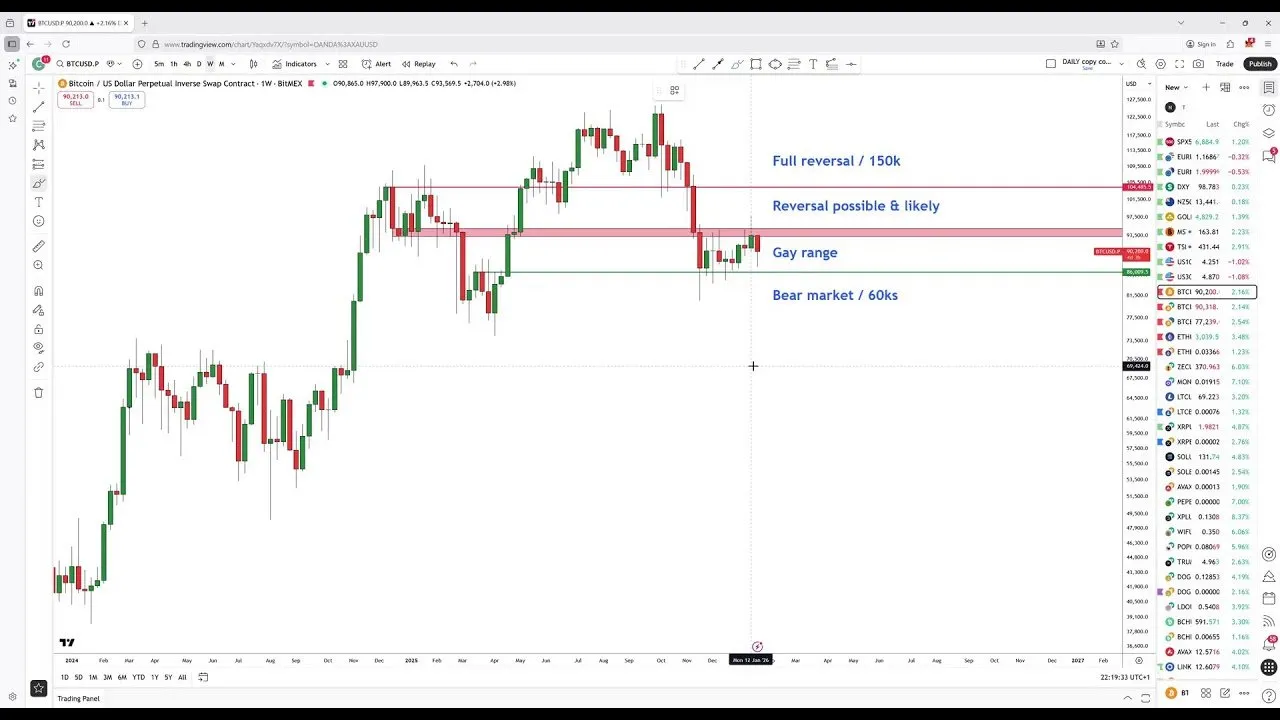
The damage from this rhetoric is cumulative. Even if policies are walked back, the uncertainty lingers, causing allies and investors to hesitate. Consequently, we have seen Bitcoin rejected at monthly resistance and looking precarious on the weekly timeframe.
The market constantly has to price in crazy stuff... strictly speaking, we are completely trading news right now.
If the administration walks back these narratives, we could see a relief bounce. However, the structural damage to the charts suggests that we are in a dangerous "in-between" stage: we haven't dumped deep enough to trigger value buying, but we aren't strong enough to reclaim higher ranges immediately.
Bitcoin and Major Asset Analysis
Bitcoin's Correlation Dilemma
A critical observation for traders right now is the lockstep correlation between Bitcoin and the S&P 500. When the S&P drops, Bitcoin follows, often with magnified weakness. Gold remains the only major asset acting as a hedge or "safe haven" in this environment.
Technically, Bitcoin has been rejected at monthly resistance. The weekly close was less than ideal, failing to reclaim the necessary range high. We are currently trading in a range that offers little edge; it is a zone of "chop" where leverage gets wiped out on both sides. Until Bitcoin can decisively reclaim levels above $100k, the path of least resistance remains sideways to down.
Ethereum vs. The Field
Contrary to the "dumb mid-curve play" narrative that dominated 2022, Ethereum is currently displaying better relative strength than many other major altcoins. While the chart isn't exactly bullish, it is holding structure better than its peers. On the ETH/BTC pair, we are seeing choppy behavior, but it hasn't capitulated in the same way Litecoin or Solana have recently.
The Problem with Solana and Support Levels
Solana's chart presents a classic technical warning sign. The price has tested the same support level repeatedly. In technical analysis, the more a support level is tested, the weaker it generally becomes.
Even if Solana manages a bounce, the probability favors a break of range lows eventually. A flush below support followed by a reclaim would arguably offer a much cleaner bullish setup than the current stagnation.
Navigating the Altcoin and Meme Landscape
The broader altcoin market is bleeding. Many coins that held diagonals or trendlines for months have broken those structures. While this doesn't guarantee a bear market, it signals that the "easy mode" period of higher lows has ended.
- Meme Coins: Generally, holding meme coins long-term is a losing strategy. They bounce hard during recovery but bleed out the fastest during corrections. If one must trade this sector, look for relative strength (assets like Pepe currently look better than WIF or Popcat), but be wary of "bagholder evangelism."
- Bitcoin Cash (BCH): Surprisingly, BCH has shown resilience. It benefits from the Bitcoin ticker association without the leverage and institutional baggage currently weighing on BTC. The "funny outcome" theory suggests markets often move toward the result that confuses the majority—in this case, legacy forks outperforming the leader temporarily.
When you really get evangelized by bagholders, you will always lose money. Look for actual, real cool stuff instead.
Trading Philosophy in a "Boring" Market
The current market mood can be best described as "boring," but this boredom is dangerous. Traders often feel the need to force action to combat the lull. However, when you lack a clear edge—especially in a news-driven environment—the best trade is often no trade.
Mood as an Indicator
There is a distinct correlation between trader excitement and market movement. When traders have to "force" themselves to find a setup, the market usually provides nothing but chop. Conversely, high-conviction trades usually present themselves clearly. If you aren't excited to take a position, the market likely isn't ready to move.
Using Technical Analysis for Risk Management
While technical analysis (TA) isn't a holy grail, it remains the primary tool for defining risk in an asset class with no traditional valuation models. TA allows us to set invalidation points. For example, buying support at $16k or $25k is valid not because we know the future, but because we know exactly where we are wrong. In the current range, those invalidation points are muddy, further suggesting a passive approach is superior.
Conclusion
We are in a holding pattern, waiting for the geopolitical dust to settle. The market has not dropped enough to offer generational value, nor has it risen enough to confirm a bullish continuation. We are stuck in the chop.
The most prudent course of action is to wait for the noise to clear. If the political rhetoric softens, we may see a recovery. Until then, capital preservation is the priority. Don't let a boring market force you into exciting losses.