Table of Contents
When we engage with ancient texts like Homer’s The Iliad, we often approach them as historical artifacts or tales of distant warfare. However, the true power of a "great book" lies not in its ability to transport us to the past, but in its capacity to act as a mirror for the present. By imagining ourselves as Achilles—identifying with his pride, his vulnerability, and his rebellion against authority—we do not just learn about a fictional Greek hero; we gain tremendous insight into the nature of the human heart.
Homer did more than recount a war; he arguably invented the modern conception of the human being by portraying characters who possess a profound, multi-layered consciousness. Through the lens of literary criticism and psychological theory, we can explore how The Iliad constructs reality, the nature of empathy, and the timeless role of the poet as a bearer of truth.
Key Takeaways
- Great books facilitate self-discovery: Fictional characters like Achilles allow us to peer deeply into our own psyche, revealing how traits like arrogance and insecurity are often two sides of the same coin.
- Consciousness is defined by disassociation: According to critic Harold Bloom, being human means "hearing yourself speak"—the ability to step back, observe oneself, and analyze the effect of one's words on others in real-time.
- Conflict is a battle for narrative control: The central dispute between Agamemnon and Achilles is not merely over spoils of war, but a struggle to impose a specific version of reality on their peers.
- The Poet functions as a Prophet: Homer acts as an antenna for universal truths and archetypes, accessing a "universal consciousness" that transcends space and time to build the foundation of civilization.
The Mirror of the Imagination
The primary function of a great book is to excite the imagination to such a degree that fictional characters become real to us. When we analyze Achilles, we often find a reflection of our own complexities. For example, many readers identify with the tension between pride and vulnerability. Achilles is a character who stops "playing the game" because he feels humiliated, a reaction that resonates with anyone who has walked away from a passion due to a bruised ego.
If we imagine Achilles today, he would likely not be a soldier submitting to the rigid hierarchy of a modern army. instead, he might be an Olympian athlete—someone who craves individual glory and universal admiration yet chafes under the restrictions of coaches and sponsors. This exercise in imagination proves that while Achilles never existed historically, he is psychologically real. He allows us to simulate experiences and emotions, expanding our capacity for empathy.
A great book is composed of characters that are real to you and make the world more real to you. They excite your imagination that allows you to think much more deeply into yourself as well as more imaginatively understand the world around you.
Consciousness and "Hearing Yourself Speak"
How exactly does Homer achieve this realism? The renowned literary critic Harold Bloom argued that great literature helps us "become human" by portraying characters who are capable of hearing themselves speak. This is the definition of consciousness in the Homeric world.
The Mechanism of Disassociation
To be conscious is effectively an act of imagination. It requires a form of disassociation where, as a person speaks, a part of their mind "steps back" like a ghost to observe the scene. This observer self analyzes three distinct elements simultaneously:
- The coherence of their own words (internal logic).
- The immediate reaction to the person they are addressing.
- The perception of the wider audience (social standing).
This triangular awareness creates a depth of character that feels strikingly modern. The characters are not just reciting lines; they are calculating the impact of their speech on the reality around them.
Narrative Warfare in The Iliad
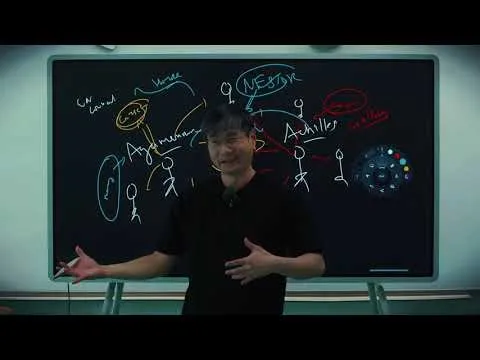
We see this heightened consciousness in action during the famous quarrel between Agamemnon and Achilles in the opening of The Iliad. The surface conflict concerns the return of a captive girl, Chryseis, to her father, a priest of Apollo, to stop a plague decimating the Greek army. However, the subtext is a high-stakes chess match for social dominance.
When Agamemnon speaks, he is doing significant cognitive work. He must respond to Achilles’ challenge while simultaneously managing the optics of the war council. He knows that simply conceding would cause him to lose face among his gangster-like peers, which could be fatal in their brutal society. Therefore, he constructs a coherent narrative: he claims he is taking Achilles’ prize not out of pettiness, but to demonstrate his superiority and maintain the hierarchy.
What they're really trying to do is through their speeches, they're trying to control reality. They're trying to impose the reality on others.
Achilles is equally conscious. He frames his refusal to fight as a moral stance, painting Agamemnon as a greedy tyrant who profits from Achilles' labor. Both men are attempting to weaponize memory and emotion to win the sympathy of the onlookers (the Greek army) and the audience (us). This is why the characters feel alive: they possess a theory of mind that allows them to manipulate the thoughts and feelings of others.
The Mystery of Homer: The Poet as Prophet
The complexity of these psychological portraits raises a difficult question: How did one mind, historically identified as Homer, construct such a complete universe with such distinct, autonomous characters? The Greeks viewed Homer not merely as an entertainer, but as a teacher and the father of their civilization.
To understand this, we must look beyond modern materialist psychology, which struggles to locate where memory and personality reside in the brain. A compelling theory suggests that the human brain functions less like a hard drive and more like an antenna. In this view, consciousness is a fundamental property of the universe—infinite and timeless.
Accessing Universal Archetypes
If we accept the premise that the universe is conscious, then memories and personalities exist as vibrations or wavelengths within that universal field. Carl Jung famously described these recurrent patterns as "archetypes." Homer’s genius lay in his ability to "tune in" to these universal frequencies.
By accessing these archetypes, Homer could create characters like Odysseus, Hector, and Helen who resonate across cultures and millennia. He wasn't inventing them from scratch; he was channeling universal truths about human nature. This explains why a text written 2,500 years ago in the Mediterranean can speak directly to a reader in 21st-century China or America. The emotional landscape is shared because the archetypes are universal.
Truth vs. Prediction
This capability defines the true role of the prophet. In the ancient context, a prophet is not necessarily a fortune teller who predicts specific lottery numbers. Rather, a prophet is one who speaks the "truth." Because truth in this framework is eternal—encompassing past, present, and future—speaking the truth inevitably predicts the future.
For example, the moral truth of The Iliad is causal: if you commit evil acts, evil will return to you. Achilles refuses to forgive Agamemnon, and in doing so, he sets in motion the death of his beloved Patroclus. The poet captures these eternal laws of cause and effect in beautiful language. This beauty ensures the survival of the story, allowing it to seed the consciousness of future generations.
Conclusion
Homer’s work suggests that civilization is built upon the expansion of consciousness. By engaging with The Iliad, we learn to step back and observe ourselves. We develop the capacity to "hear ourselves speak" and to empathize with the interior lives of others. This cognitive leap—from simple existence to complex, disassociated self-awareness—is the foundation of empathy, curiosity, and society itself. In this sense, Homer did not just write a book; he provided the blueprint for the human mind.