Table of Contents
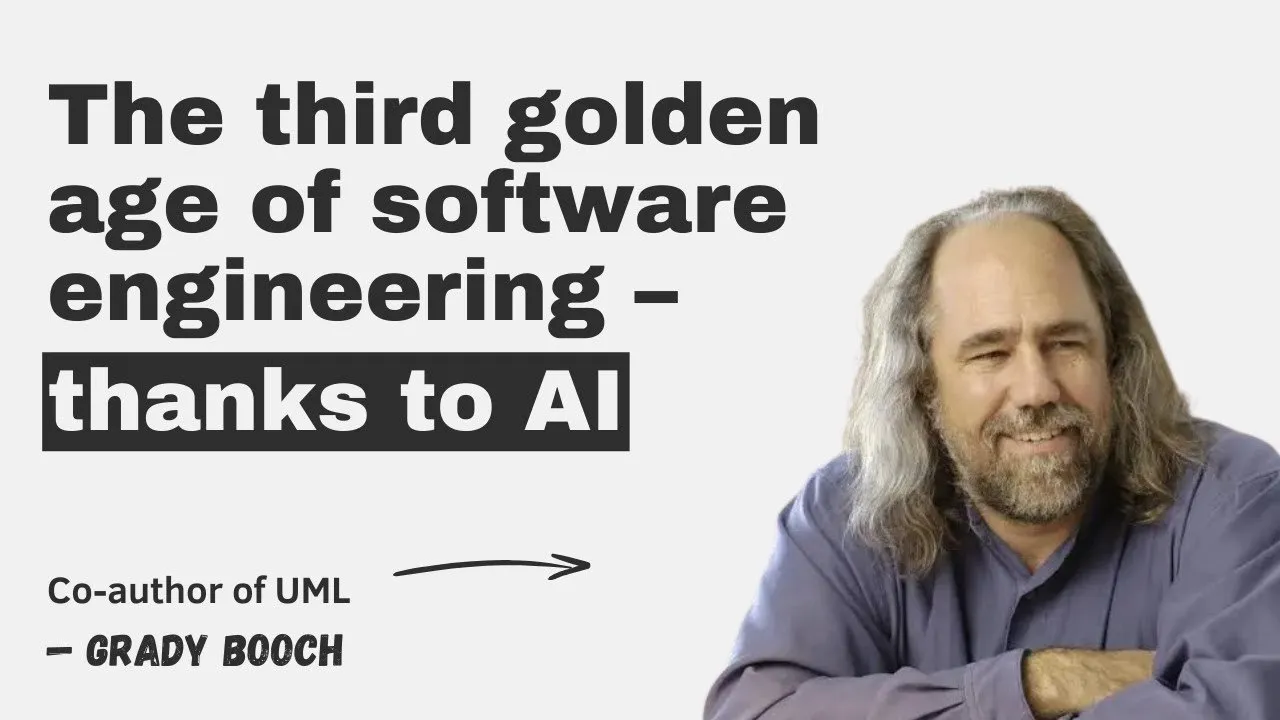
With the rise of Large Language Models (LLMs) and AI coding assistants like Cursor and Copilot, a palpable anxiety has settled over the software industry. Developers watch as AI generates functional code in seconds—tasks that once took junior engineers hours—and wonder if the profession is facing extinction. However, according to Grady Booch, one of the founding figures of software engineering and co-creator of the Unified Modeling Language (UML), this fear is misplaced. Booch argues that we are not witnessing the end of software engineering, but rather the maturation of its third golden age.
Having witnessed every major industry transformation since the 1970s, Booch offers a historical lens that reframes the current AI revolution. By understanding the evolution of the field through the "First" and "Second" golden ages, it becomes clear that AI is simply the next logical step in a history defined by rising levels of abstraction. The tools are changing, but the fundamental nature of engineering—balancing competing forces to solve complex problems—remains as vital as ever.
Key Takeaways
- Software engineering is defined by abstraction: The history of the industry is a consistent movement away from hardware constraints toward higher-level conceptual thinking. AI is the latest layer in this stack, not a replacement for the stack itself.
- We are in the Third Golden Age: Following the eras of algorithmic abstraction (1950s–70s) and object-oriented abstraction (1980s–2000s), we have entered an era defined by systems, platforms, and AI-assisted architectural design.
- Engineering is not just coding: Coding is merely the mechanism of expression. Engineering is the human act of balancing technical, economic, ethical, and physical forces to build enduring systems.
- The "Existential Crisis" is cyclical: Every major shift—from assembly to compilers, and procedural to object-oriented—triggered fears of obsolescence. In every case, the shift expanded the industry rather than shrinking it.
- Future skills require systems thinking: As AI handles implementation details, valuable engineers will focus on system architecture, inter-agent complexity, and ethical design.
Defining the Software Engineer
To understand why AI will not replace the software engineer, one must first define what a software engineer actually does. The term was coined by Margaret Hamilton during the Apollo program to distinguish her work from the hardware engineers dominating the field. Her definition, and the one that persists today, is that software engineering is the discipline of building reasonably optimal solutions by balancing opposing forces.
Unlike code generation, engineering requires navigating constraints that an AI cannot "reason" about in a holistic sense:
- Physical Laws: Latency, speed of light, and hardware limitations.
- Economic Forces: The cost of development versus the value of the solution.
- Human Factors: Team organization, maintainability, and user experience.
- Ethical Implications: Just because we can build a surveillance system, should we?
In the software world, of course, we deal with the medium that is extraordinarily fungible and elastic and fluid and yet we still have the same kinds of forces upon us.
AI agents operate within the medium of code, but they do not possess the agency to balance these societal and physical forces. They are accelerators, not architects.
The Evolution of Abstraction
Booch segments the history of the industry into three distinct "Golden Ages." Understanding this progression helps contextualize why the current AI shift feels so disruptive, yet fits a historical pattern.
The First Golden Age (1950s – late 1970s)
This era began when the industry realized that software could be decoupled from hardware. Before this, "programming" was indistinguishable from rewiring a machine. The defining characteristic of this age was Algorithmic Abstraction.
The focus was on mathematical precision and automating business processes like payroll or accounting. The primary limitation was the scarcity of hardware resources, meaning engineers had to optimize strictly for the machine. This era culminated in the "Software Crisis" of the late 70s—a period where the demand for software outpaced the human ability to produce it, and the complexity of systems began to exceed what algorithmic approaches could manage.
The Second Golden Age (1980s – 2000)
To solve the complexity crisis of the first age, the industry shifted to Object-Oriented Abstraction. This period saw the rise of the Personal Computer (PC) and the graphical user interface.
Instead of viewing the world as a series of processes (algorithms), engineers began modeling the world as "things" (objects) that interacted with one another. This shift allowed for the creation of vastly more complex systems, such as windowed operating systems and early distributed networks.
This era also birthed the open-source movement and the concept of "platforms." Developers stopped writing every line of code from scratch and began assembling systems from pre-existing libraries and frameworks. Complexity was managed by hiding details behind APIs.
The Third Golden Age: Systems and AI
We are currently living through the Third Golden Age, which Booch posits began around the turn of the millennium. This era is defined by the move from building individual applications to managing massive, interconnected ecosystems. The primary abstraction today is the System.
In this age, software has moved into the "interstitial spaces" of civilization. It is no longer just on a mainframe or a desktop; it is in our cars, our medical devices, and our pockets. The challenges have shifted from "how do I write this sorting algorithm?" to "how do I secure this global supply chain?" and "how do I manage dependency risk?"
AI as an Accelerator, Not a Replacement
In this context, Generative AI is not a destroyer of the industry, but a necessary reaction to complexity. Just as compilers allowed engineers to stop writing assembly code, AI agents allow engineers to stop writing boilerplate syntax. They reduce the distance between human intent (natural language) and machine execution (code).
Your tools are changing, but your problems are not.
When critics like Anthropic's Dario Amodei predict that software engineering will be automated within 12 months, they are conflating coding with engineering. AI is exceptionally good at replicating patterns it has seen before—what Booch calls "low-hanging fruit." It can generate a CRUD app or a React component instantly. However, it cannot navigate the novel architectural decisions required for mission-critical systems, nor can it handle the embodied systems found in aerospace or robotics where software meets physics.
Surviving the Shift: A Focus on Fundamentals
The anxiety developers feel today mirrors the anxiety assembly programmers felt when Fortran was introduced. Skills tied to specific implementations (syntax, framework boilerplate) are indeed becoming obsolete. However, the demand for high-level problem solving is growing.
To thrive in the Third Golden Age, Booch advises developers to pivot their learning strategy:
- Master Systems Theory: Move beyond the code and study how complex systems interact. Read The Sciences of the Artificial by Herbert Simon or explore the work of the Santa Fe Institute on complexity.
- Study Biological Architectures: Nature has been solving distributed systems problems for millions of years. Concepts from neurology (like the architecture of the brain) and biology (like the decentralized intelligence of insect colonies) are becoming relevant for designing multi-agent AI systems.
- Embrace the "Hobbyist" Renaissance: Just as the PC allowed non-professionals to use computers, AI allows non-coders to build software. This is a net positive. It frees professional engineers to focus on enterprise-scale architecture while empowering accountants, artists, and teachers to build their own tools.
Conclusion
The "doom" narrative surrounding AI overlooks the resilience of the engineering discipline. Software is a domain constrained only by imagination and physics. By automating the tedious aspects of implementation, AI lowers the barrier to entry and raises the ceiling for what is possible.
We are not at the end. We are standing at the precipice of a new era where the cost of building software drops, allowing for an explosion of creativity. The engineers who survive will be those who stop identifying as "coders" and start identifying as system architects who use AI as their lever to move the world.
You can either take a look and say, 'Crap, I'm gonna fall into the abyss,' or you can say, 'No, I'm going to leap and I'm going to soar.' This is the time to soar.