Table of Contents
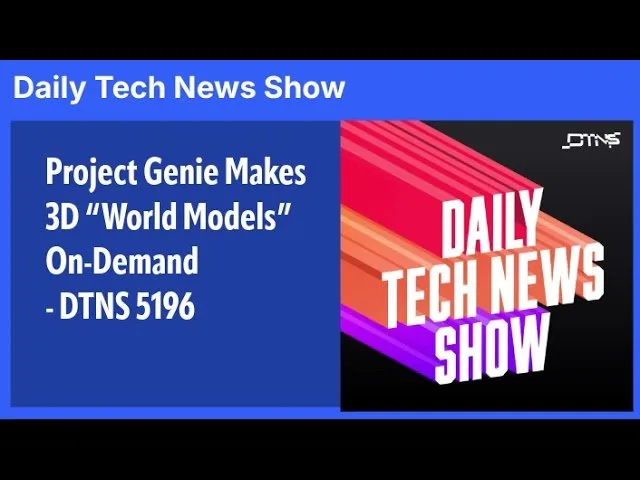
Google has launched Project Genie, a generative AI platform allowing users to create interactive, playable 3D worlds from simple text or image prompts, marking a significant step forward in "world model" technology. Released exclusively to AI Ultra subscribers in the United States on January 30, 2026, the tool serves as a research testbed for identifying new applications in media visualization, education, and robotics training.
Key Points
- Project Genie Launch: Google’s new AI sandbox generates 60-second, 720p interactive 3D sessions, though early tests reveal performance lag and potential copyright friction regarding Nintendo intellectual property.
- Apple Earnings & AI Strategy: Apple posted 23% year-over-year growth driven by iPhone 17 demand and confirmed Google Gemini will power the upcoming revitalization of Siri.
- Windows Milestone: Microsoft’s Windows 11 has surpassed 1 billion active users, reaching the benchmark faster than Windows 10 despite stricter hardware requirements.
- Perplexity Cloud Deal: Perplexity secured a three-year, $750 million agreement to utilize Microsoft’s Azure Foundry as its primary cloud platform.
Generative AI Enters the Gaming Sandbox
Project Genie represents a consumer-facing application of "world models," a burgeoning sector of artificial intelligence designed to simulate physical environments. The system allows users to generate simple 60-second gameplay sessions running at 24 frames per second with 720p resolution. While currently framed as a proof of concept, the technology enables users to control characters or objects using standard keyboard inputs immediately after generation.
Google positions the tool as a mechanism to explore creative workflows, such as visualizing film scenes or developing interactive educational content. However, the launch has raised immediate questions regarding intellectual property rights. Early demonstrations indicated the model’s ability to faithfully recreate copyrighted assets, such as Nintendo’s Mario and Zelda franchises, based on prompt descriptions.
"Google says this was all trained using publicly available data on the web... [but] if you've ever wanted to see a very barren, 2FPS version of Breath of the Wild, that is the place to go. The model was able to reproduce all of Nintendo's flagship things immediately."
The Verge reported that while the controls remain "finicky and laggy," the system demonstrates a sophisticated understanding of game mechanics, including jumping and gliding physics. This capability suggests that the model was trained on vast amounts of gameplay footage, potentially including content from Google-owned YouTube, igniting debate over the definition of "publicly available data" in AI training.
Apple Financials and the Gemini Pivot
In a major holiday quarter performance, Apple reported 23% revenue growth compared to the previous year. The surge was attributed to high demand for the iPhone 17 lineup, specifically the Pro models, which successfully captured market share in mature regions like China. Services revenue also hit record highs, driven by App Store activity and iCloud subscriptions.
Beyond the financials, CEO Tim Cook provided the first official confirmation regarding the company's AI infrastructure partnership. Apple has selected Google Gemini to underpin the next generation of Siri, citing it as the "most capable model" to function alongside Apple’s proprietary Foundation models. This strategic reliance on a competitor’s technology highlights the immense pressure on hardware manufacturers to deliver competent AI agents rapidly.
Despite the strong earnings, management signaled caution regarding near-term supply chains, specifically noting potential memory and chip constraints that could impact hardware availability in the coming quarters.
Software Milestones and Market Consolidation
Microsoft’s Windows 11 has officially crossed the 1 billion user threshold. According to CEO Satya Nadella, the operating system achieved this milestone days faster than its predecessor, Windows 10. This adoption rate is notable given the operating system's controversial hardware requirements, which excluded many older devices.
However, the ecosystem remains fractured. Reports indicate that roughly 1 billion devices are still running Windows 10, creating an even 50/50 split in the user base. Microsoft has announced plans to "swarm" engineering resources to address persistent performance issues and modernize legacy user interface elements in Windows 11 to bridge this gap.
Emerging Tech Deals
In the broader tech landscape, cloud infrastructure and AI consolidation continue to accelerate. Perplexity has signed a $750 million deal over three years to use Microsoft Azure Foundry, granting it access to models from OpenAI, Anthropic, and xAI. Simultaneously, reports suggest Elon Musk is exploring a merger to bundle SpaceX, xAI, Starlink, and X into a single trillion-dollar entity ahead of a potential public offering.
As Google pushes the boundaries of generative media with Project Genie, industry observers will be closely monitoring Nintendo’s legal response to the unauthorized replication of its intellectual property, a scenario that could set legal precedents for AI-generated content in 2026.