Table of Contents
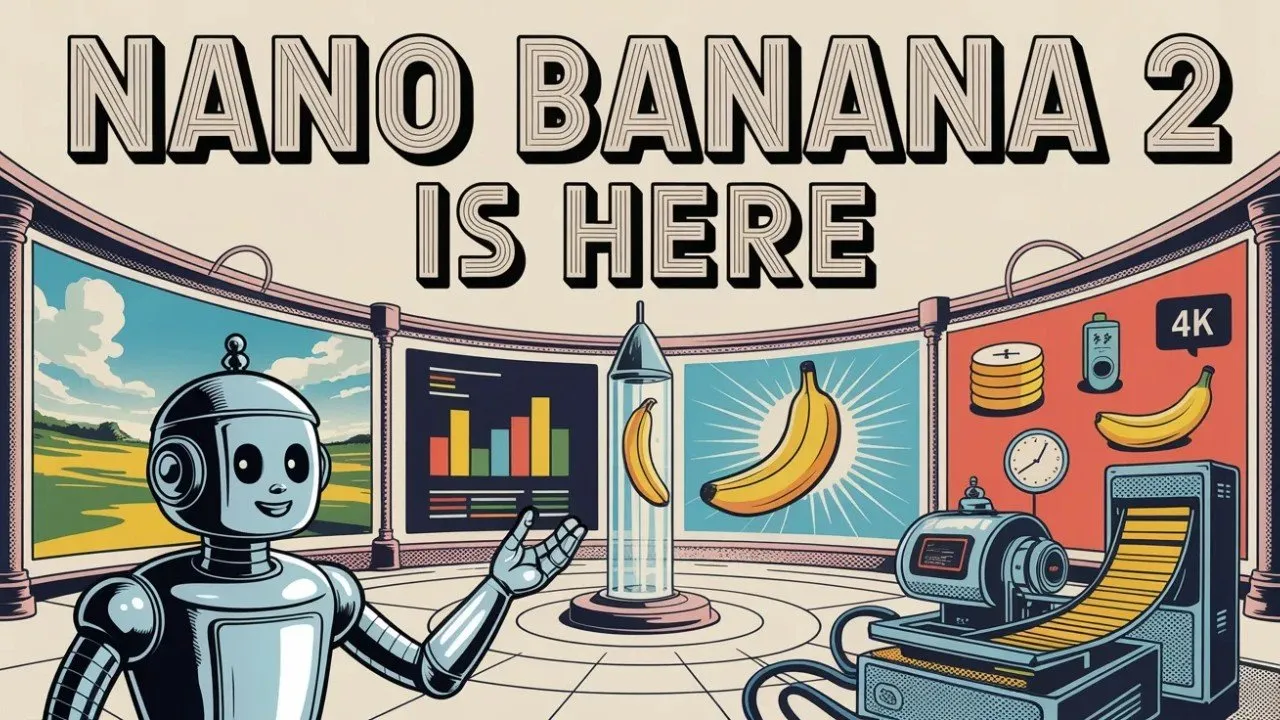
Google has launched Nano Banana 2, a significant update to its specialized image generation and reasoning suite, signaling a shift in the artificial intelligence industry from creative novelty toward production-scale efficiency. Formally designated as Gemini 3.1 Flash Image, the new model replaces Nano Banana Pro as the default tool for subscribers, offering comparable reasoning capabilities at twice the speed and half the operational cost. The release arrived alongside a flurry of industry shifts, including Anthropic's surging adoption rates and a strategic pivot in Meta's custom silicon program.
Key Points
- Google released Nano Banana 2 (Gemini 3.1 Flash Image), delivering high-quality infographic generation and 4K output with significantly reduced latency and cost.
- Anthropic reported that daily signups for its Claude platform have tripled since November, driven largely by technical tools like Claude Code.
- IBM shares plummeted 13%—its largest single-day drop since 2020—following an Anthropic report highlighting AI's ability to modernize legacy COBOL codebases.
- Meta scaled back its custom AI chip ambitions, refocusing on less complex silicon while securing a multi-billion dollar deal to rent Google TPUs.
- Microsoft unveiled Copilot Tasks, an autonomous agent equipped with a virtual browser designed to execute mundane administrative tasks for general consumers.
Google Shifts Toward Production-Ready Infrastructure
The introduction of Nano Banana 2 marks a pivot in Google's AI strategy, prioritizing "good enough" output at scale over marginal gains in aesthetic quality. By applying the image generation layer of the previous Pro model to a streamlined "Flash" base, Google has created a model that inherits full web-search capabilities and advanced world knowledge while remaining cost-effective for enterprise deployment. The model maintains its predecessor's hallmark ability to generate legible text and complex infographics, but now supports outputs up to 4K resolution and the integration of up to five characters and 14 objects from source images.
Industry analysts suggest this move reflects a broader "land grab" for the production-scale market. According to VentureBeat:
"Nano Banana 2 doesn't represent a generational leap in image generation quality. What it represents is the maturation of AI image generation from a creative novelty into a production-ready infrastructure component."
To demonstrate the model's practical integration, Google CEO Sundar Pichai showcased a demo titled "Window Seat," which utilizes the model's spatial reasoning and live weather data to generate accurate views from any window coordinate globally. Early testers, including Ethan Mollick and Justine Moore of A16Z, noted that while the model is not perfect, it represents a "leveled up" solution for complex diagrams, product photography, and technical advertisements.
The Anthropic Surge and the COBOL Disruption
While Google focused on infrastructure, Anthropic demonstrated rapid market penetration. Internal data reported by The Information reveals that daily signups for Claude have tripled since November, with paid subscriptions doubling since October. This growth is particularly concentrated in technical sectors, as users increasingly adopt Claude Code to handle complex programming tasks.
The implications of this technical proficiency were felt acutely in the financial markets this week. IBM stock experienced a 13% drawdown after an Anthropic blog post detailed how Claude can modernize COBOL systems—the aging programming language that still powers much of the global banking infrastructure. Traditionally, overhauling these legacy systems required "armies of consultants" and years of manual mapping. Anthropic argues that AI can now automate the exploration and analysis phases that previously made such projects prohibitively expensive.
The market reaction suggests a newfound sensitivity to AI's disruptive potential in the high-margin consulting sector. While Morgan Stanley previously reported saving 280,000 developer hours using OpenAI models for COBOL modernization last June, the recent volatility indicates that investors are only now fully pricing in the threat to traditional enterprise service providers.
Hardware Roadblocks and the Rise of Autonomous Agents
The race for AI dominance continues to encounter physical limitations in the hardware sector. Meta has reportedly reigned in the scope of its custom silicon program after hitting design roadblocks. According to The Information, the company scrapped its most advanced AI chip design to focus on a simplified version of its Meta Training and Inference Accelerator (MTIA). To bridge the gap, Meta has signed massive purchase deals with Nvidia and AMD, while simultaneously entering a multi-billion dollar agreement to rent Google's Tensor Processing Units (TPUs).
As hardware stabilizes, the software layer is moving toward greater autonomy. Microsoft recently announced Copilot Tasks, an agentic tool designed to offload routine chores like scheduling appointments or generating study plans. Unlike previous iterations of Copilot, this version utilizes a virtual computer and browser to act on behalf of the user.
"You describe what you need in natural language, Copilot plans, and goes to work. You adjust or refine as needed," Microsoft stated during the announcement.
The release of Nano Banana 2 and Copilot Tasks suggests a convergence toward a "utilities" phase of AI development. As models become faster and more integrated with live data, the focus for 2024 is shifting away from pure research breakthroughs and toward the seamless execution of high-volume, low-cost tasks across both consumer and enterprise landscapes.