Table of Contents
The enterprise technology landscape is evolving at a velocity that defies historical precedent. For founders and leaders in the Artificial Intelligence space, this speed presents a paradox: while the models themselves are advancing exponentially, the actual application of these technologies within businesses is in its infancy. This disconnect suggests that despite the hype, the true transformation of the workplace has barely begun.
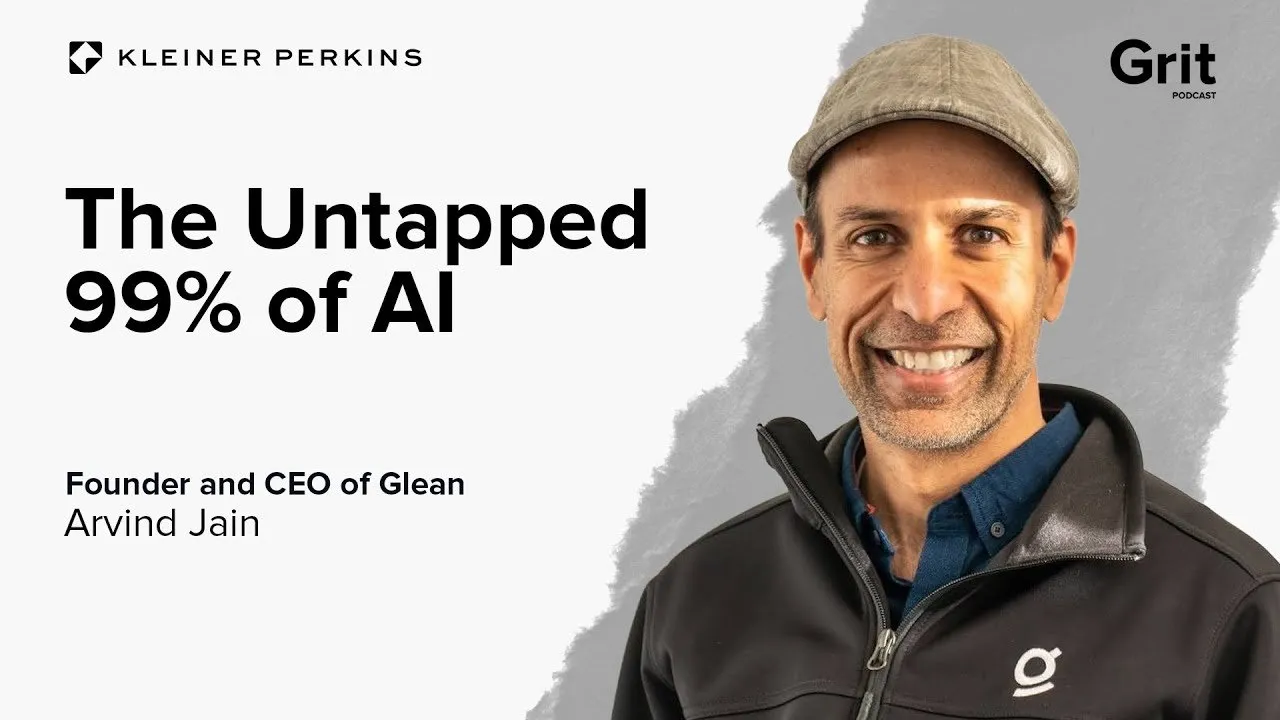
Arvind Jain, CEO and co-founder of Glean, suggests that the industry is currently utilizing less than 1% of AI’s potential capabilities. As the leader of a company that recently crossed the 1,000-employee mark and has become a central player in enterprise search and knowledge management, Jain offers a unique vantage point on the "brutally competitive" nature of the AI race. His insights challenge conventional wisdom regarding competitive moats, hiring strategies, and the definition of productivity in the age of Large Language Models (LLMs).
Key Takeaways
- The 1% Reality: Despite massive hype, businesses are currently leveraging a fraction of what current AI models are capable of; product implementation lags significantly behind model capability.
- Obsolescence is the New Default: Code written a year ago should be viewed as potentially obsolete. The traditional "tech moat" is dead; agility is the only sustainable advantage.
- Hiring for AI Fluency: "AI fluency" is now a core hiring metric, prioritizing curiosity and the ability to restructure work over simple technical expertise.
- The CEO as Power User: Leaders should use AI not just for drafting emails, but as an unbiased strategic partner to generate reports and challenge viewpoints before involving human teams.
- Horizontal vs. Vertical: In a crowded market, success lies in building a horizontal platform that connects disparate vertical applications rather than trying to replace them all.
Why the Traditional Tech "Moat" is Dead
For decades, software companies relied on the complexity of their codebase and their accumulated intellectual property as a defensive moat. In the generative AI era, Jain argues that this mindset is not only outdated but dangerous. The speed at which LLMs evolve means that holding onto legacy code—or legacy ways of solving problems—can quickly turn an asset into a liability.
"My mindset by default is that if you build something last year, it's got to be obsolete. There has to be a new way to do that thing better today. And if not, then it's just lack of imagination."
In this environment, a company’s "moat" is no longer its proprietary stack. Instead, competitive advantage is defined by two dynamic factors:
- Extreme Agility: The ability to discard old code and rebuild features using the latest model capabilities is now more valuable than maintaining a stable, older system. Teams must be rewarded for deleting code as much as writing it.
- Deep Customer Partnerships: As technology becomes commoditized, the trust and integration a company has with large enterprises become the true barrier to entry. Being the partner that guides a customer through their AI transformation provides a stickiness that raw software cannot.
The 1% Utilization Theory
There is a pervasive fear in the tech sector that the rate of improvement in foundation models might slow down. Jain dismisses this concern as irrelevant to the immediate future of business. Even if model innovation froze today, the software industry has approximately five years of work ahead simply to build the products required to harness the current intelligence of existing models.
The gap between raw model capability and business value is where the opportunity lies. Today, models require significant orchestration, context, and guardrails to be useful in an enterprise setting. We are currently utilizing less than 1% of the available power of these systems. Moving from 1% to 10% or 20% utilization will drive the next massive wave of growth, independent of whether GPT-5 or its successors arrive tomorrow.
Scaling in a Brutally Competitive Industry
Scaling a startup is always difficult, but doing so in the current AI climate presents unique pressures. Glean recently surpassed 1,000 employees, a milestone that Jain admits caused as much panic as it did celebration. The challenge shifts from finding product-market fit to maintaining alignment across a sprawling organization.
The Challenge of "Co-opetition"
In the early days, Glean was the only player in its specific niche. Today, the landscape is crowded with vertical agents, search startups, and massive incumbents like OpenAI and Perplexity. This creates a complex dynamic where companies are often partners and competitors simultaneously.
Jain’s strategy for navigating this is focus. While model providers and vertical SaaS applications expand their surface areas, there is a distinct need for a horizontal platform that connects them all. By remaining the neutral, central nervous system of enterprise data, Glean complements rather than cannibalizes the tools it integrates with.
Redefining Talent and Leadership
The rise of AI assistants like Cursor and Claude has fundamentally changed what it means to be a high-performing employee. This shift has forced a re-evaluation of how talent is assessed and how leaders operate.
Hiring for Curiosity Over Tenure
Experience is valuable, but it can sometimes bring rigidity. Glean has introduced "AI Fluency" assessments for all roles, not to test for technical expertise in machine learning, but to test for an open mindset. The ideal candidate is someone who questions traditional workflows and actively seeks ways to automate or augment their work using new tools.
Interestingly, while junior engineers are adopting AI tools by default (often because they lack the context of "how things used to be done"), senior engineers use these tools differently. For them, AI aids in high-level architecture, debugging, and system design rather than just generating boilerplate code. The productivity gains are visible across the spectrum, provided the mindset is right.
Writing as a Proxy for Thinking
Despite the influx of AI-generated content, Jain emphasizes the importance of human writing. In a fast-moving organization, the ability to crystallize thoughts into a written memo is the ultimate test of clarity. While AI can help structure these thoughts, relying on it to generate "work slop"—copious amounts of text that no one reads—is a trap organizations must avoid.
Using AI as a Strategic "Super Colleague"
One of the most actionable insights for executives is the shift from using AI as a search engine to using it as a reasoning engine. Jain describes a personal productivity shift where he treats Glean as his most capable colleague.
Before delegating a complex strategic question to his human executive team—which creates distraction and workload—he asks the AI to conduct deep research and generate a two-page report. This process offers two distinct advantages:
- Bias Reduction: AI provides a comprehensive, unbiased view of the data, whereas human department heads often unconsciously project their specific departmental worldview.
- Efficiency: By sharing the AI-generated artifact as a starting point, meetings become more surgical. The team starts with a baseline of data rather than spending the first hour discovering it.
"I've realized that Glean is a more powerful colleague of mine than any other colleague... doing deep strategic questions. I can ask Glean to actually go work on it and given that it has all that context of our company, it's just incredible."
Conclusion
The journey of building an AI company today is a paradox of endurance and speed. It requires the stamina to survive a "grind" that may last a decade, coupled with the agility to reinvent the product stack every year. For leaders like Arvind Jain, the goal isn't to build a fortress around their technology, but to build an organization capable of navigating a shifting foundation.
As the industry moves to capture the remaining 99% of AI's potential, the winners will not necessarily be those with the best models, but those with the imagination to apply them to real workflows and the courage to abandon yesterday's innovations for today's better solutions.