Table of Contents
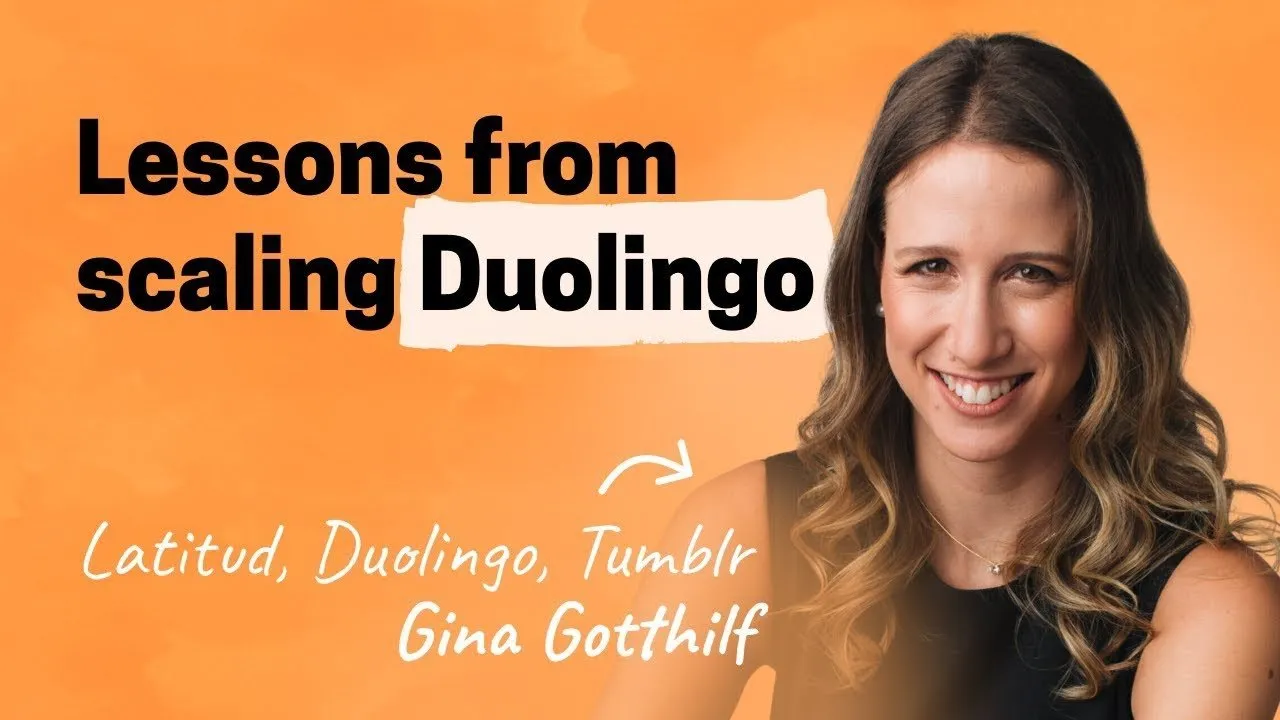
Most people know Gina Gotthilf as the force behind Duolingo’s meteoric rise from 3 million to 200 million users. Her resume reads like a highlight reel of Silicon Valley success: VP of Growth at Duolingo, a stint on the Mike Bloomberg presidential campaign managing a historic ad budget, and now co-founder of Latitud, a company building the operating system for tech startups in Latin America.
However, the polished resume—or the "A-Side"—rarely tells the whole story. Behind the viral green owl and the massive user acquisition numbers lies a series of failed experiments, scraped knees, and hard-won insights into human psychology. In this deep dive, we explore Gina’s unconventional playbook for organic growth, the importance of building a brand that actually makes people feel something, and why Latin America is the next great frontier for tech innovation.
Key Takeaways
- Retention is the prerequisite for growth. Before spending a dime on acquisition, you must ensure your product provides real value; otherwise, you are simply filling a leaky bucket.
- Constraints breed creativity. Duolingo’s lack of a marketing budget in the early days forced the team to master organic channels, PR, and product-led growth.
- Brand voice matters more than you think. In a crowded market, being professional is often less effective than being distinct, funny, or even slightly controversial.
- Treat the world as one market. Contrary to popular localization advice, focusing on universal human behaviors often yields better results than over-customizing for every single territory.
- Every career has a "B-Side." We tend to publicize our wins, but resilience in the face of layoffs, failed launches, and rejections is what actually builds a career.
The "B-Side" of a Silicon Valley Success Story
We are conditioned to present the "Instagram version" of our careers—the promotions, the exits, and the hockey-stick growth charts. Gina conceptualizes this as the "A-Side" of a record. While her A-Side includes scaling Duolingo and meeting President Obama, her B-Side is equally important, though rarely discussed.
Early in her career, Gina faced rejection from Ivy League schools, dropped out of college due to depression, and navigated a tumultuous start in the workforce involving visa issues and layoffs. These "B-Side" moments are not just footnotes; they are the crucible in which resilience is forged. Understanding that everyone—from junior operators to billionaire founders—has a messy B-Side helps combat imposter syndrome and normalizes the non-linear path of entrepreneurship.
It’s not just about doing things that actually matter and learning, it’s about being able to tell a story and understanding what other people perceive as valuable.
The Duolingo Playbook for Organic Growth
Consumer subscription apps are notoriously difficult to scale. Few survive, and fewer still become cultural icons. Duolingo’s success wasn't accidental; it was built on specific, replicable pillars that prioritized long-term health over short-term vanity metrics.
1. Mission as a Growth Engine
A strong mission does more than look good on a pitch deck; it attracts top-tier talent who might otherwise go to higher-paying tech giants. Duolingo’s obsession with free education allowed them to hire passionate engineers and marketers who were driven by impact. This internal alignment permeates the product and marketing, creating a brand that users want to root for.
2. The Luxury of No Budget
When Gina took over growth, she was given a mandate: grow the user base, but do it with zero budget. While this seemed like a handicap, it was a blessing. It forced the team to ignore paid acquisition—which can often mask poor product-market fit—and focus entirely on organic growth.
This approach requires a relentless focus on retention. If you cannot buy users, you must keep the ones you have. By focusing on the "CAC to LTV" ratio (Customer Acquisition Cost to Lifetime Value) before there was even a monetization strategy, Duolingo ensured that when they eventually turned on revenue streams, the fundamental unit economics were already sound.
If you don't force yourself to pay attention to retention and finding the users to whom this is the most useful really early on, you risk convincing yourself of metrics and glossing over important stuff.
3. Obsessive A/B Testing
Growth at Duolingo wasn't about guessing; it was about rigorous data analysis. The team ran thousands of A/B tests. However, not every test was a winner. Gina recalls delaying a "gamification badges" experiment for months because the ROI seemed low. When they finally launched a Minimum Viable Product (MVP) version of badges, it failed miserably.
Upon review, the team realized they hadn't "dogfooded" (used the product internally) enough. The badge design was uninspiring. Later, when they revisited badges with a proper design and strategy, it became a massive engagement driver. The lesson? A failed test might not mean the idea is bad; it might mean the execution was off.
Building a Cult Brand Voice
One of Duolingo’s most defensible moats is its brand voice. In an industry where most educational tools are dry and instructional, Duolingo chose to be quirky, funny, and occasionally passive-aggressive. This wasn't just a creative choice; it was a retention strategy.
The Power of Emotion
Communication is about ensuring a message is received, understood, and felt. The team found that making users "feel" something—even if that feeling was a slight pang of guilt from a crying green owl—was effective.
This culminated in the famous "passive-aggressive" notifications. When a user stopped practicing, they would eventually receive a notification saying, "These reminders don't seem to be working. We'll stop sending them for now." It was a risk. It was cheeky. But it worked. It sparked a meme culture where users joked about the owl coming for them if they missed a Spanish lesson. Rather than shying away from this "menacing" persona, Duolingo leaned into it, solidifying their place in internet culture.
Communication isn't about being able to convey a message; it's about being able to convey a message in a way that the listener receives it, understands it, and remembers it.
High-Stakes Optimization: Lessons from the Bloomberg Campaign
Transitioning from a zero-budget startup environment to the Mike Bloomberg presidential campaign, Gina managed a historic digital ad budget of roughly $1 million per day. This environment provided a unique laboratory for high-velocity testing.
With that volume of traffic, statistical significance on landing page tests could be reached in hours rather than weeks. The biggest takeaway? Most companies over-index on ad optimization and under-index on the post-click experience.
Landing Page Essentials
Gina found that she could double or triple conversion rates not by tweaking the ad copy, but by overhauling the landing page. Key optimizations included:
- Mobile Optimization: Designing mobile-first, not desktop-first.
- Skimmability: Writing headlines and subheads that convey the full story, assuming nobody reads the body paragraphs.
- The "Squint Test": Ensuring the headline and the Call to Action (CTA) button make sense together without reading anything else.
- Visual Consistency: Matching the emotional tone of the ad (e.g., fear or urgency) with the color palette and imagery of the landing page.
Internationalization: Humans are More Alike Than Different
A common trap for startups expanding globally is over-localization. Companies often believe they need to rebuild their app from the ground up for markets like Brazil, Japan, or India because of "cultural differences."
While regulatory and payment infrastructure differences are real, Gina argues that core human psychology is remarkably consistent. People everywhere want to learn, they want to be entertained, and they respond to similar gamification triggers. Maintaining separate codebases or app versions for different countries creates massive technical debt. The smarter play is to assume 80% of human behavior is universal and only customize the 20% that is absolutely necessary (like specific payment methods or avoiding cultural taboos).
The Next Frontier: Latin America
Now, as the co-founder of Latitud, Gina is applying these lessons to the Latin American ecosystem. The region represents a massive opportunity, often underestimated by US investors.
Why Latin America Now?
The region has a GDP of $6 trillion and a population of 600 million, yet the tech sector is still a fraction of the size of the US or Chinese markets. This gap represents pure opportunity. Furthermore, the "leapfrog" effect is in play: many Latin American consumers are skipping the desktop era entirely and moving straight to mobile-first financial and educational tools.
Latitud aims to be the operating system for this new generation of startups, solving the unsexy but critical friction points—incorporation, cross-border payments, and fundraising—that typically strangle growth in emerging markets.
Conclusion
Whether scaling a language app to 200 million users or building the infrastructure for a continent's tech ecosystem, the principles remain the same. Success requires a willingness to embrace the "B-Side" moments, a commitment to rigorous testing, and the courage to build a brand with a distinct, human voice. As Gina notes, "fake it till you make it" isn't about lying; it's about projecting the version of yourself—or your company—that you are striving to become until the reality catches up with the ambition.