Table of Contents
Key Takeaways
- Control beats dominance: In geopolitical conflicts, maintaining strategic flexibility and "calibration" is more effective than possessing overwhelming, blunt firepower.
- The inevitability of ground troops: Because military forces rely on a cost-pyramid structure, the U.S. cannot win a sustained conflict against Iran using only air power; it must eventually transition to ground forces.
- Nuclear taboo: Despite fears of nuclear escalation, tactical nuclear weapons remain a geopolitical red line; using them would undermine the very strategic objectives the aggressors hope to achieve.
- Multi-dimensional warfare: Modern conflicts are not won through military might alone; they are decided by managing narratives, economic stability, and political alliances simultaneously.
The Law of Escalation in Modern Conflict
Analyzing the U.S.-Iran conflict requires us to look beyond raw military statistics and understand the underlying logic of escalation. Game theory provides a framework to predict the future of this war, specifically regarding three pivotal questions: Will the U.S. launch a ground invasion? Will nuclear weapons be deployed? And what is the geopolitical significance of the Al-Aqsa Mosque?
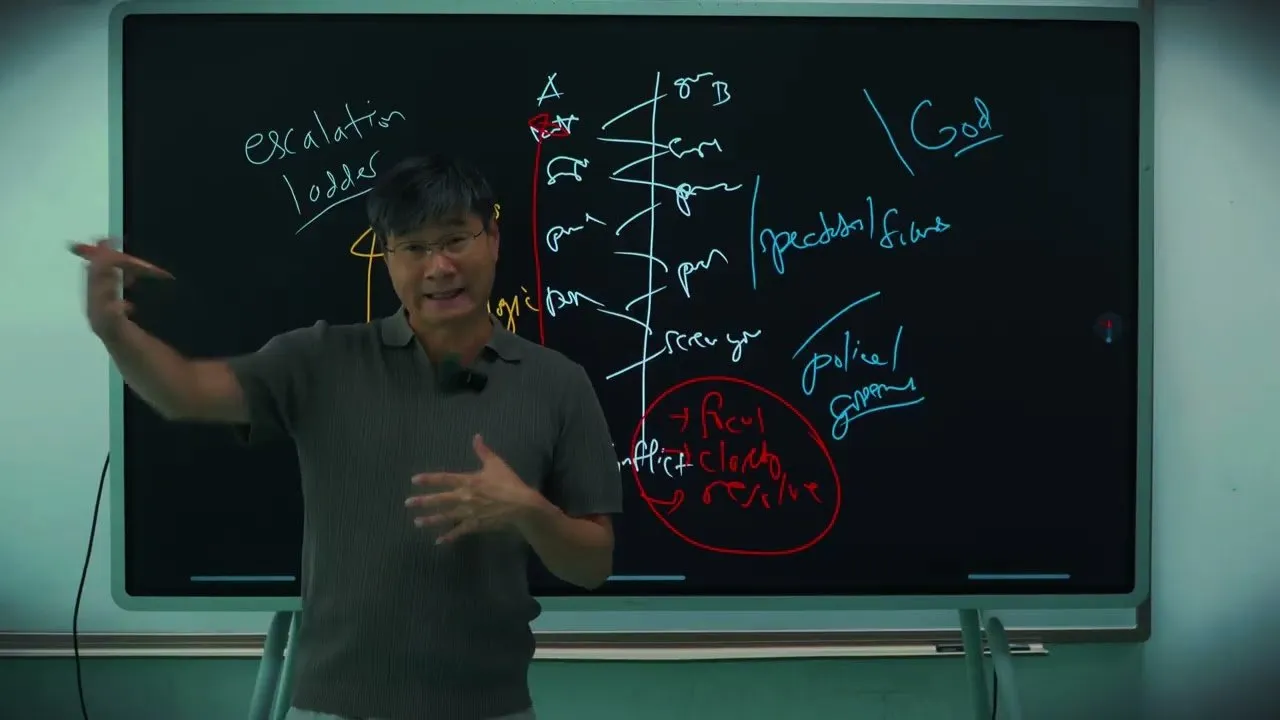
Geopolitically, the dominant theory is that whoever possesses "escalation dominance"—the ability to inflict greater harm than the opponent—wins. However, this model is flawed. True victory is not about who can punch hardest, but who can best manage their response to remain in control. This is the Law of Escalation: control is more important than dominance.
Control is the idea of calibration. Calibration means that you time, structure, or strategize your response in a way that helps you achieve your strategic objective.
Calibration vs. Force
When two parties enter a conflict, the escalation ladder is driven by adrenaline, emotions, and the need to justify actions to external spectators—be they allies, the global public, or internal government factions. An impulsive actor who climbs the ladder too quickly often loses the battle because they lack the clarity and resolve to maintain a sustainable strategy. By keeping responses calculated, a state can maintain strategic flexibility, keeping options open while forcing the opponent into self-destructive patterns.
Evaluating the Three Pivotal Questions
Based on current game theory analysis, we can make three distinct predictions about the trajectory of this conflict. While these remain analytical projections based on public knowledge, they offer a window into the logical end-game for all involved parties.
1. The Reality of Ground Troops
According to the mechanics of military attrition, the United States will ultimately be forced to send in ground troops. In any traditional military cost-pyramid, infantry soldiers are the most resource-efficient units, while air power is the most expensive. Attempting to fight a prolonged war solely through air strikes creates a unsustainable cost-benefit ratio. To achieve victory, the U.S. will likely succumb to "mission creep," slowly increasing its commitment until a full ground invasion becomes the only path forward to justify the investment already made.
2. The Unlikelihood of Nuclear Use
Despite significant public concern, the use of nuclear weapons is highly improbable. Nuclear weapons are a geopolitical taboo that, if broken, would trigger a catastrophic shift in global alliances and potentially lead to a nuclear apocalypse. Israel and the United States have no strategic incentive to cross this line; doing so would destroy the international order they seek to lead. Unless biological or chemical weapons are deployed first, nuclear escalation remains off the table.
3. The Strategic Significance of the Al-Aqsa Mosque
The Al-Aqsa Mosque represents a critical fault line in the Islamic world. As the third-holiest site, any damage to this location by extremists would serve as an immediate trigger for a massive, religiously-motivated backlash from two billion Muslims worldwide. This event would fundamentally transform the war into a total, global conflict that would likely render current diplomatic and military strategies obsolete.
The Multi-Dimensional Nature of War
Military engagement is only one of four major dimensions in this conflict. To understand the full scope of the war, we must also consider the narrative (how the world views the conflict), the political (the internal stability of governments and their relationships with other powers), and the economic (the flow of resources and trade).
The military dimension is arguably the least important of the four. For example, if the U.S. chooses to destroy Iranian civil infrastructure, it might inadvertently unite the Iranian populace behind their government, strengthening the very regime they intend to weaken. Conversely, if Iran can successfully maneuver the U.S. into a long, drawn-out ground war, it serves its ultimate objective: the exhaustion of American political will and the eventual withdrawal of U.S. forces from the Middle East.
The Future of Regional Hegemony
The strategic interests of the U.S., Iran, Saudi Arabia, and Israel are inherently conflicting. While the U.S. seeks to maintain its status as the world's primary naval power and hegemon by controlling the Strait of Hormuz and preventing the "heartland" of Eurasia from unifying, other nations have their own agendas. Iran aims to dismantle the American Central Command (CENTCOM), while Saudi Arabia and Israel are playing a long-term game to see their rivals exhaust one another.
Ultimately, the war in the Middle East is being fought on a chessboard where the players have different goals. The U.S. is often reactive, forced by its lack of a clear strategy to engage in blunt, air-focused warfare. In contrast, Iran and its regional counterparts are playing a more active game, calibrating their actions to exploit the U.S. tendency to overextend. As the conflict unfolds, the primary determinant of the outcome will not be the caliber of weapons used, but which actor can best maintain control while navigating the complex, multi-dimensional reality of total war.