Table of Contents
Samsung’s Galaxy Z TriFold has arrived as a high-stakes entry into the ultra-premium mobile market, positioning itself as a $3,000 hybrid that blurs the line between smartphone and full-sized tablet. Featuring a complex hinge system that reveals a 10-inch internal display, the device seeks to address the productivity limitations of traditional "book-style" foldables while introducing new challenges in ergonomics and software optimization.
Key Points
- The Galaxy Z TriFold features a massive 10-inch main display, offering a screen experience comparable to an iPad Air and significantly larger than the 8-inch panel on the Galaxy Z Fold 7.
- Hardware specifications include a 200-megapixel primary camera and a 5,600 mAh battery, which supports 45-watt fast charging to reach 61% capacity in 30 minutes.
- The device carries a significant physical footprint, weighing 309 grams with a folded thickness of 12.9 mm, making it noticeably denser than standard foldable models.
- Software scaling remains a hurdle, as several popular applications are not yet optimized for the unique aspect ratio of the 10-inch tri-fold configuration.
A True Tablet-Phone Hybrid
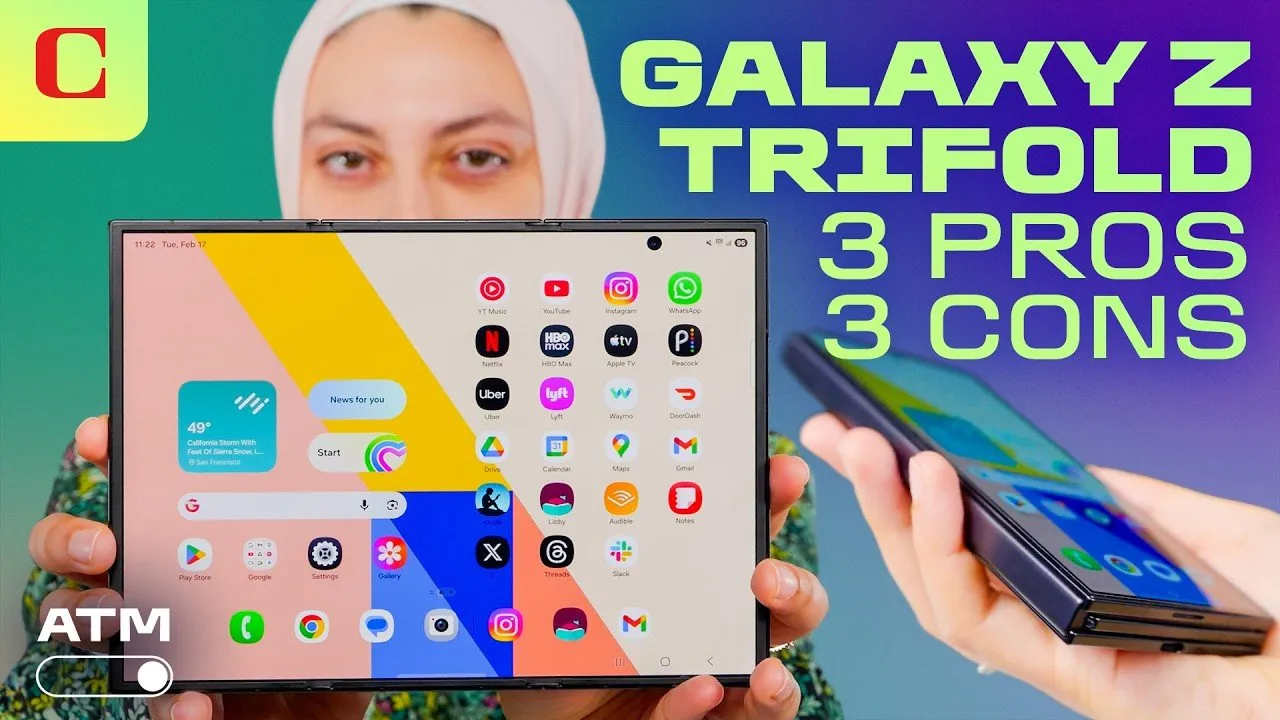
While previous foldables like the Galaxy Z Fold 7 have been criticized for occupying an awkward middle ground, the Galaxy Z TriFold leans fully into the tablet experience. The 10-inch internal display provides enough digital real estate to run three applications simultaneously without the cramped interface typical of smaller foldables. This expanded surface area is paired with a 6.5-inch cover screen for standard smartphone utility.
According to All Things Mobile, the transition between these modes feels transformative:
"It really is like night and day when you prop this thing open as if you switched to a whole other device. And in the end, it still folds shut and fits in your pocket or bag."
The device also maintains flagship-level imaging, utilizing the same sensor array found in the Z Fold 7. This includes a 200-megapixel wide-angle lens, a 12-megapixel ultrawide, and a 10-megapixel telephoto camera. Early testing suggests the hardware handles complex lighting and high-contrast environments effectively, ensuring that users do not have to compromise on photography for the sake of the novel form factor.
Ergonomics and Performance Trade-offs
The ambitious design of the Galaxy Z TriFold necessitates certain physical compromises. At 309 grams, it is nearly 44% heavier than the Z Fold 7 (215 grams). The 12.9 mm thickness when folded contributes to a sense of density that may deter users accustomed to slimmer flagship devices. Furthermore, the width of the 10-inch display makes handheld typing difficult, even with split-keyboard software optimizations.
However, the larger chassis allows for a substantial 5,600 mAh three-cell battery. In real-world testing, this capacity provides roughly a day and a half of use on a single charge, particularly when users rely on the cover screen for routine tasks like messaging and social media. When the main display is engaged for power-intensive activities like video streaming or multitasking, the battery life remains competitive with high-end tablets.
Market Viability and Software Challenges
Despite the hardware's sophistication, the Galaxy Z TriFold faces obstacles regarding third-party app compatibility. Platforms such as Instagram and DoorDash currently struggle to scale to the 10-inch internal display, often resulting in grainy visuals or awkward formatting. While Samsung provides toggle arrows to shift content for easier scrolling, the experience highlights a gap between hardware capability and developer support.
"Using apps like X or Door Dash on the main display feels a little unnecessary because they aren't formatted to fill that space... I do hope more apps become compatible with the main display in future versions of this phone," the report states.
At a price point of nearly $3,000, the Galaxy Z TriFold remains a niche product aimed at business professionals and media enthusiasts rather than the general consumer. The high cost of entry reflects the cutting-edge nature of the tri-fold technology, which Samsung positions as the eventual evolution of the mobile form factor.
As the technology matures, industry analysts expect manufacturing costs to decrease and software ecosystems to adapt to these larger aspect ratios. For now, the Galaxy Z TriFold serves as a functional proof-of-concept for the future of mobile productivity, with the next iteration likely focusing on reducing weight and refining the user interface for specialized applications.