Table of Contents
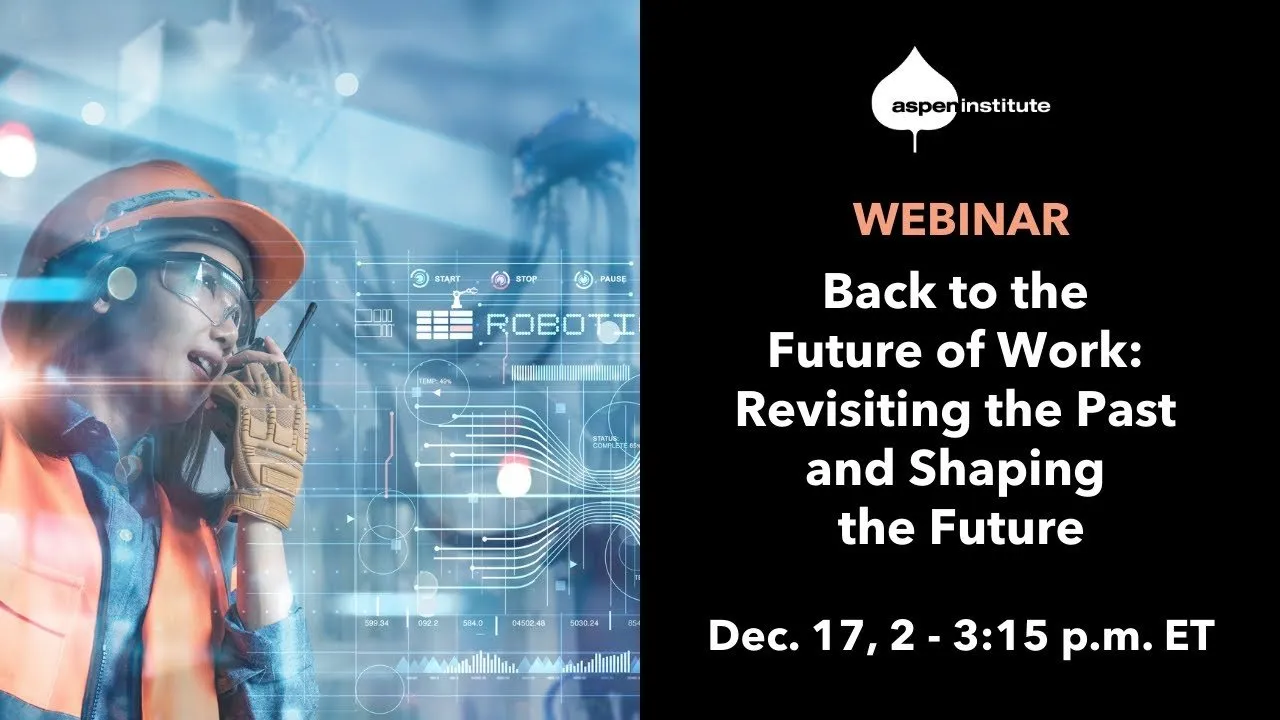
We have reached a critical inflection point in the global conversation about labor, technology, and the economy. For the past decade, the "future of work" has often been dominated by hype cycles, breathless predictions about automation, and a scramble to understand the gig economy. However, as the Aspen Institute marks the 10th anniversary of its Future of Work Initiative, the focus is shifting from prediction to retrospection—and, crucially, to agency.
The narrative is no longer just about what technology will do to us, but how we can shape the infrastructure of work to support democracy and human dignity. In a recent capstone discussion, experts from Microsoft Research, NYU Stern, and Harvard Law School gathered to dismantle the myths of the past ten years. They explored why productivity hasn't translated to shared prosperity, why the "micro-entrepreneur" promise fell short, and how the next decade must focus on worker power, data ownership, and the essential nature of care work.
This article synthesizes their insights, offering a roadmap for moving beyond the buzzwords and forging a new social contract for the modern worker.
Key Takeaways
- The "Gig" prediction was right, but the policy response was wrong: While experts correctly anticipated the shift toward non-employment work arrangements, society failed to create stability for these workers, mistakenly trying to shoehorn them into outdated W-2 models rather than building new safety nets.
- Worker power requires more than a seat at the table: True agency requires "time, togetherness, and leverage." Workers need the space to collectively imagine their own futures rather than simply reacting to the imaginations of tech developers.
- Data is the new labor negotiation: As AI systems are built on productivity data and human creativity, workers must demand ownership of their "intellectual capital," ensuring they benefit when their output is used to train algorithms.
- Care work is the future: Contrary to robot-centric sci-fi visions, the most resilient future jobs lie in the care sector. Valuing and professionalizing this work is essential for a healthy economy.
The Decade in Review: Flexibility Without Stability
Ten years ago, the discourse around the future of work was largely centered on the rise of platforms. We correctly anticipated that work would increasingly detach from the traditional employer-employee relationship. However, the optimism that surrounded this shift—specifically the rebranding of precarious workers as "micro-entrepreneurs"—obscured a harsher reality.
Arun Sundararajan, Professor of Entrepreneurship at NYU Stern, notes that while we successfully predicted the fragmentation of work, we failed to modernize the social safety net to match it. In the United States, benefits and stability are inextricably linked to employment. When work became "gigified," workers gained flexibility but lost their floor of security.
The Myth of the Micro-Entrepreneur
The narrative that every Uber driver or freelance designer is a budding CEO promised a reduction in inequality through the decentralization of business ownership. This did not materialize at scale.
"The reality is that entrepreneurship is not an easy life... We haven't moved fast enough to provide adequate protections that replicate what you get when you are employed. When you're employed, you get income stability. You are able to predict how much you're going to earn every month."
While platforms delivered on the promise of absolute flexibility—allowing parents to work around childcare schedules or students to earn supplemental income—they largely failed to decentralize capital ownership. Without owning the structural capital of the business, gig workers remain vulnerable to volatility without the upside of true business ownership.
Beyond "Feedback": The Necessity of Worker Power
A recurring theme in the last decade of labor policy was the assumption that technology is inevitable and workers must simply adapt. Michelle Miller, Director of Innovation at Harvard Law School’s Center for Labor and a Just Economy, argues that we must invert this dynamic. Workers should not just be testers of technology already built; they must be architects of the solution.
Miller introduces a framework for worker power built on three pillars: Time, Togetherness, and Leverage.
- Time: Workers need paid time to think through complex problems, a luxury usually reserved for executives and consultants.
- Togetherness: Innovation happens in the aggregate. Individual workers cannot solve systemic issues in isolation.
- Leverage: The collective capacity to withhold labor or influence outcomes is the only way to ensure worker recommendations are actually implemented.
"We are living under the imaginations of other people. That is because they have had the time, the money, and the leverage to make what is their imagined sense of reality into something real."
The Efficiency of Worker Voice
Integrating worker voice isn't just a moral imperative; it is an efficiency imperative. Miller cited an example from a worker board in Pennsylvania overseeing technology implementation for public benefits. Before discussing advanced AI solutions, the workers identified that their primary bottleneck was outdated hardware—specifically, trying to allocate SNAP benefits on computers running Windows 95.
When workers are excluded from the design process, organizations waste resources solving the wrong problems with expensive technologies. Empowering workers to identify the friction points leads to better tools and higher productivity.
AI, Data Rights, and Human Capital
As we look toward the next ten years, the conversation is shifting from "gig work" to "generative AI." However, the core issue remains the same: who owns the value created by human effort? Mary Gray, Senior Principal Researcher at Microsoft Research, emphasizes that AI is, at its core, software built on the aggregated data of human productivity.
Ownership of Productivity Data
Currently, when workers collaborate to solve a problem, the data generated by that interaction is often harvested to train algorithmic management systems. Gray argues that workers should view their collective data as a leverage point. By utilizing data trusts or cooperatives, workers could collectively control the "raw material" that powers AI, ensuring that the technology is designed to augment rather than replace them.
The Crisis of Mid-Career Transitions
We are entering an era where AI can replicate specific human skills—a writer's voice, a surgeon's technique, or a salesperson's cadence. This creates a new urgency around "human capital ownership." If an AI is trained on a professional's lifetime of work, that professional should retain rights to that intellectual capital.
Furthermore, society lacks the infrastructure for mid-career reinvention. Our university system is designed for early-career education. We need a "university system for the 30-something" who has a mortgage and a family but whose occupation has been rendered obsolete by automation. Without a robust infrastructure for occupational transition, the displacement caused by AI will exacerbate inequality.
Reframing the Future: Care Work as Infrastructure
Perhaps the most significant oversight of the past decade was the obsession with robots and the devaluation of human-centric work. As automation handles routine cognitive and manual tasks, the economy will increasingly pivot toward service and care work—sectors that require empathy, complex communication, and human touch.
Care work—nursing, teaching, child care, and elder care—is the "AI-proof" economy. Yet, historically, these roles have been undervalued and underprotected. A sustainable future of work requires a cultural and economic shift that recognizes care work not as a low-skill commodity, but as essential infrastructure.
Mary Gray points out that technology should support, not replace, these roles. For community health workers, the value of technology lies in connecting them to resources and aggregating knowledge to solve community problems, not in automating the care itself.
Conclusion: Charting a New Course
The past decade has taught us that innovation does not automatically yield equity. The next era of work cannot simply be about better algorithms or faster platforms; it must be about power, agency, and reciprocity.
To build a future that benefits democracy and the economy, we must move beyond the "technological inevitability" narrative. This means creating safe spaces for workers to experiment and take risks without losing their healthcare. It means democratizing innovation policy so that communities, not just defense contractors and tech giants, decide which problems we solve with our computational power.
The optimism for the next decade lies in the fact that people are eager to have this conversation. Workers are organizing, demanding a say in how technology is deployed, and asserting their right to a future shaped by their own imaginations.
To explore these themes further, read the full editorial series Back to the Future of Work, curated by the Aspen Institute.