Table of Contents
Why do people fanatically love their Tesla or their iPhone, yet view their home appliances with indifference or even frustration? In the world of home robotics, specifically vacuum cleaners, innovation has often meant adding more sensors rather than adding intelligence. For decades, the industry standard has been a device that navigates by bumping into walls—automation without perception.
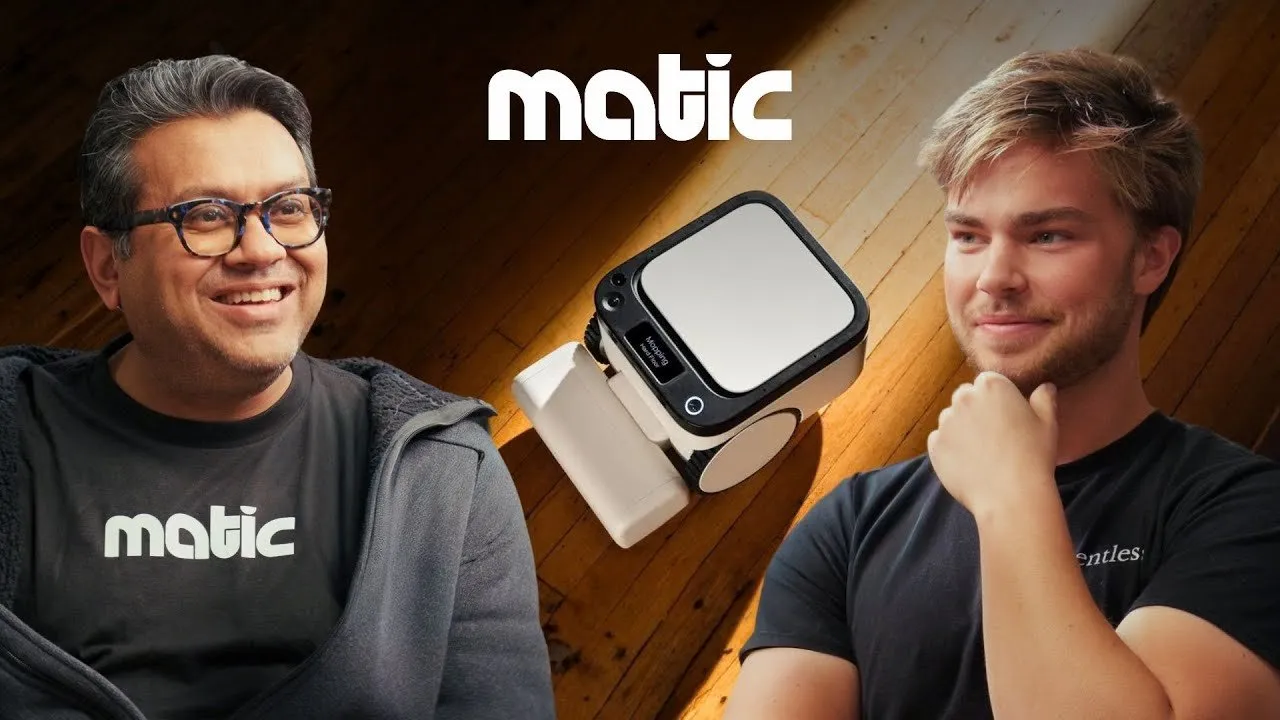
Mehul Nariyawala, co-founder of Matic and a veteran of Nest and Google, spent six years operating in stealth to change this paradigm. His goal was not just to build a better vacuum, but to create a robot that possesses a visual cortex—a device that sees and understands the home exactly as a human does. By rejecting the industry standard of LiDAR and bumpers in favor of a vision-first approach similar to Tesla’s self-driving technology, Matic aims to transition home robotics from clumsy gadgets into intelligent, autonomous residents.
Key Takeaways
- Vision-First Navigation: Unlike traditional robots that use "bump-and-turn" mechanics or single-pixel LiDAR, Matic uses RGB cameras and computer vision to navigate, allowing it to understand 3D context and avoid obstacles intelligently.
- The "Minimum Lovable Product" (MLP): In hardware, a buggy Minimum Viable Product (MVP) destroys trust. Nariyawala argues for an MLP—a product that exceeds customer expectations from day one, even if the feature set is constrained.
- Simplicity as a Moat: Drawing lessons from Nest and WhatsApp, Matic prioritizes doing one thing perfectly over feature bloat, maintaining that simplicity is far harder to engineer than complexity.
- The Reality of Hardware Scaling: Going from prototype to mass production uncovers "unknown unknowns," such as supply chain deviations where a simple glue change can ruin a motor's acoustics.
- Solving for Time, Not Just Dirt: The ultimate value proposition of home robots isn't cleaning; it is returning time to humans by shifting household chores from "batch processing" to continuous, autonomous maintenance.
Moving Beyond "Blind" Automation
The fundamental flaw in the last two decades of robot vacuums is a lack of true perception. The original Roombas, launched in 2002, were revolutionary for their time, but they operated on a principle of blindness. They navigated by colliding with the world. Even modern iterations that utilize LiDAR are often essentially operating with a "long cane"—they know an obstacle exists at a specific distance, but they lack the context to understand what it is.
"All these robots were essentially automation without intelligence... The way we thought about it is that first Roombas in 2002... really what they were is you put a blindfold around your eyes and you start walking and you keep bumping into each other... and if you bump a wall enough time and keep crossing you'll cover the entire room."
Nariyawala’s thesis is that if autonomous vehicles are striving for "Level 5" autonomy—driving like humans—home robots must aim for the same standard. A Level 5 home robot should navigate, clean, and understand context like a human. It should know that a pile of wires is a hazard to be avoided, not an obstacle to be chewed up. This requires moving away from a "Christmas tree of sensors" to a streamlined, vision-only system that mimics the human eye and brain.
The Challenge of SLAM and Absolute Mapping
One of the most significant technical hurdles Matic faced was perfecting Simultaneous Localization and Mapping (SLAM). Most robots create relative maps; they only know where they are in relation to their charging dock. If you pick them up and move them, they are lost.
Matic spent years developing a neural network-based SLAM system that creates an absolute map. Like a human, the robot can recognize its location instantly, regardless of where it is placed or which door it "entered" through. This level of spatial awareness is a prerequisite for a robot that is intended to act as a seamless part of the household rather than a gadget that requires babysitting.
Designing a "Minimum Lovable Product"
In the software world, the prevailing wisdom is to ship fast and iterate. In hardware, shipping a broken product is fatal. Because consumers have preconceived notions about what a vacuum should do, a new entrant cannot simply meet those expectations; it must exceed them. This necessitated a shift from the Minimum Viable Product (MVP) to the Minimum Lovable Product (MLP).
This philosophy was heavily influenced by Nariyawala's time working with Tony Fadell at Nest. The lesson was clear: the purpose of the product must be immediately obvious, and the experience must be delightful.
The Anatomy of Trust
Building an MLP meant Matic spent six years in R&D before shipping. During this time, they iterated through hundreds of prototypes, initially using 3D-printed parts to save capital. The goal was to solve specific user frustrations:
- Noise pollution: Traditional vacuums use high noise levels to signal power, but effective cleaning on hard surfaces requires agitation (brush rolls) and airflow, not deafening suction. Matic prioritized quiet operation to ensure the robot could run while people were home.
- Privacy: By processing data locally rather than in the cloud, Matic addressed the growing concern of having cameras inside the home.
- Personality: To bridge the gap between appliance and companion, the team incorporated interaction design that mimics pets—using movement and sound to communicate status rather than cryptic LED codes.
"What I've learned over my career is that there is no such thing as a perfect product. But there is a simple product and a complex product. And simplicity is much, much harder to maintain."
The Crucible of Manufacturing
Scaling a hardware startup is notoriously difficult. As Elon Musk has noted, "the factory is the product." Designing a functional prototype is exponentially easier than building a manufacturing line that can produce thousands of units with consistent quality.
Nariyawala recounted the inevitable "production hell" that occurs when scaling from 100 to 10,000 units. Issues that are invisible at small scales become critical failures at mass production. For instance, Matic faced a crisis where motors that had been reliable for years suddenly became noisy. The root cause was traced back to a sub-supplier changing the glue used on the impeller—a minor change with major acoustic consequences.
Supply Chain Complexity
The Matic journey highlights the immense friction of hardware innovation:
- Component Reliability: A single sensor added to a hardware product creates exponential complexity in software calibration and supply chain management. This drove Matic’s decision to stick to a vision-only approach, absorbing the complexity in software rather than hardware.
- Regulatory Hurdles: Unlike software, hardware faces a "whack-a-mole" of regulations. Nariyawala compared the unsexy, tedious nature of these hurdles to Nest’s battle with thermostat compatibility, noting that this tediousness actually serves as a protective moat against competitors like Google or Amazon, who often avoid such operationally heavy categories.
Customer Experience and the Long-Term Vision
The ultimate goal of Matic is not just to clean floors, but to manage domestic entropy. Nariyawala points out that Western households are designed around "batch processing"—we let dishes pile up for the dishwasher and laundry pile up for the weekend. This is a result of human time constraints.
Robots offer the possibility of continuous cleaning. By matching the rate of entropy (mess creation) with the rate of cleaning, a home can remain perpetually pristine. This shifts the value proposition from "doing a chore" to "giving time back."
The 11-Star Experience
To achieve this, Matic focuses on extreme transparency with early adopters. When pressure to ship mounted in late 2023, the product still lacked certain features, such as edge cleaning. Rather than delaying further or hiding the flaws, the company emailed pre-order customers with a starkly honest list of what the robot could and could not do.
This transparency built a community of users willing to collaborate on the product’s evolution. It mirrors the strategy of companies like Tesla, where the initial product funds the development of the long-term vision. For Matic, the floor is just the beginning. The foundational technology—visual perception, navigation, and semantic understanding—is the platform upon which future domestic robots will be built.
"No one really wants AI. They want solution to their problem... In the same way, robots is a means to an end... No one actually wants a robots. This idea that you want to buy robot is a in my mind misnomer... People want solution to their problems."
Conclusion
Matic’s journey underscores a return to first-principles thinking in Silicon Valley. Rather than chasing the hype of the moment, the company spent years refining a complex integration of hardware and software to solve a mundane but pervasive problem. By betting on vision-only navigation and local compute, they have positioned themselves to do for the home what autonomous vehicle companies are attempting to do for the roads.
As the company ramps up production, the challenge remains immense. Yet, the vision offers a glimpse into a future where technology doesn't just automate tasks, but fundamentally changes how we live in our spaces, turning the home into a self-maintaining environment and returning the most valuable asset—time—back to its owners.