
Table of Contents
The landscape of software engineering is undergoing a seismic shift. With 92% of developers already utilizing AI tools and over 1.5 million engineers relying on GitHub Copilot, artificial intelligence has graduated from a novelty to a fundamental component of the developer environment. However, the rapid adoption of these tools raises critical questions: Will AI replace engineers? How do we measure productivity in this new era? And how must the skill sets of junior developers evolve to keep pace?
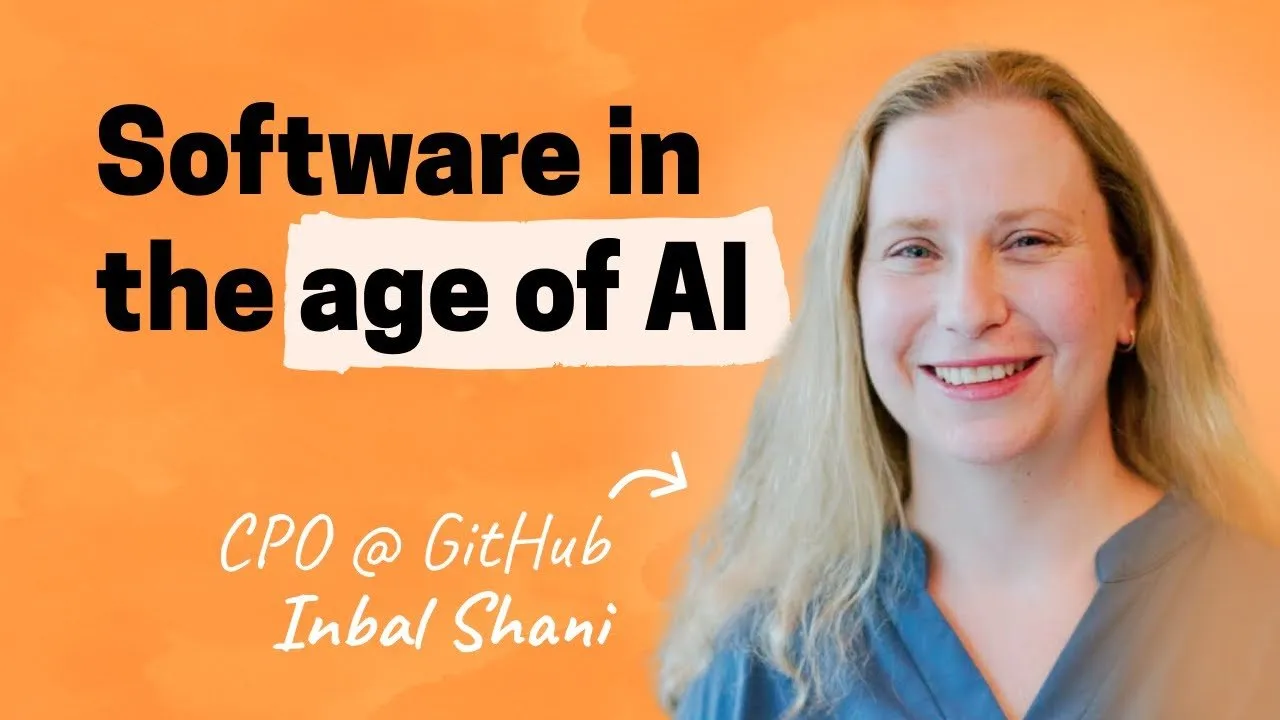
Inbal Shani, Chief Product Officer at GitHub, offers a unique vantage point on these shifts. Drawing from her experience at Amazon Robotics, AWS, and Microsoft, Shani provides a pragmatic look at the current state of AI-assisted development. Her insights reveal that the future isn't about replacing humans, but about elevating them—shifting the focus from writing boilerplate code to architectural thinking and system design.
Key Takeaways
- The Human Element Remains Essential: Generative AI acts as a "co-pilot, not a pilot." It cannot replace the creative spark, innovation, and decision-making capabilities of human engineers.
- Productivity Beyond Speed: While AI increases coding speed by 55%, the ultimate metrics for success are developer happiness, "time to value," and the reduction of cognitive load.
- The Testing Revolution: One of the most underhyped applications of AI is its ability to generate comprehensive testing suites, from unit tests to security penetration testing.
- Evolving Skill Sets: Junior developers must now adopt a "senior" mindset earlier in their careers, focusing on system architecture and the connected experience rather than just syntax.
- Innovation Requires Safety: Successful product teams operate on a "ship to learn" philosophy, where failing forward is encouraged and rigorous "dogfooding" is mandatory.
The Reality of AI: Hype vs. Utility
As AI reshapes the industry, distinguishing between inflated expectations and tangible value is crucial for engineering leaders. The narrative that generative AI will replace human software engineers is, according to Shani, significantly overhyped. The technology requires data to function, and that data is generated by human activity. More importantly, AI lacks the innate creative spark that drives true innovation.
What is often overlooked, however, is the impact of AI on quality assurance. While much of the conversation focuses on code generation, the ability of AI to revolutionize testing is a massive, underutilized opportunity.
The Untapped Potential of AI-Driven Testing
In a traditional workflow, writing robust test suites—ranging from unit and integration tests to load and penetration testing—is often a manual, time-consuming process that developers may deprioritize. As AI accelerates code generation, the volume of software being produced is exploding. Without a corresponding acceleration in testing capabilities, quality assurance becomes a bottleneck.
Shani argues that leveraging AI to automatically generate testing suites is critical. This ensures that the increased speed of production does not compromise security or stability. By automating the validation process, teams can maintain high standards even as their output velocity increases.
Redefining Developer Productivity and Happiness
Quantifying the impact of AI tools like Copilot requires moving beyond archaic metrics like "lines of code." GitHub’s internal data suggests that the benefits of AI extend far beyond raw output.
- Speed: Developers write code 55% faster with Copilot.
- Confidence: 85% of users feel more confident in their code quality.
- Satisfaction: 88% report feeling less frustrated and more focused on meaningful work.
However, speed is not a standalone success metric. It is entirely possible to write bad code faster. Therefore, organizations must pivot to measuring "Time to Value"—the duration between a developer starting a task and that task generating real-world value, whether through revenue, user adoption, or market feedback.
"Co-pilot is a co-pilot, it's not a pilot. You still need the human in the loop... productivity is not the right metrics against each one of these components. It's really about how are we taking time and translating it to efficiency to productivity... leading to eventually developer happiness."
The ultimate goal of integrating AI is not to reduce headcount, but to reduce burnout. By offloading tedious tasks—such as writing boilerplate functions, generating documentation, or conducting code reviews—developers reclaim time for collaboration and creative problem-solving.
The Evolution of the Developer Skill Set
The widespread adoption of AI tools is fundamentally changing what it means to be a junior developer. Historically, early-career engineers spent years mastering syntax and writing simple functions. Today, AI assistants can handle much of that foundational coding instantly.
This shift forces junior developers to accelerate their learning curve regarding system architecture. They no longer have the luxury of ignoring the "big picture."
From Syntax to Systems Thinking
With AI handling the implementation details, developers must focus on how different components of a system interact. The expectation is that even junior engineers will utilize the time saved on coding to understand the product environment, the customer experience, and the connected systems they are building.
"The junior developers when they start usually we expect them to be able to write simple code but if now there is an AI assistant that is helping them writing code they can spend more time from the get-go understanding the system understanding the environment that they are building."
This creates a hybrid workflow where engineers might still hand-write critical, performance-intensive code (like C for embedded systems) while delegating routine logic and abstraction layers to AI. The skill lies in knowing which tool to use for which task.
Cultivating a Culture of Innovation
GitHub’s ability to stay at the forefront of the AI revolution is not accidental; it is the result of a deliberate organizational structure designed to foster experimentation. This approach creates a "bed for innovation" where failure is viewed as a necessary step in the learning process.
The "Ship to Learn" Philosophy
Innovation cannot happen without risk. Shani emphasizes a "fail forward" mentality, where teams are encouraged to experiment with new ideas even if they don't immediately succeed. This is formalized through GitHub Next, a research division comprised of researchers and engineers dedicated to investigating the future of software development three to five years out.
Unlike innovation labs in other organizations that often become disconnected "ivory towers," GitHub Next maintains deep synergy with product and engineering teams. This ensures that valid research concepts—like the early experiments that led to Copilot—are transitioned into production reality rather than languishing as theoretical papers.
Dogfooding at Scale
A critical component of GitHub’s product strategy is that they are their own "Customer Zero." GitHub runs on GitHub. From engineering and design to finance and legal, the platform is used internally for all collaboration and project management.
This rigorous internal usage ensures that no feature reaches the customer before it has been battle-tested by the team itself. If the product team cannot find value in a feature, they assume the customer won't either. This feedback loop is essential for refining AI integrations and ensuring they reduce friction rather than add to it.
Conclusion: The Hybrid Future
The future of software development is not a binary choice between human and machine. It is a hybrid ecosystem where specialized AI models and generalist LLMs work in concert with human ingenuity. While generative AI will handle general-purpose tasks, specific industries—such as automotive or aerospace—will likely rely on highly tuned, niche models to meet rigorous safety standards.
For organizations navigating this transition, the lesson is clear: Avoid the trap of adopting AI simply to check a box. Instead, work backward from the problem you are trying to solve. Use AI to remove the drudgery from the developer experience, allowing your human talent to focus on what they do best—innovation, strategy, and creative problem-solving.



![Trump Market Manipulation Will Trap You! [This Happens Next]](/content/images/size/w1304/format/webp/2026/03/trump-market-manipulation-volatility-warning.jpg)
)