
Table of Contents
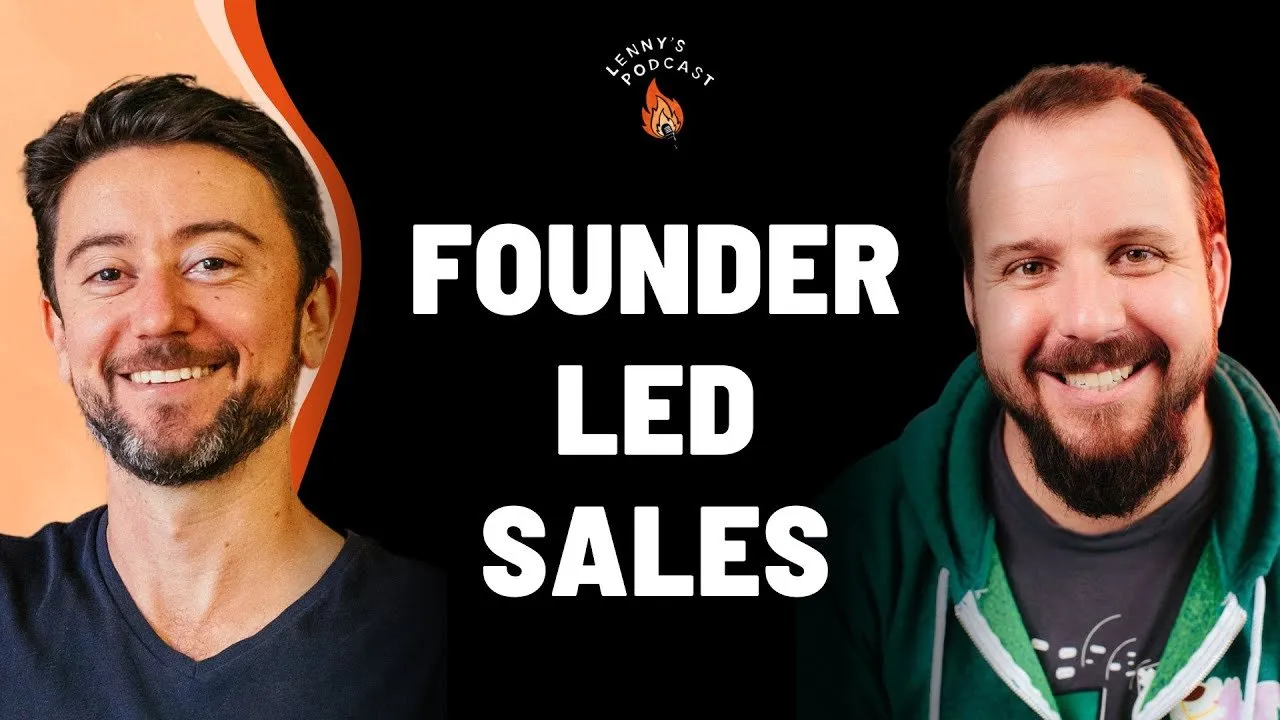
For many product-focused founders, sales can feel like a "black box" discipline—a domain reserved for extroverts with a knack for persuasion rather than engineering rigor. However, Pete Kazanjy, founder of Atrium and author of Founding Sales, argues that modern sales is less about magic and more about metrics, process, and iteration. Coming from a product management background himself, Kazanjy deconstructs early-stage sales into a framework that technical founders can not only understand but master.
The reality is that founders cannot outsource the initial discovery phase of selling. Just as you wouldn’t outsource the writing of your core codebase, you cannot outsource the development of your "sales source code." Learning to sell is essential for validating product-market fit, refining messaging, and creating a repeatable motion that can eventually be handed off to a dedicated team.
Key Takeaways
- Founder-led sales is mandatory: You cannot hire a VP of Sales to fix product-market fit. Founders must close the first batch of deals to build the "source code" of the sales motion.
- The "Run on Local" benchmark: Before hiring your first rep, you should achieve a 15–25% win rate on 50–100 qualified opportunities to prove the motion is repeatable.
- Hire "Pioneers," not "Town Settlers": Avoid hiring a VP of Sales from a massive company as your first hire. Look for the "deputy" or early rep from a company that was at your stage two years ago.
- Monitor leading indicators: When ramping new reps, ignore lagging revenue metrics initially. Focus heavily on activity, meetings booked, and "second dates" (progression to the next stage).
- Sales is consulting, not coercion: Modern sales is about identifying prospects who genuinely have the problem you solve and guiding them to a solution, not convincing skeptics to buy things they don't need.
The "While Loop" of Founder-Led Sales
Many founders view sales as a linear hand-off: build the product, then hire someone to sell it. Kazanjy reframes this, viewing sales as the sequel to The Lean Startup. It is a continuous loop of customer development.
In the early days, a founder’s goal isn't just revenue; it is information. When a founder sells, they are testing the product against the market in real-time. If a pitch lands flat, a founder has the authority to change the slide deck, the pricing, or the product roadmap immediately. A hired sales representative does not have that autonomy, leading to a broken feedback loop.
"You can't outsource that behavior. The founder has to do that stuff... It’s going to be way easier for you to get minimally viable good at selling by having interactions with non-friendly parties... than it is for some third party to become as expert at the subject matter that you are."
By handling the first few dozen deals, the founder writes the "source code" for the sales motion. This includes the objection handling scripts, the value proposition, and the discovery questions. Only once this code is written and debugged can it be installed in the "brain" of a hired salesperson.
When to Fire Yourself: The "Runs on Local" Heuristic
A common pitfall for startups is hiring their first salesperson too early or too late. Kazanjy offers a technical analogy for determining the right moment: does the sales motion "run on your local" machine without erroring out?
To determine if your sales motion is ready to be scaled, you need statistical significance. Closing two deals out of ten attempts is luck; closing twenty out of a hundred is a system. Kazanjy suggests the following benchmarks to validate repeatability:
- Volume: You need to have taken 50 to 100 "at-bats" (interactions with qualified prospects).
- Win Rate: You should reliably convert 15% to 25% of these first meetings into customers.
- Reliability: The process should feel consistent, not like every deal requires a heroic, custom effort.
If you are closing less than one out of ten prospects, your product or messaging likely needs iteration, not a salesperson. Adding headcount to a broken process simply scales inefficiency.
Decoding the First Sales Hire
Once you have validated that the sales motion works, the next challenge is hiring someone else to execute it. This is where most startups fail. There is a temptation to hire a "Big Company VP"—someone with a pristine resume from Salesforce, Oracle, or a post-IPO unicorn.
This is almost always a mistake. A sales leader who manages managers at a large corporation has likely not been in an individual contributor role for years. They are accustomed to established brands, infinite marketing support, and polished collateral.
The "Deputy" Profile
Instead of the shiny executive, founders should look for the "pioneer" or the "deputy." These are the early sales hires at companies that are currently successful but were at your stage two or three years ago. For example, if you are building a design tool, look for the early reps at Figma who figured out the sales motion before the brand was ubiquitous.
You want someone who is comfortable with ambiguity, willing to build their own collateral, and capable of selling without a brand name behind them. Ideally, hire two reps simultaneously. This allows you to A/B test their performance. If one fails and the other succeeds, it was a personnel issue. If both fail, it is likely a problem with your sales motion or onboarding.
Data-Driven Management: Managing for "Second Dates"
Managing a sales team requires a shift from lagging indicators to leading indicators. In the early months of a new hire, looking at "closed won" revenue is useless because the sales cycle hasn't finished yet. Founders must look upstream.
Kazanjy compares this to dating. The goal of a first date isn't marriage; it's a second date. Similarly, the primary metric for a ramping salesperson is progression.
- Activity Metrics: Are they making the calls and sending the emails?
- Inflow: Are they booking first meetings?
- Progression (The "Second Date"): Are those first meetings turning into second meetings? Ideally, you want to see a 50% conversion rate from first meeting to second meeting.
If a rep is generating meetings but getting zero second meetings, they likely have a skill gap in running the discovery call. If they are getting second meetings but no proposals, the issue is downstream. By instrumenting these leading indicators, you can diagnose failure in month two rather than waiting for a missed quota in month nine.
The Modern Sales Mindset
For technical founders, the biggest barrier to sales is often psychological. There is a lingering perception of sales as manipulative or sleazy—the "selling ice to Eskimos" trope. Kazanjy rejects this entirely.
"If you're selling ice to an Eskimo, you're an asshole. They don't need ice... As a seller, what you should be doing is being a consultant that has a particular predilection for a given solution."
Modern sales is about Ideal Customer Profile (ICP) discipline. It involves identifying the specific subset of the market that suffers acutely from the problem you solve. When you rigorously qualify for ICP, sales becomes a helpful consultation. You are revealing a pain point the prospect may not have fully quantified and offering a verified solution.
Tactical Shifts for Founders
To succeed, founders must adopt specific behavioral shifts:
- Turbo Rapport: Develop the ability to build trust in the first 90 seconds of a conversation. This is a practiced skill, not an innate trait.
- Context Switching: Unlike engineering, which requires deep work, sales operates on a manager’s schedule. You must be comfortable switching between five different prospect contexts in a single day.
- Continuous Auditing: Especially for junior reps, remote work can be detrimental to learning. Sales is an apprenticeship profession learned through osmosis and immediate feedback loops. Sitting "shoulder-to-shoulder" (virtually or physically) allows for instant correction after a call, drastically shortening the learning curve.
Conclusion
Sales is not an innate talent bestowed upon the charismatic; it is a discipline of engineering, psychology, and process. For founders, the path to scale involves first doing the work themselves to build the prototype of the sales machine. Only once that machine is running locally can you hire the operators to run it in the cloud. By treating sales with the same rigor as product development—focusing on data, iteration, and fit—founders can transition from building a great product to building a massive business.

)