Table of Contents
Industrial maintenance and facility management are undergoing a technological shift as ultrasonic detection tools move from niche applications to mainstream operational essentials. The adoption of high-end acoustic imaging, such as the Fluke ii915, allows technicians to visualize invisible system failures, including pressurized air leaks and mechanical wear, that traditional inspection methods often miss. By converting high-frequency sound waves into a visual sound map, these devices are helping businesses mitigate energy waste and prevent costly equipment downtime.
Key Points
- The Fluke ii915 utilizes an array of 64 microphones to detect ultrasonic frequencies between 2 kHz and 100 kHz, well beyond the threshold of human hearing.
- Integrated software, such as LeakQ, provides real-time ROI analysis by calculating the annual energy cost of detected leaks based on local currency and compression settings.
- Beyond simple air leaks, acoustic imaging is being deployed to identify partial discharge and arcing in high-voltage transmission towers from distances up to 120 meters.
- Predictive maintenance features like MecQ enable facilities to identify failing bearings and mechanical components during planned inspections, reducing the risk of unexpected outages.
The Mechanics of Sound Mapping
The core of modern acoustic imaging lies in the sophisticated synchronization of hardware and software. The Fluke ii915 features a specialized microphone array arranged in a logarithmic spiral. This configuration is critical for beamforming, a signal processing technique that determines the exact direction of a sound source by analyzing the microscopic delays in reception across the 64 individual sensors.
The device overlays this data onto a standard visual camera feed, creating what is known as a sound map. This visualization functions similarly to a thermal heat map, highlighting "hot spots" where sound intensity is highest. Because the microphones are calibrated to specific locations relative to the central camera, the internal algorithms can filter out background industrial noise to focus exclusively on the high-frequency signatures associated with gas leaks or electrical arcing.
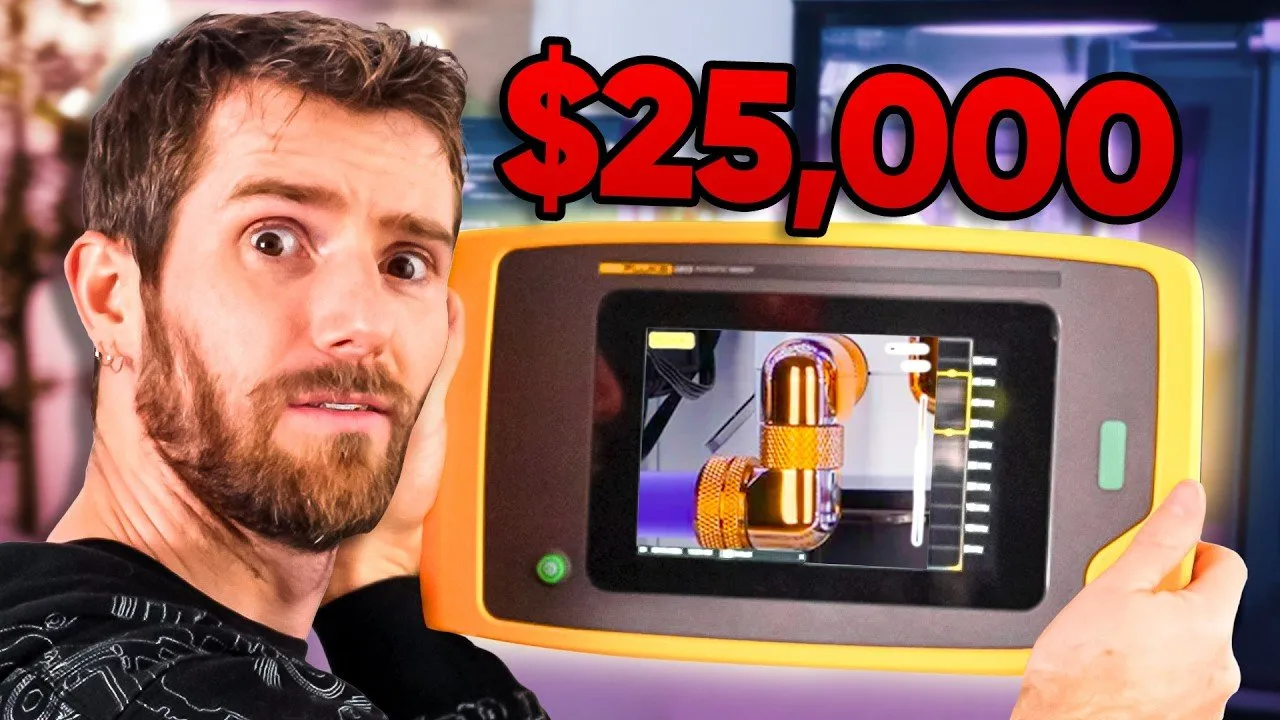
"This $25,000 handheld camera does not work like a normal camera... instead, it takes in sound and uses it to find leaks and equipment malfunctions, even detecting noises beyond the range of human hearing," the report noted during a demonstration of the hardware's capabilities.
Economic Implications and Energy Efficiency
For large-scale manufacturing and workshop environments, compressed air is a vital but expensive utility. Undetected leaks represent a direct drain on profitability. Testing revealed that even a minor, localized air leak can result in an estimated loss of $45 per year. In a facility with dozens or hundreds of such leaks, the cumulative waste can reach thousands of dollars annually, often justifying the high capital expenditure of specialized detection equipment.
The LeakQ mode simplifies the business case for these tools by automating the financial analysis. By inputting energy costs and compressor specifications, operators can prioritize repairs based on the severity and cost-impact of each leak. This transition from reactive to proactive maintenance ensures that the most "expensive" problems are addressed first, optimizing the maintenance budget and reducing the carbon footprint associated with wasted energy.
Broadening Industrial Applications
While leak detection remains the primary use case, the versatility of acoustic imaging extends into electrical and mechanical sectors. The technology is particularly effective at identifying partial discharge in utility infrastructure. This phenomenon, which can precede catastrophic failure in power lines and transformers, is often audible in the ultrasonic range long before it becomes visible or causes a system trip.
Furthermore, the MecQ functionality targets the mechanical health of assembly lines. By identifying the specific acoustic signature of a failing bearing, technicians can schedule repairs during natural downtime. This prevents the "cascading failure" scenario where a single worn component leads to an emergency shutdown. The technology also proves useful in electronics development, where it can pinpoint the source of coil whine—vibrations in power delivery components—helping engineers refine board designs for quieter operation.
"A really cool application for acoustic imagers is identifying problems with transmission towers at a distance, say from the ground. It apparently works at up to 120 m or 393 ft and can be used to detect partial discharge or arcing."
As the market for acoustic imaging matures, the entry of more varied hardware options—ranging from the high-end Fluke series to modular, open-source systems like the Centenna—suggests that sound-based diagnostics will become a standard component of the industrial toolkit. Companies looking to integrate these tools must now decide between the turn-key reliability of established brands or the customizable potential of emerging open-source platforms to secure their infrastructure against the "invisible" costs of system degradation.