Table of Contents
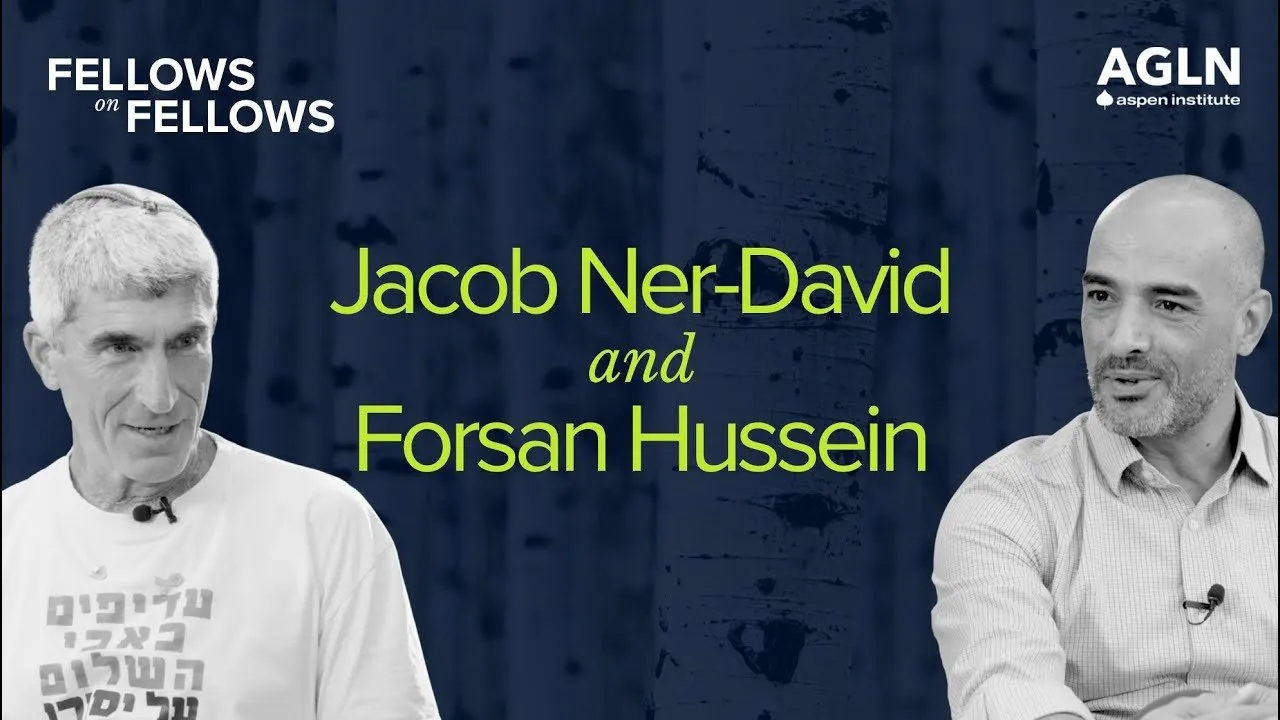
In a region often defined by entrenched narratives and cyclical violence, the choice to see the humanity in the "other" is a radical act. The conversation between Forsan Hussein, a Palestinian citizen of Israel, and Jacob Ner-David, an American-born Israeli Jew, offers a profound case study in this resilience. Brought together by the Aspen Institute’s Henry Crown Fellowship, these two entrepreneurs have moved beyond coexistence into deep partnership, navigating the complexities of identity, business, and the trauma of conflict.
Their dialogue reveals that peace is not merely a political agreement signed by leaders, but a daily practice of empathy, economic cooperation, and the stubborn refusal to inherit a broken world. Below, we explore their shared journey from separate bubbles to a unified mission of shared humanity.
Key Takeaways
- Narratives change through proximity: Stereotypes are often cemented by isolation; simple human encounters can shatter decades of indoctrination.
- Entrepreneurship as a bridge: Business ventures create pragmatic interdependence, offering a "country code" for connection where politics often fails.
- Resilience requires intentionality: During moments of extreme trauma, such as October 7th, maintaining cross-cultural relationships requires active work to resist the retreat into tribalism.
- Dual-track peace is essential: Grassroots "people-to-people" processes are vital, but they must be matched by political engagement to effect sustainable change.
Breaking the Single Narrative
Both men grew up in environments that could have easily led to permanent estrangement. Forsan describes growing up with a "single narrative" in a village surrounded by Jewish settlements he was forbidden to enter. To a young boy witnessing the conflict through Arab media, the Jewish Israeli was solely an occupier or an enemy soldier.
However, the architecture of hate is often fragile. For Forsan, the paradigm shift occurred during a childhood incident where he trespassed into a neighboring Jewish moshav to retrieve a wayward sheep. Instead of the violence he expected, he was met with kindness—and a chocolate chip cookie—from a religious Jewish man who resembled his own grandfather.
"That really changed my life... Only then did I start asking questions and questioning my own narrative that really set me on that journey."
Conversely, Jacob’s upbringing in New York was steeped in "organic Zionism" and a Jewish bubble. Yet, his father modeled a different approach by maintaining close friendships with non-Jews, including Egyptian academics. This foundation allowed Jacob, upon moving to Jerusalem, to traverse the invisible lines of the city. While others saw borders between neighborhoods, Jacob saw a city to be explored, running and biking through areas most Israelis avoided.
Economic Interdependence as a Tool for Peace
While dialogue is crucial, Forsan and Jacob emphasize the stabilizing power of economic interdependence. They argue that shared business interests create a fabric of reality that is harder to tear apart than abstract political agreements.
The Role of Entrepreneurship
Both men have leveraged their backgrounds in technology and business to foster connection. They cite Zetun Ventures, a company created to build an interconnected Middle Eastern economy, as a prime example of this philosophy. The logic is straightforward: when people work together, the "other" becomes a partner rather than an existential threat.
Jacob recounts a specific instance from his time in the telecommunications sector. Realizing that Palestine lacked a functional country code, which hindered business and dignity, he utilized technology to turn on a country code overnight. This allowed for cheaper calls and a sense of national pride, bypassing bureaucratic hurdles to create immediate value.
From Tech to Agriculture
This philosophy extends to their current endeavors. Jacob’s winery in the Jezreel Valley is a partnership with a Palestinian Christian, Sami Abu Daoud. The winery’s very name was suggested by Sami, illustrating how shared ownership fosters a shared narrative. Similarly, Forsan’s olive oil production serves as a cultural currency, something to be exchanged and shared, symbolizing a connection to the land that predates modern political borders.
Navigating Trauma and the "Us vs. Them" Mentality
The events of October 7th and the ensuing war served as a severe stress test for all cross-cultural relationships in the region. Both men acknowledge the immense difficulty of maintaining empathy when communities retreat into defensive postures.
Forsan speaks candidly about his disappointment in the aftermath of the attacks. He noted that many Jewish partners, with whom he thought he shared deep values, retreated into a tribal "us vs. them" mentality, demanding proofs of loyalty rather than offering mutual support.
"If you are not part of the solution, then somehow you're contributing to the complexity of the problem... I feel like I cannot afford being depressed, being angry, not being productive."
The Philosophy of Reaction
Jacob counters the impulse for immediate retribution by citing his teacher, the late Rabbi David Hartman. Hartman famously noted that his political reaction to a terror attack depended on when he was asked—immediate rage would eventually give way to a renewed desire for peace.
This philosophy guided Jacob’s actions on October 7th. Rather than succumbing to the divisiveness of the moment, one of his first calls was to the mayor of a neighboring Arab town, Kafr Manda, to ensure their local ecosystem of coexistence remained intact. This act highlighted a complex reality: the town had citizens serving in the Israeli army, but also residents with family in Gaza. In such a tangled web of relations, binary thinking fails; only human connection sustains.
The Responsibility of Leadership
A recurring theme in their dialogue is the transition from "success to significance." It is not enough to build successful companies; leaders must leverage their influence to shape the political landscape. Both men critique the tendency of "peace camps" to focus solely on grassroots dialogue without getting their hands dirty in politics.
Forsan argues for a dual-track approach:
- A People’s Peace Process: Bottom-up shifts in mindsets and hearts, fostering empathy and understanding.
- Political Leadership: Top-down engagement that secures the framework for peace.
They admit that relying on one without the other is insufficient. The "peace agreements" of the past failed because they were signed by leaders but ignored by the populace. Conversely, grassroots movements struggle to survive when political leadership actively fans the flames of conflict.
Conclusion: Optimism as a Strategy
Despite the bleakness of the current geopolitical climate, both Forsan and Jacob refuse to surrender to despair. Their optimism is not naive; it is a calculated strategic choice driven by their responsibility to their children.
Forsan reflects on his own journey, noting that he never imagined he would be raising his children in a reality as broken as the one he sought to fix at age ten. This realization fuels a relentless drive to model a different life—one where commonalities exceed differences. For Jacob, the diverse tapestry of his family and his neighbors serves as a constant reminder that everyone is created in the image of God.
Ultimately, their fellowship demonstrates that while we cannot control macro-political events, we have absolute agency over how we relate to our neighbors. As Forsan concludes, in a region where no one is going anywhere, we are destined to share the land. The only choice left is whether to share it in misery or in partnership.