Table of Contents
The journey from professional success to deep social significance is rarely a straight line. It requires what Aspen Institute Fellows describe as an inflection point fueled by "conviction and courage." For many leaders established in the corporate or media worlds, the transition to social entrepreneurship isn't just about a career change; it is about confronting a crisis of purpose. Whether it is tackling the entrenched practice of child marriage in Northern India or combatting misinformation through data journalism, the leap requires moving beyond collecting ideas to taking tangible action.
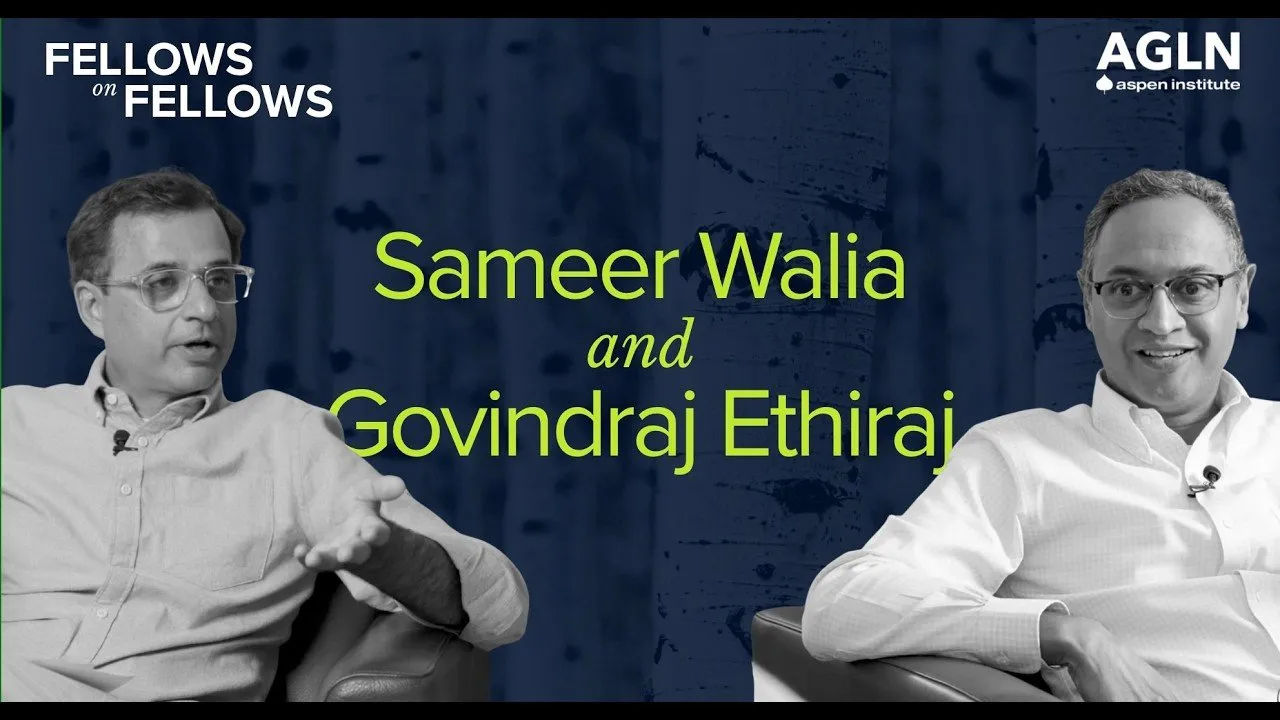
Two leaders who have made this transition are Samir Valia, a former management consultant and entrepreneur, and Govindraj Ethiraj, a veteran journalist and founder of IndiaSpend and BOOM. Their dialogue reveals that solving systemic problems often requires "lateral fixes"—unconventional approaches that address root causes through unexpected pathways, such as using sports to delay marriage or data evidence to influence public policy.
Key Takeaways
- The Pivot to Significance: Moving from corporate success to social impact requires a "leap of faith" driven by moral clarity and the willingness to leave behind established safety nets.
- Lateral Solutions work best: Deep-rooted social issues often respond better to indirect interventions—such as building toilets to improve school attendance or using sports to build confidence—rather than direct confrontation alone.
- Data over Rhetoric: In an era of polarization, fact-based, data-driven journalism is more effective at influencing government policy than emotional activism.
- The Universality of Parenting: Contrary to assumptions about culture or patriarchy, parents globally want the best for their children; often, economic constraints and safety concerns, rather than malice, drive negative outcomes like early marriage.
- The Criticality of Support Systems: The transition to social leadership is emotionally taxing, making personal support networks—particularly spouses and peer communities—essential for resilience.
From Corporate Success to "The Leap of Faith"
For many professionals, the first decade or two of a career is defined by competence and accumulation. Samir Valia spent ten years in management consulting and nearly two decades building and selling a successful analytics company. Govindraj Ethiraj spent over 25 years in mainstream journalism, working with major networks like Bloomberg and CNBC.
However, the transition to social impact often stems from a realization that professional success does not equate to solving foundational human problems. This shift is often described as the "success to significance" arc. Valia notes that while his corporate life was rewarding, the "dirty work" of implementation—actually making things happen rather than just advising—was what drove him. This eventually led him to liquidate his commercial ventures to self-fund a grassroots organization focused on gender equity.
I think the biggest triggers and the biggest inspiration inflection points are really to do with conviction and courage... finally, what is it that makes you take the leap?
For Ethiraj, the realization came from the limitations of traditional financial journalism. Despite doing hard-hitting stories, he felt the "needle wasn't moving" on India's most critical issues: education, health, and gender. This prompted the creation of non-profit platforms focused purely on data and evidence, stripping away the distortions often introduced by advertising-driven media models.
Addressing Systemic Issues Through Lateral Fixes
One of the most profound insights shared by both leaders is the concept of the "lateral fix." Complex socio-economic problems are rarely solved by attacking the symptom directly; they require addressing the environmental factors that allow the problem to persist.
Sports as a Vehicle for "Ungendering"
Valia’s organization works in Northern India, a region where, in certain demographics, statistics suggest four out of five girls are married before the legal age of 18. Rather than strictly campaigning against early marriage, Valia utilizes sports as a primary intervention tool. The logic is rooted in confidence and agency.
When adolescent girls play team sports like volleyball or cricket, they develop a physical and mental confidence that changes how they carry themselves. More importantly, it forces a shift in community perception. This process, which Valia terms "ungendering," aims to get parents and the community to view girls with the same potential and agency as boys.
Infrastructure as a Barrier to Education
Ethiraj highlights a similar phenomenon in the education sector. A decade ago, data journalism revealed that a primary driver for girls dropping out of school was not solely cultural pressure, but a lack of infrastructure—specifically, the absence of toilets. Once girls reached puberty, the lack of private sanitation facilities made attending school impossible.
Some of the fixes for these problems are lateral... We think we need more money... but some of these fixes like sports to me is an amazing lateral fix to the problem.
In both instances, the solution wasn't a direct lecture on morality. Instead, providing facilities (toilets) or opportunities (sports) removed the logistical and psychological barriers preventing girls from succeeding.
The Power of Evidence-Based Journalism
In a global environment characterized by polarization and misinformation, the role of media has shifted. Ethiraj argues that activism without evidence is easily dismissed by those in power. However, "sharp issues" backed by irrefutable data are harder to ignore.
When journalism focuses on foundational issues—like menstrual health challenges or sanitation statistics—and presents them without an agenda to humiliate the administration, policymakers are often receptive. They rely on this external data to understand ground realities that their own bureaucracies may obscure.
Navigating Pressure and Misinformation
The challenge for modern leadership is not just gathering data, but navigating an information ecosystem that is increasingly hostile to dissent. Ethiraj notes that while there is pressure on media organizations, a rigorous adherence to facts provides a shield. When stories are authentic, researched, and provide subjects ample time to respond, it builds respect even among detractors.
Furthermore, the battle is now shifting toward the intersection of technology and society. The focus is no longer just on correcting false news but on educating the next generation on how to consume the internet safely, ensuring that digital tools aid progression rather than cognitive decline.
Challenging Assumptions About Patriarchy and Parenting
A common narrative in social work is that parents in marginalized communities are the antagonists in their children's stories. Valia’s fieldwork contradicts this. He asserts that parents globally—regardless of economic status—desire the best for their offspring. The decisions to pull a girl out of school or marry her off early are often driven by crushing economic realities or safety concerns, not malice.
Ethiraj reinforces this with an example from Haryana, where parents prevented a qualified female engineer from taking a job solely because the commute was unsafe. The barrier was not a lack of aspiration, but a lack of safe transport and security.
Recognizing this intent allows social entrepreneurs to work with communities rather than against them. When parents see their daughters succeed in sports—traveling to block-level or state-level tournaments—their pride is evident. This shift in parental perspective is a critical metric of success, proving that agency can be cultivated even in deeply patriarchal structures.
Conclusion: The Courage to Show Up
The transition from a structured corporate career to the messy, complicated world of social impact is fraught with despair and difficulty. There are no quarterly earnings reports to validate success, and the impact often takes a generation to materialize. Leaders in this space must rely on "moral courage" and the discipline to simply show up every day.
Both Valia and Ethiraj emphasize that this journey is unsustainable without a "net"—a support system comprising spouses, mentors, and networks like the Aspen Institute. These connections provide the emotional resilience required to take risks. Ultimately, the work is about legacy and significance: using one's accumulated skills not just to generate wealth, but to dismantle barriers for those who have been left behind.