Table of Contents
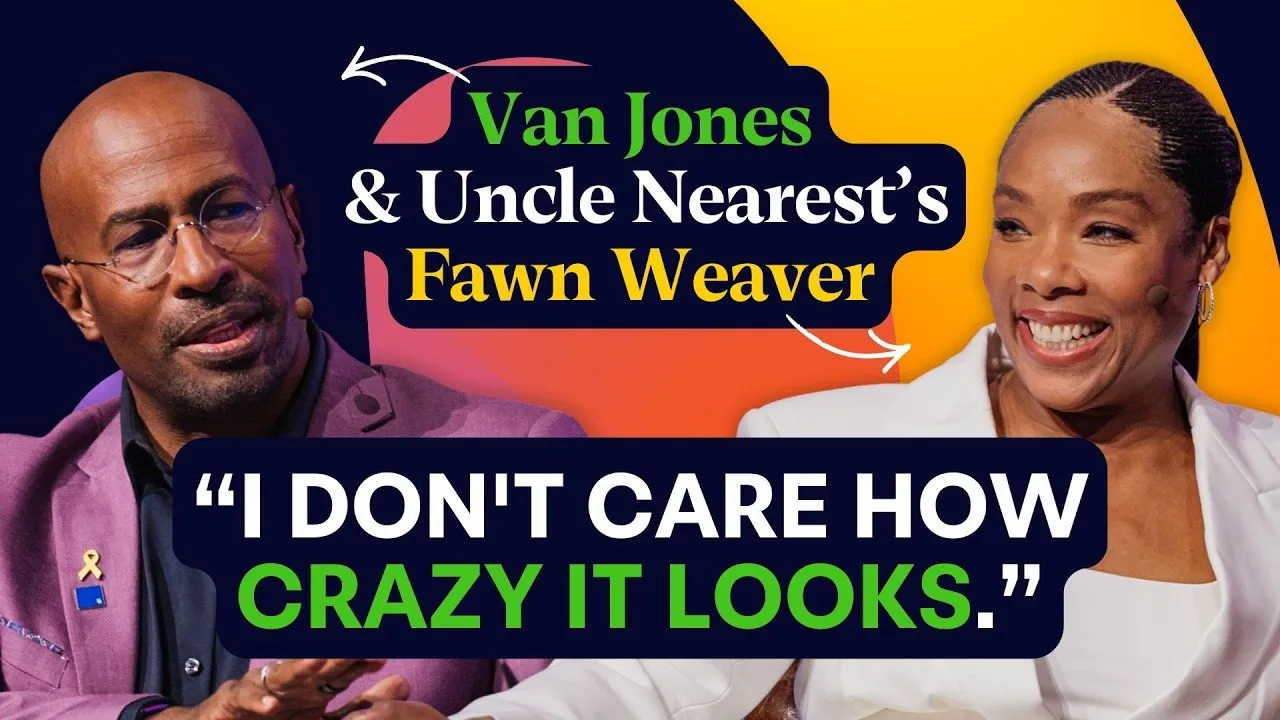
When Fawn Weaver launched Uncle Nearest Premium Whiskey, she didn’t just create a spirit brand; she ignited a movement that rewrote American history. As the first Black woman to build a billion-dollar spirit business from the ground up, Weaver’s approach to entrepreneurship defies the standard Silicon Valley playbook. In a candid conversation with CNN host Van Jones at the Masters of Scale Summit, Weaver dismantled the myths surrounding the fear of failure, the necessity of mentorship, and the separation of business and personal life.
Weaver’s philosophy is rooted in radical authenticity and a deep study of historical titans rather than contemporary trends. Her journey offers a masterclass in scaling a business without losing one's soul, proving that the most sustainable competitive advantage is a founder’s ability to remain open, loving, and entirely unafraid of public scrutiny.
Key Takeaways
- The fear of failure is a misnomer: Most entrepreneurs are actually paralyzed by the fear of public embarrassment, not the failure itself.
- History reveals the blueprint: Weaver relies on the biographies of past industrial titans (like Carnegie and Rockefeller) rather than living mentors to guide her strategic decisions.
- Allyship drives the narrative: The success of Uncle Nearest is built on a story of love and honor between Jack Daniel and Nearest Green, distinguishing it from typical narratives of exploitation.
- Data cannot replace wisdom: Modern companies risk becoming "data smart and people stupid" by prioritizing metrics over human connection.
- Rejection is redirection: Adopting a mindset where a "no" is viewed as divine intervention protects a founder’s confidence and keeps them open to new opportunities.
Deconstructing the Fear of Failure
One of the most pervasive narratives in entrepreneurship is that founders hesitate to scale or launch because they are afraid of failing. Weaver challenges this psychological assumption, arguing that the true inhibitor is vanity rather than risk aversion. If an entrepreneur were to try a venture in a vacuum—where no one else knew of the attempt—the sting of failure would be negligible. The paralysis comes from the audience, not the outcome.
It's not really a fear of failure. It's a fear of public embarrassment of people knowing that you failed.
This distinction is critical for leaders. When a founder detaches their self-worth from public perception, they unlock the freedom to take calculated risks that others avoid. Weaver’s rapid ascent with Uncle Nearest was fueled by this indifference to external judgment. By accepting that she might have to "build it again" if things fell apart, she removed the emotional stakes that typically cloud decision-making.
The Danger of the Shame Button
In the age of social media and hyper-visibility, the "shame button" is easily pressed. Founders often curate a persona of invincibility, which makes the prospect of a public stumble terrifying. Weaver’s counter-strategy is radical transparency. By refusing to guard her reputation or manage an ego, she eliminates the leverage that fear holds over her. This "Olivia Pope era" of fixing problems with confidence stems from a belief that public embarrassment is a necessary rite of passage for achieving extraordinary scale.
Reframing History Through the Lens of Allyship
The origin story of Uncle Nearest Premium Whiskey is not merely a marketing tactic; it is a correction of the historical record regarding American whiskey. For decades, the contributions of Nearest Green, the first known African American master distiller, were obscured. When a 1904 photo surfaced showing Jack Daniel seated next to an African American man, many assumed the standard narrative of the era: exploitation.
Weaver’s analysis of the visual hierarchy in that photograph revealed a different truth. In the Jim Crow South, Jack Daniel—the owner—stepped out of the center position to give it to George Green, Nearest’s son. This visual evidence suggested honor, respect, and allyship rather than theft.
If you want to hide an enslaved man or his children, what you don't do is put him as the center of a photograph.
Weaver understood that America has an "underbelly of race" that usually provokes a defensive reaction. By choosing to highlight the story of Jack Daniel as a business ally rather than a villain, she created a brand narrative centered on love and unity. This approach allowed the brand to transcend demographic divides, appealing to a broad spectrum of consumers who wanted to participate in a story of reconciliation and excellence.
The Titan Blueprint vs. Modern Mentorship
In a business culture obsessed with networking and mentorship, Weaver takes a contrarian stance. She frequently declines requests to mentor others and rarely seeks mentorship for herself. Her reasoning is pragmatic: living mentors are still fallible humans who may be successful in business but disastrous in their personal lives. A mentor with a broken marriage or estranged children offers a blueprint that Weaver refuses to follow.
Learning from the Dead
Instead, Weaver turns to the "Titans"—historical figures whose lives and careers have concluded. By studying the biographies of industrialists like Andrew Carnegie and Reginald Lewis, she gains a complete picture of the cause-and-effect relationships in their strategies. She notes that current business challenges are rarely unique; they are simply recurring patterns that have been solved before.
For example, when Carnegie faced public skepticism about the safety of his steel bridge, he orchestrated a PR stunt involving an elephant to prove its stability. Weaver applies these historical lessons to the spirits industry, recognizing that brilliant PR and bold moves are timeless mechanics of scale. This method allows her to extract business wisdom without inheriting the personal dysfunction often found in high-performing contemporaries.
Radical Authenticity as a Competitive Advantage
Van Jones likened Weaver’s presence to that of the late musical icon Prince, describing a rare quality of being "free." In the corporate world, this freedom manifests as a lack of separation between the professional and the personal self. Most founders exhaust significant energy maintaining a "representative"—a polished, guarded version of themselves for investors and the public.
Weaver argues that this bifurcation creates a hole in the heart of leadership. The tech industry, in particular, is producing companies that are rich in data but poor in wisdom because their founders have sacrificed personal integration for professional output. By showing up as herself—whether in a boardroom or a casual setting—Weaver fosters trust and connection that sterile professionalism cannot replicate.
We weren't placed on earth to build. We were placed on earth to love. And if the building supersedes the love, you are going to walk around empty.
This integration serves as a stress-management tool. Weaver utilizes biometric tracking (via an Oura ring) to monitor her stress levels, consistently remaining in a "restored" or "engaged" state even during high-pressure crises. This physiological resilience is a direct result of having "no walls" and nothing to hide.
Resilience and the "Divine No"
Every entrepreneur faces rejection, but the interpretation of that rejection dictates their longevity. Weaver employs a theological framework to process the word "no." Drawing on the biblical narrative of Moses and Pharaoh, she views rejection not as the stubbornness of a gatekeeper, but as a divine intervention designed to redirect her path.
In the story, every time Pharaoh considered saying yes, his heart was hardened by God to ensure the Israelites left entirely, not just partially. Weaver applies this to venture capital and partnerships: if a potential investor declines, she assumes they are not part of her destiny. This cognitive reframing prevents bitterness and keeps her open to the next opportunity.
By removing the ego from the equation, she ensures that a "no" never results in a closed heart. In an industry where fundraising and scaling are fraught with friction, this ability to remain emotionally open is perhaps the most critical factor in her ability to endure and thrive.
Conclusion
Fawn Weaver’s success with Uncle Nearest is a testament to the power of rewriting the rules. By rejecting the fear of public embarrassment, finding wisdom in history rather than hollow networking, and prioritizing love over raw data, she has built a company that is both economically massive and culturally significant. Her journey suggests that the ultimate scale is not just revenue, but the ability to build an extraordinary life alongside an extraordinary business.