Table of Contents
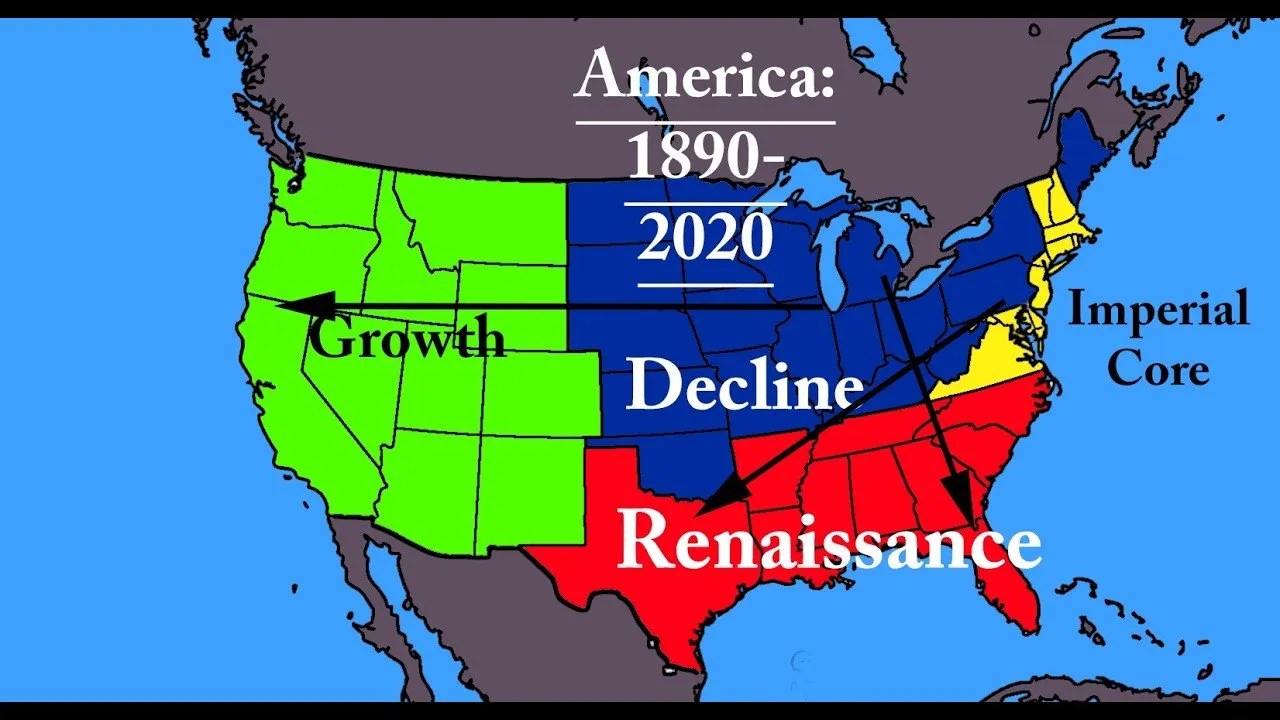
Most discussions about American history divide the timeline by wars or presidencies. However, to truly understand the structural forces shaping modern life, it is more effective to look at the rise of organizational systems. This is the "Corporate Era" of America—a period stretching from the end of the 19th century to the present day.
This era is defined not just by the existence of businesses, but by a fundamental shift in how society is structured: from local, independent ownership to a vast, interlocking system of managerial bureaucracies. By analyzing the insights of thinkers like Sam Francis, Houston Smith, and David Riesman, we can uncover how this transition has altered everything from our economic incentives to our psychological landscapes.
Key Takeaways
- The Shift from Ownership to Management: The Defining feature of the 20th century was the transfer of power from local founders and distinct social elites to a "managerial class" that wields authority without the traditional responsibilities of ownership.
- History as a Double Helix: Contrary to the linear view of "progress," history operates like a double helix; while technology and wealth may improve linearly, moral character and social cohesion move in cycles, often regressing as material wealth peaks.
- The Psychology of the "Lonely Crowd": Modern urbanization created a shift from "inner-directed" individuals (motivated by conscience and honor) to "other-directed" individuals (motivated by anxiety and peer approval), fundamentally changing the American character.
- The Vacuum of Nihilism: The mid-20th-century embrace of nihilism—under the guise of tolerance—dismantled the West’s cultural immune system, allowing bureaucratic and Marxist ideologies to capture institutions.
The Rise of the Managerial Elite
To understand the political friction of today, one must look back to the structural revolution of the late 19th and early 20th centuries. In 1920, approximately 80% of Americans worked for small businesses or were self-employed. By 1990, self-employment had plummeted to roughly 10%. This was not merely an economic statistic; it represented the death of a specific way of life.
In the 19th century, power was local. A factory owner in a Pennsylvania town held authority, but he was also embedded in the community's social fabric. This system was replaced by national conglomerates and the rise of what political theorist Sam Francis termed the managerial class.
The Separation of Ownership and Control
The crucial distinction in this new era is the separation of ownership from control. The old "Wasp" elites (White Anglo-Saxon Protestants) and industrial founders owned their companies and bore the financial risks. The new elite—CEOs, bureaucrats, and administrators—manage institutions they do not own.
"The managerial class seized social authority but they were not in positions of responsibility... systems are always more predatory than individuals."
This disconnect created a unique form of resentment. The managerial class, lacking the legitimacy of the founding families, often defined themselves in opposition to the very cultures that built the institutions they now ran. This is why we observe modern bureaucracies frequently attacking the heritage and values of their own organizations' founders.
The Double Helix of Progress
A common modern fallacy is the belief in inevitable, linear progress. However, scholars of comparative religion like Houston Smith argue that history is better visualized as a double helix.
One strand of the helix represents material and technological development, which does tend to improve linearly over time. We are wealthier and healthier than our ancestors. The second strand, however, represents human nature, morality, and social cohesion. This strand is cyclical. A society can be at its technological peak while simultaneously being in a spiritual or cultural dark age.
Universal Recurrence
Truth and value are often determined by "universal recurrence"—ideas and structures that successfully reappear across different civilizations and eras, such as the concept of the family unit or natural law. The Corporate Era, however, has been characterized by a "Great Forgetting."
In the rush toward industrialization and global dominance, America shed vast amounts of social technology—traditions, mating norms, and religious foundations—that had sustained Western civilization for centuries. We traded these intangibles for material comfort, resulting in a society that is rich in goods but poor in meaning.
The Failed Marriage of Red and Blue America
The cultural polarization seen in the United States today can be framed as a divergence in psychological operating systems, predicted decades ago by sociologist David Riesman in The Lonely Crowd.
Inner-Directed vs. Other-Directed
Riesman categorized the traditional American character as inner-directed. These individuals, often found in the frontier or rural areas (and today's "Red States"), operated on an internal gyroscope of principles, honor, and conscience. They were less concerned with fitting in than with being "right" according to their code.
Conversely, the corporate and urban environment bred the other-directed personality. This type, dominant in coastal cities ("Blue States"), is driven by anxiety and the desire for group approval. In a corporate bureaucracy, standing out is dangerous; survival depends on consensus and navigating complex social signaling games.
This created a "failed marriage" between two distinct cultures:
- The Interior (Red): Retains a pre-modern, masculine code of honor, valuing independence and agency.
- The Coasts (Blue): Adopted a "mouse utopia" psychology, characterized by hyper-socialization, safetyism, and a feminine approach to power that relies on manipulation rather than direct authority.
Nihilism and the "Age of the Last Man"
The philosophical undercurrent of the Corporate Era has been nihilism. In the mid-20th century, the American elite—largely liberal and pragmatic—embraced a form of "value-neutrality" to manage a diverse, democratic society. The logic was that if the state believed in nothing specific, it could offend no one.
However, nihilism is not a neutral position; it is a vacuum. As James Burnham argued in Suicide of the West, liberalism functions as the ideology of Western suicide because it lacks the conviction to defend its own civilization. By refusing to assert positive values, the liberal elite created an opening for more aggressive ideologies—specifically mutated forms of Marxism—to capture institutions.
"Nihilism is not a real philosophic position. It is an intellectual cry for help... If you break the age of the last man, you win everything."
This culminated in what Friedrich Nietzsche called the "Age of the Last Man"—a society obsessed with comfort, safety, and sterility, devoid of great ambitions or overcoming struggles. The current cultural stagnation is the direct result of a century spent prioritizing security over vitality.
Cultural Reflection: From the Hays Code to American Beauty
The trajectory of Hollywood serves as a perfect microcosm for the Corporate Era. Initially, Hollywood operated as an outsider industry, often producing morally ambiguous content. The introduction of the Hays Code forced a synchronization with Middle American values, leading to a "Golden Age" of cinema that respected the audience's moral framework.
However, as the managerial elite grew more insulated, the dynamic shifted. By the late 1990s, films like American Beauty began to signal the cracks in the facade. The film depicted a material paradise where every character was internally miserable—trapped in sexless marriages, meaningless jobs, and performative suburban lives.
Today, that disconnect has widened into open contempt. Modern corporate media often acts like a "decadent oriental court," producing content that actively mocks or deconstructs the values of its own audience. This hostility is a symptom of a ruling class that has lost its tether to the population it is supposed to serve.
Conclusion
The Corporate Era of America delivered unprecedented material wealth and global dominance, but it demanded a heavy price: the erosion of individual agency, the loss of organic community, and the rise of a stifling managerial bureaucracy. We are currently living through the friction of this cycle ending.
However, the existence of these cycles offers hope. The "Age of the Last Man" is fragile because it suppresses human nature. History is not static; it is a double helix that allows for renewal. By understanding the mechanisms of the managerial class and rejecting the paralysis of nihilism, it is possible to break the cage and initiate a new cycle of genuine growth and vitality.