Table of Contents
While history often focuses on the triumphs of the 20th century—the technological leaps, the spread of democracy, and the rise of global prosperity—there is a darker, often overlooked narrative that played out in the heart of the Old World. The events that transpired in Eastern Europe between 1900 and 2000 represent a civilizational catastrophe equivalent to the Fall of Rome or the Bronze Age Collapse. This was not merely a series of wars; it was the systematic dismantling of an entire cultural sphere, a "sentient tragedy" where highly intelligent, modernized societies descended into the deepest pits of totalitarianism and moral failure.
To understand the modern geopolitical landscape, we must look beyond the standard Western curriculum. We must analyze the collision of feudalism with rapid industrialization, the psychological shock of mass politics, and the brutal efficiency of the regimes that filled the void left by fallen empires. This is an exploration of how the intellectual and spiritual heart of Europe was hollowed out, and why the scars of that century still define the continent today.
Key Takeaways
- A Civilizational Collapse: The destruction of Eastern Europe in the 20th century is arguably the greatest tragedy in human history, knocking out a vibrant, culturally distinct area of the world and leaving a legacy of stagnation.
- The Shock of Modernity: The rapid transition from medieval peasant life to industrialized warfare created a psychological break, leading populations to embrace totalitarianism as a way to manage the friction of modern mass society.
- The Vacuum of Authority: The collapse of the traditional monarchies (Russia, Prussia, Austria) removed the social "immune systems" that protected these nations, allowing bureaucratic tyrannies to seize absolute power.
- The Failure of the Nobility: Traditional elites failed to adapt to mass politics, creating an opening for "Caesarist handlers" and demagogues to hijack the state using modernist ideologies like Fascism and Communism.
- The Depth of the Trauma: The violence of the Eastern Fronts in both World Wars, combined with the purges of Stalin and Hitler, physically wiped out the "natural elites"—the artists, intellectuals, and officers—resulting in a profound, long-term cultural lobotomy.
The Hermetic Pressure of Modernization
One of the most profound lenses through which to view 20th-century Eastern Europe is the concept of "Hermetic pressure"—the inescapable force of the industrial revolution. While the Anglo-Saxon world invented industrial modernity and adapted to it organically, Eastern Europe had it thrust upon them. You had populations where the peasantry lived in Neolithic conditions, unable to read a clock, suddenly drafted into mechanized warfare involving tanks, airplanes, and complex logistics.
This rapid shift created a psychological and sociological fracture. When a society bypasses the organic "bourgeois capitalist" phase—which instills values of rule of law and individual agency—and jumps straight to state-managed industrialization, the result is often catastrophe. The following dynamics defined this transition:
- The Rejection of Industry: Large bureaucratic societies like Russia and China initially adopted Leftism as a way to reject the chaotic freedom of the industrial revolution, while nations like Germany and Japan adopted Right-wing authoritarianism for similar reasons—to control the disruption.
- The Loss of Lived History: In classical eras, "lived history" (the rate of cultural change) was high, generating philosophy and art. In the 20th century, the pressure to conform to mass industrial standards sterilized this cultural output.
- The Literacy Gap: In 1900, literacy was high in Protestant countries and France but abysmal in Eastern Europe. The transition to mass literacy was managed by the state, often for the purpose of propaganda rather than enlightenment.
- Barrington Moore’s Thesis: Historian Barrington Moore argued that if a society transitions to modernity via a capitalist agricultural structure, it becomes a democracy. If the peasantry interfaces directly with the government rather than a landlord class, the society tends toward Marxism or totalitarianism.
- Bureaucratic Usurpation: Modernist utilitarian ideologies often emerge at the exact moment the bureaucracy realizes it no longer needs the King. The state apparatus becomes a power unto itself, discarding tradition for efficiency.
- The Anglo-Saxon Outlier: The merchant-dominated societies of the West are historical anomalies. In Eastern Europe, the absence of a strong native merchant class meant that military and state structures were the only organizations capable of managing the transition to the modern world.
The second you create a bureaucratic office that is power parallel to the king, the bureaucracy realizes it's the one in charge and kills the king.
The Collapse of the Three Empires
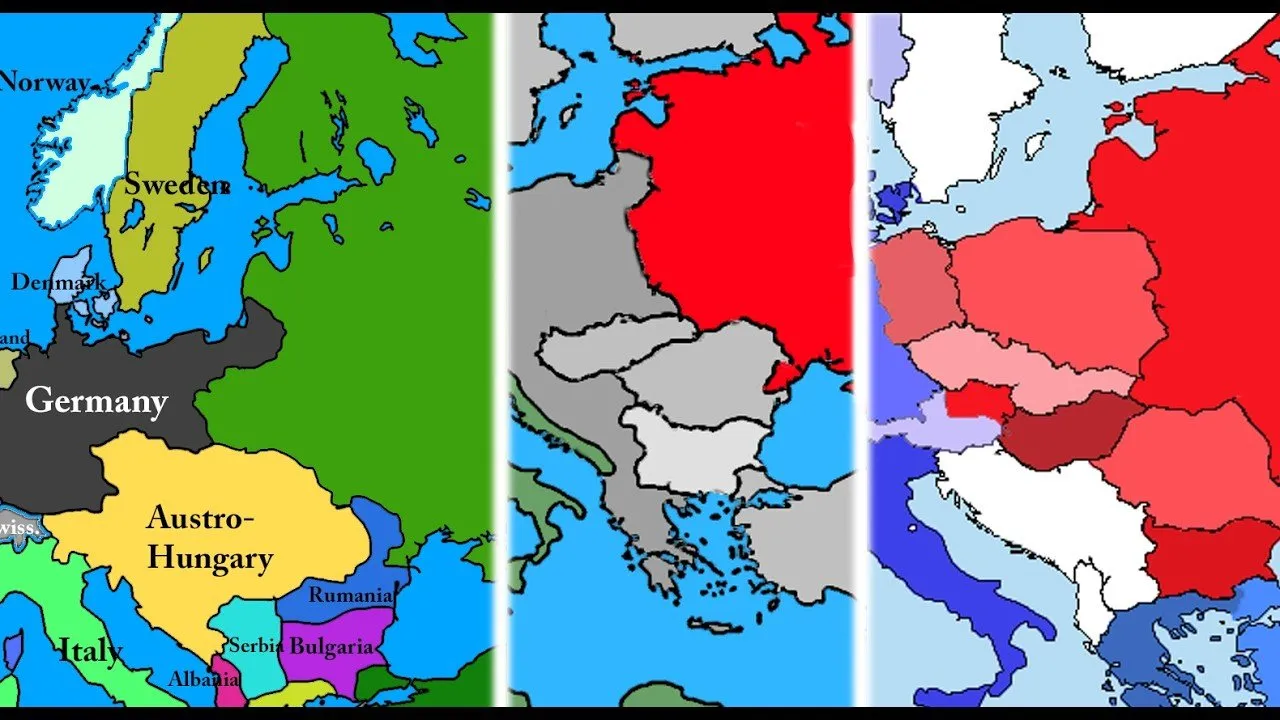
In 1914, Eastern Europe was stabilized by three great empires: Russia, Prussia (Germany), and Austria-Hungary. These were not merely political entities; they were civilizations that managed immense ethnic diversity. The collapse of this order did not lead to freedom, as Woodrow Wilson’s doctrine of self-determination hoped, but to a violent free-for-all that the region has scarcely recovered from.
The Austrian Empire, in particular, is often remembered unfairly. For many ethnic minorities, including Jews and various Slavic groups, the Habsburg monarchy provided a "passive civility" and a cosmopolitan framework that allowed culture to flourish. The disintegration of these empires unleashed chaos:
- The Balkan Powder Keg: The decline of the Ottoman Empire left a power vacuum in the Balkans. The resulting "Balkan Wars" were a prelude to WWI, characterized by ethnic cleansing and the inability of small ethnostates to coexist peacefully.
- The Problem of Ethnostates: Unlike the multi-ethnic empires, the new nations carved out of the map demanded homogeneity. This led to the violent shuffling of populations—Greeks, Turks, Hungarians, and Poles—often culminating in genocide.
- Serbian Agitation: The immediate cause of WWI lay in Serbia's aggressive, state-sponsored terrorism against Austria-Hungary. The assassination of Archduke Franz Ferdinand was an attack on the very concept of imperial legitimacy and multi-ethnic harmony.
- The "Map" Problem: The borders drawn after WWI were often arbitrary, splitting organic economic and cultural zones. This left millions of ethnic minorities (like Germans in Poland or Hungarians in Romania) on the "wrong" side of the border, creating immediate revanchist grievances.
- The Loss of the "Good Soldier": The Austrian military, despite its inefficiencies, fostered a unique culture of loyalty to the Emperor that transcended language barriers. Its collapse meant the loss of a unifying symbol for Central Europe.
- The German Vacuum: The fall of the German and Austrian monarchies removed the conservative "brake" on society. Without the nobility to guide the state, the masses turned to radical ideologies to fill the spiritual and political void.
The Eastern Front: A War of Movement and Horror
While the Western Front of World War I is remembered for the static horror of trench warfare, the Eastern Front was a dynamic, fluid conflict that reshaped the geography of the continent. It was here that the true scale of the tragedy began to unfold. The war in the East was not just armies fighting armies; it was the total breakdown of societal function.
The sheer incompetence of the Tsarist Russian military, juxtaposed against the terrifying efficiency of the German war machine, set the stage for the Bolshevik Revolution. The events on this front broke the back of the old order:
- The Battle of Tannenberg: A seminal moment where the German military, outnumbered significantly, utilized superior organization to annihilate the invading Russian armies. This victory prevented a Russian occupation of Berlin but also fed the German myth of military invincibility in the East.
- Institutional Rot: The Russian military was plagued by a lack of trust. Officers often withheld maps and plans from their own subordinates for fear of spies, leading to chaotic defeats where soldiers were sent into battle without weapons.
- The Rise of Warlordism: As central authority collapsed in Russia and parts of Eastern Europe, power devolved to local warlords and militias. The distinction between a military unit, a political party, and a criminal gang often vanished.
- The "Dead Men" Attack: The brutality of chemical warfare in the East was exemplified at Osowiec Fortress, where Russian soldiers, coughing up their own lungs from gas, launched a counter-charge so horrifying that it routed the German attackers.
- German Colonial Ambitions: Even before the Nazis, Imperial Germany viewed Eastern Europe as its colonial playground—a "Wild East" to be tamed, settled, and exploited, similar to how the American West was viewed by settlers.
- The Psychological Toll: The fluctuation of the front lines meant that civilians were repeatedly occupied, liberated, and re-occupied, each time subjected to different laws, currencies, and pogroms. This destroyed any sense of stability or rule of law.
The Rise of Totalitarianism: Stalin and Hitler
The interwar period was a pressure cooker. The nascent democracies established at Versailles had no cultural foundation; they were "cargo cult" democracies that mimicked Western forms without Western substance. When the pressures of the Great Depression and social unrest hit, these fragile states collapsed into authoritarianism.
However, there is a critical distinction to be made between the traditional military dictatorships (like Pilsudski’s Poland or Horthy’s Hungary) and the totalitarian regimes of Hitler and Stalin. The former were repressive but aimed to preserve the social order; the latter were revolutionary movements that sought to rewrite human nature through terror.
- The Failure of Mass Politics: The traditional nobility and conservatives were inept at mass politics. They could not compete with the demagoguery of the Communists. Fascism arose as a "counter-revolutionary" movement—a way for the Right to utilize the tools of mass politics to fight Marxism.
- Totalitarianism vs. Authoritarianism: In a military dictatorship, you might be oppressed, but you could live a private life. In Stalinist Russia or Nazi Germany, the state demanded total control over your private thoughts, your family life, and your soul.
- The "Bloodlands": The area between Berlin and Moscow became the killing fields of the century. The scale of death—40 million on the Eastern Front of WWII alone—is incomprehensible. This was not war; it was industrial slaughter.
- The Destruction of the Elite: Both the Nazis and the Soviets systematically targeted the "natural elites"—the officers, priests, professors, and community leaders. By killing the people capable of organizing society, they ensured that the remaining population was pliable and leaderless.
- The Holocaust and the Gulag: These were not merely side effects of the war but central projects of the regimes. The Holocaust represented the industrial destruction of a specific people, while the Gulag system turned an entire nation into a slave colony.
- The Betrayal of Poland: Poland’s fate exemplifies the tragedy. Invaded by both Germany and Russia in 1939, its resistance was crushed, its intelligentsia murdered at Katyn and in the concentration camps, and its "liberation" by the Soviets in 1945 only led to another half-century of occupation.
Fascism emerged when they needed to form an ideology parallel to communism to get the right to unify... because the nobility were not good at mass politics.
The Long Shadow of the Iron Curtain
The tragedy of Eastern Europe did not end with the defeat of Nazi Germany. The imposition of the Iron Curtain effectively froze the cultural and political development of half the continent for 45 years. While Western Europe rebuilt under the Marshall Plan and moved toward liberalism, Eastern Europe was subjected to a "societal deep freeze."
The Soviet system was uniquely corrosive because it targeted the human spirit. It created a society based on lies, where everyone knew the system was failing, yet everyone was forced to applaud it. This created a cynicism and a psychological duality that persists to this day.
The Architecture of Despair
The physical and social architecture of the Eastern Bloc reflected this despair. From the brutalist concrete of the ubiquitous apartment blocks to the secret police networks that turned neighbors into informers, the environment was designed to crush individuality.
- Ceausescu’s Romania: Perhaps the most grotesque example of this was Communist Romania, where the state banned contraception to force population growth, resulting in thousands of unwanted children warehoused in inhumane orphanages—a literal experiment in state-inflicted trauma.
- The Economic Absurdity: The command economies of the East were not just inefficient; they were delusional. They focused on heavy industry at the expense of consumer goods, leading to a world where you could build a tank but not buy a pair of decent shoes.
- The "Double Think": Citizens were forced to live in two realities: the "official" reality of socialist progress and the actual reality of poverty and repression. This destroyed the concept of public truth.
- The Resistance of the Spirit: Despite the oppression, the human spirit found cracks in the concrete. Movements like Solidarity in Poland fused labor rights with Catholic spirituality to challenge the state, proving that the "natural elite" could not be entirely extinguished.
- The Brain Drain: The most lasting damage may be the demographic and intellectual loss. For decades, the smartest and most capable Eastern Europeans fled to the West if they could. This selection pressure left the remaining populations depleted of their most dynamic elements.
- The Kleptocratic Aftermath: When the Soviet Union finally collapsed, it didn't result in immediate flourishing for all. In Russia and Ukraine, the lack of rule of law allowed the old communist bosses to simply rebrand themselves as oligarchs, looting the state assets and establishing new forms of tyranny.
Conclusion
The history of 20th-century Eastern Europe is a testament to the fragility of civilization. It serves as a stark warning of what happens when the delicate balance of social traditions, rule of law, and organic economic growth is disrupted by utopian ideologies and state force. The "greatest tragedy in human history" was not an accident of nature, but a deliberate dismantling of human societies by regimes that believed they could engineer a better world through murder and repression.
Today, as we look at the scars on the map and the psyche of Eastern Europe, we must recognize the resilience of the nations that survived. Their skepticism of Western progressivism and their fierce protection of national identity are not born of ignorance, but of a deep, traumatic memory of what happens when a society lets go of its traditions and submits to the "Caesarist handlers" of the total state.
Eastern and Central Europe were profoundly intelligent and sentient during this time period. They knew exactly what they were doing... and one of the things people don't get is they were smart enough to know what they were doing was morally wrong.