Table of Contents
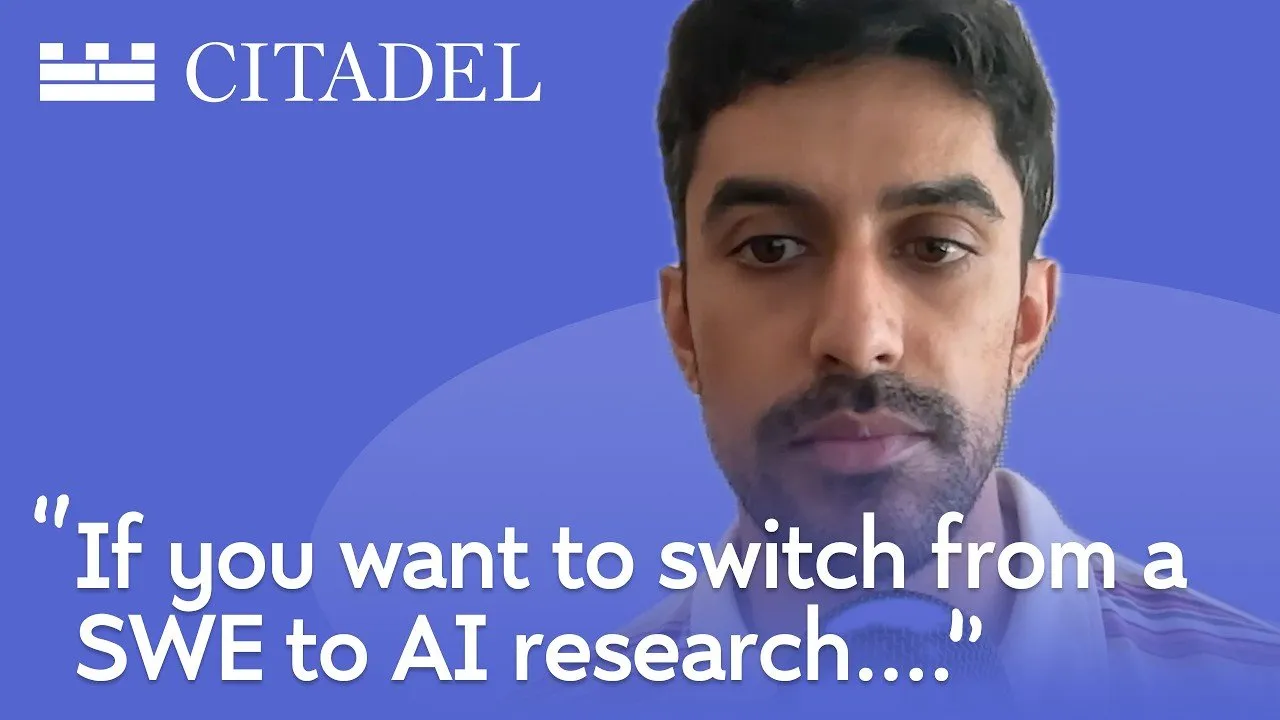
Navigating the intersection of high-frequency trading and generative AI requires a rare combination of mathematical rigor and engineering intuition. Nimit Sohoni, a Stanford PhD AI researcher who transitioned from a quantitative researcher role at Citadel Securities to founding engineer at the voice AI startup Cartisia, offers a unique perspective on these elite industries. His journey sheds light on the often-opaque world of quantitative finance, the technical bottlenecks of modern Transformers, and the strategic differences between working at massive research labs versus agile startups.
Whether you are weighing the value of a PhD, curious about the "golden handcuffs" of financial non-competes, or interested in the architecture of next-generation State Space Models (SSMs), Sohoni’s insights provide a roadmap for technical career capital.
Key Takeaways
- The PhD acts as a filter and a training ground: While not strictly required for every role, a PhD significantly aids in getting interviews at top firms and, more importantly, teaches "research taste"—the ability to select the right problems to solve.
- Quant work-life balance can surprise you: Contrary to popular belief, some quant roles offer better work-life balance than big tech AI roles, largely because trading hours provide a natural boundary for the workday.
- Secrecy defines finance; Openness defines Tech: Quantitative firms operate in silos to protect "alpha," often utilizing strict garden leave policies, whereas AI research thrives on open collaboration and publication.
- The future of AI architecture: We are moving beyond pure Transformers. Hybrid architectures and State Space Models (SSMs) are addressing the memory bottlenecks inherent in processing long sequences and audio data.
- Deep fundamentals over trends: The most effective career strategy is ignoring short-term hype to build deep proficiency in mathematics and computer science fundamentals.
The Role of the PhD in Elite Technical Careers
There is a persistent debate in computer science and finance regarding the necessity of a PhD. Sohoni suggests that while barriers to entry are lowering, the degree remains a powerful differentiator for specific types of high-level work.
The Filtering Mechanism
For competitive roles in AI research or quantitative finance, a PhD often serves as a primary filter. Without the degree, getting past the initial resume screen at top-tier firms can be difficult unless the candidate has exceptional internships or connections. However, once inside, the "shape" of the role varies based on education level. Non-PhD roles in AI often skew toward engineering—infrastructure, data processing, and evaluation—whereas PhDs are typically granted the time and runway to explore "pie in the sky" architecture design and first-principles research.
Developing "Research Taste"
Beyond the credential, the actual value of the PhD lies in skill acquisition. Sohoni emphasizes that execution is only a fraction of the job; the primary challenge is identifying which problems are worth solving.
I would say like 90% of the battle in research is actually finding the right problems... You have to find a problem that is interesting, meaningful, that people are actually going to care if you solve it... and is actually tractable for you to make progress on.
This skill, often called "research taste," involves understanding the literature deeply enough to spot patterns and knowing how to scope a problem so that it is neither too trivial nor impossible. For early-career researchers, the strategy is to attack small sub-problems or extend existing methods to new special cases, gradually working up to novel, fundamental ideas.
Inside the Black Box: Quantitative Finance at Citadel
Moving from academia to Citadel Securities, Sohoni experienced a cultural shift that challenges many stereotypes about the finance industry.
Culture, Secrecy, and "Garden Leave"
The most jarring difference between tech and finance is the approach to intellectual property. In AI, researchers share findings openly on X (formerly Twitter) and Arxiv. In finance, secrecy is paramount. Because "alpha" (the edge that generates profit) degrades as soon as it becomes public knowledge, firms are incredibly tight-lipped.
This secrecy extends internally. Finance firms often organize into "pods" that operate independently. This structure prevents correlated risks—if one pod’s strategy fails, it doesn't drag down the whole firm—but it also creates an environment where colleagues cannot share their work. This protectionism leads to the industry practice of Garden Leave.
A non-compete is... you cannot work for a competitor for a period of time after you leave the firm... The norm is like 6 months to two years. And so yeah, during this period, you're basically just paid to not work.
Comp and Job Security
Compensation in quantitative finance is notoriously high but highly variable. Unlike tech, which has standardized levels (e.g., IC4, IC5), quant pay is driven by the firm's performance, the team's P&L, and the individual's contribution to alpha generation.
Job security follows a "U-shaped" curve. Junior quants are relatively inexpensive and given time to ramp up. However, senior quants become expensive assets. If a senior researcher stops generating alpha, they may no longer justify their high cost, leading to a culture that ruthlessly trims underperformance.
The Technical Frontier: Transformers vs. State Space Models
Sohoni left Citadel to join Cartisia, a startup focusing on real-time voice AI. This move was driven by a desire to return to the forefront of AI research, specifically addressing the limitations of the dominant Transformer architecture.
The Memory Bottleneck
The standard Transformer architecture treats data like a database: it keeps the entire history of a conversation (the Key-Value cache) in memory to predict the next token. As the sequence length grows, the memory and compute requirements grow linearly. For long conversations or high-density data, this becomes cost-prohibitive and slow.
The SSM Solution
Cartisia utilizes State Space Models (SSMs), such as Mamba. Sohoni compares SSMs to a human brain rather than a database. The brain does not store an infinite log of every event; it compresses information into a fixed-size state.
The size of the state is fixed and so as a result... the cost of doing a certain step doesn't change with the length of the sequence... [It] is kind of like a brain... it takes in information and it processes and it keeps it in this fixed size state.
This architecture is particularly effective for audio. Audio data has high redundancy—one millisecond of sound is very similar to the next. Compressing this data via SSMs offers a "free lunch": improved performance and lower latency without sacrificing quality. The industry is likely moving toward hybrid models, interleaving Transformer layers (for exact recall) with SSM layers (for efficient state tracking).
Startups vs. Big Labs: The Innovation Dilemma
For researchers choosing between a massive lab (like OpenAI or Google DeepMind) and a startup, the trade-off is between resources and risk appetite.
The Groupthink Trap
Big labs possess virtually unlimited compute resources, but this abundance can foster risk aversion. Because the cost of investigating a new idea is so high, these organizations often converge on "safe" trends, leading to groupthink. For example, before Mamba, the consensus in big labs was that sequence modeling was a solved problem: just scale Transformers.
The Startup Advantage
Startups like Cartisia, lacking infinite compute, must be smarter with their bets. This necessity drives innovation in efficiency and architecture. Sohoni argues that the most effective AI companies sit at the intersection of product and research. Pure research companies risk burning cash without finding a market, while "wrapper" companies (those simply using GPT-4 APIs) risk obsolescence as foundation models improve. The sweet spot is owning the model architecture to solve specific product problems, such as the latency requirements in voice agents.
Career Advice for the Technical Elite
Sohoni’s career trajectory—from Stanford to Citadel to Cartisia—offers a blueprint for navigating high-leverage technical roles.
Master the Fundamentals
When asked for advice for aspiring researchers, Sohoni warns against chasing the latest frameworks or hype cycles. The interview process and the day-to-day work in both quant funds and AI labs rely on the same core pillars: linear algebra, stochastic calculus, and computer science fundamentals.
Don't Over-Optimize
Reflecting on his career, Sohoni notes that his biggest regret was the time spent worrying about decisions that ultimately didn't matter. His advice is to simplify the career algorithm:
Focus on building the deep technical skills... don't waste time with trifling stuff or spreading yourself too thin... It is a simple recipe that's very hard to follow... It's kind of like, you know, what's the secret to being healthier? It's exercising and eating right.
Conclusion
Whether optimizing trading algorithms or designing the next generation of voice synthesis, the principles of success remain consistent: rigorous mathematical understanding, the ability to select tractable problems, and the discipline to focus on deep work over shallow trends. As AI continues to evolve beyond the Transformer era, those who master these fundamentals will be best positioned to build the future.