Table of Contents
Ethereum has evolved through a series of landmark transitions, from the move to Proof of Stake in the Merge to the optimization of rollup economics in the Dencun upgrade. However, a new era is emerging on the horizon: the ZK EVM era. Often described as the "Manhattan Project" of blockchain development, the integration of Zero-Knowledge Ethereum Virtual Machines (ZK EVMs) into the mainnet represents the most ambitious technical leap in the network's history. This upgrade isn't just about incremental improvements; it is a fundamental redesign of how blockchain nodes operate, shifting the network from a model of redundant re-execution to one of effortless cryptographic verification.
Key Takeaways
- Verification vs. Re-execution: The ZK EVM allows nodes to verify the correctness of a block using a cryptographic proof rather than re-calculating every transaction, eliminating redundant computation across the network.
- Scaling the Three Constraints: The upgrade addresses the core bottlenecks of bandwidth, IO, and compute, enabling Ethereum to scale all three simultaneously.
- The 3x Annual Goal: Ethereum researchers are targeting a 3x increase in scaling every year, transitioning from traditional methods to ZK-backed scaling over the next several years.
- Real-Time Settlement for L2s: The ZK EVM will enable "real-time" settlement between Layer 2s and Layer 1, drastically reducing bridging times and improving ecosystem composability.
- The Roadmap to 2030: The transition follows a multi-year path through optional proofs, security hardening, and finally a mandatory proof-based consensus.
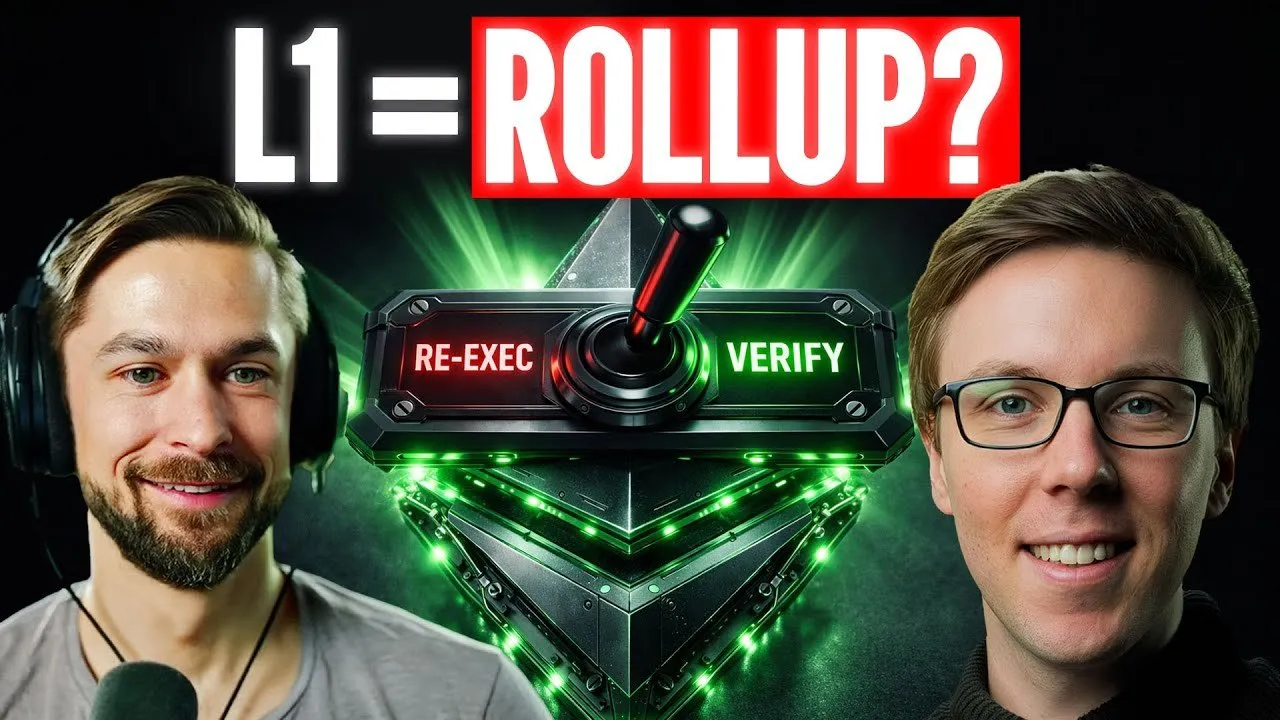
The Shift from Re-execution to Verification
Historically, blockchains have relied on a "trust but verify" model where every node on the network re-executes every transaction to ensure the rules are followed. While this ensures decentralization, it creates a massive efficiency bottleneck. The slowest node in the network effectively sets the speed limit for the entire blockchain. The ZK EVM changes this symmetry by introducing a specialized role for block producers who generate complex proofs, which the rest of the network can verify with minimal effort.
"ZKVM is this fundamental insight that what you can do is you can basically allow nodes to verify that a block followed all the rules without having to re-execute the block."
This "magical compression" allows Ethereum to break free from the constraints of traditional re-execution. By moving to a model where a single proof confirms the validity of thousands of transactions, Ethereum can increase its throughput without forcing every hobbyist node operator to upgrade to industrial-grade hardware. This maintains the network's core philosophy of accessibility while unlocking performance levels previously reserved for highly centralized chains.
Scaling the Three Pillars: Bandwidth, IO, and Compute
Scaling a blockchain requires addressing three distinct constraints: compute (the processing of transactions), IO (input/output operations on disk), and bandwidth (the data required to sync the network). The ZK EVM is the "unlocking piece" that allows Ethereum to address all three in a unified way.
Solving the Compute Bottleneck
Through Zero-Knowledge proofs, compute becomes a constant cost for the verifier. Regardless of how complex the smart contracts in a block are, the proof remains easy to check. This allows for nearly infinite complexity in execution without increasing the burden on the average node.
Optimizing IO through Statelessness
The transition to a ZK EVM enables a concept called "partial statelessness." Traditionally, nodes must store the entire state of the Ethereum blockchain to verify blocks. With ZK proofs, nodes no longer need local copies of the entire state to confirm validity. They can simply update a "root commitment," significantly reducing the disk space requirements for running a node.
Bandwidth and Data Availability
By leveraging existing infrastructure like "blobs" (introduced in EIP-4844), Ethereum can treat its own blocks like rollups. Nodes can use Data Availability Sampling (DAS) to ensure a block exists without downloading the entire thing. Combined with ZK proofs, this allows for massive blocks that only require a fraction of the bandwidth to verify.
The Roadmap to Mandatory Proofs
The transition to a ZK-native Ethereum is not a single "flip of the switch" moment but an ongoing evolution. The research community has identified a clear progression path to ensure security and reliability before making the ZK EVM the mandatory standard for the network.
"We are starting to achieve the target... we are actually able to prove consistently reliably prove a full Ethereum block within 5 seconds."
The rollout follows a four-stage process:
- Performance (2025): Achieving real-time proving speeds where a full block can be proven within the 12-second slot time.
- Security (2026): Hardening the provers and ensuring client diversity to eliminate bugs that could halt the chain.
- Production (2027): Introducing "optional proofs" where enthusiasts and specialized nodes can begin running the ZK stack in production.
- Mandatory Transition (2028-2030): The final hard fork where the network mandates ZK proofs for all block verification, officially entering the ZK EVM era.
Client Diversity and the Formal Verification Frontier
One of Ethereum's greatest strengths is its client diversity, which prevents a single bug from taking down the network. Integrating a ZK EVM introduces new complexities to this model. To maintain security, the network will likely require "multi-proofs"—a system where a block is only accepted if multiple independent proving systems agree on its validity.
There is also significant excitement around "formal verification." Because ZK EVMs rely on mathematical circuits, it is theoretically possible to prove that the code itself is bug-free. In the long term, a formally verified, post-quantum secure ZK EVM could remove the need for redundant clients, creating an ultra-lean and indestructible core for the global financial system.
Second-Order Effects: L2s and the World Beyond Crypto
While the focus is often on Layer 1 scaling, the second-order effects of a ZK-integrated Ethereum will be felt across the entire ecosystem. For Layer 2 rollups, the existence of a real-time ZK EVM on Layer 1 means settlement can happen almost instantly. This eliminates the current seven-day wait periods for optimistic rollups and allows assets to move between different L2s with unprecedented speed and security.
"Ethereum is making the generational leap to the next gen blockchain and no other blockchain will have these properties."
The impact may even extend beyond the blockchain industry. The cryptographic tools developed for the ZK EVM—such as standardized instruction sets like RISC-V and high-performance provers—are already being explored for non-blockchain uses. From privacy-preserving "ZKIDs" that prove age without revealing identity to AI agents that provide provable statements about their data processing, the Ethereum "Manhattan Project" is funding a leap in the global cryptography toolkit.
Conclusion
The ZK EVM is the final major piece of the Ethereum roadmap, transforming the network into a highly efficient, cryptographically secured "internet of value." By moving away from the redundant re-execution model of the past decade, Ethereum is preparing for a future of mass adoption, where thousands of transactions per second can be verified by a simple laptop. This transition ensures that Ethereum remains not just a pioneer of decentralized finance, but the most sophisticated and scalable social infrastructure ever built.