Table of Contents
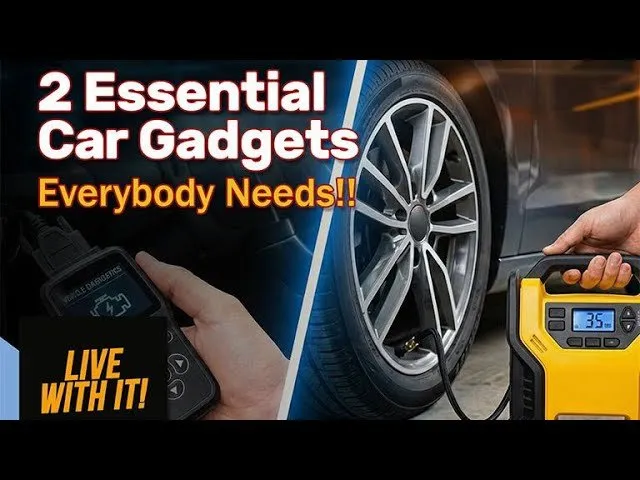
Roger Chang, technical producer for the Daily Tech News Show, recommends two essential automotive gadgets that every driver should own: a portable tire inflator and an OBD2 scanner. Both devices, costing under $100 combined, can help motorists handle common car issues independently without waiting for roadside assistance or paying expensive diagnostic fees at repair shops.
Key Points
- The Astro AI portable air compressor ($30) automatically inflates tires to preset pressure levels and includes LED lighting for roadside emergencies
- The Ancel AD410 OBD2 scanner ($30) reads engine diagnostic codes and works with any vehicle manufactured after 1996
- Both devices plug into standard car power outlets and can save drivers time and money on basic maintenance
- Professional diagnostic equipment costs $700-800 plus manufacturer licensing fees, making these consumer alternatives highly cost-effective
- The portable inflator can reach all four tires on most vehicles and automatically stops when reaching the target pressure
Portable Tire Inflator Solves Common Roadside Problems
The Astro AI portable air compressor addresses one of the most frequent automotive maintenance needs while eliminating guesswork about proper tire pressure. Chang demonstrated the device's compact size, comparing it to a smartphone and noting it equals roughly two 12-ounce soda cans in volume.
The inflator features several practical design elements for emergency situations. It includes an integrated LED flashlight for nighttime use and inflates tires up to 100 PSI, well above the 29-32 PSI required by most passenger vehicles. The device connects to the car's auxiliary power port and includes multiple adapters for bicycles, beach equipment, and other inflatable items.
Chang emphasized the device's automated operation, which prevents overinflation concerns that discourage many drivers from attempting tire maintenance themselves.
"You just set the amount of pressure you need in that tire. You dial it in, and it will run until it reaches that number that you've preset and then it stops," Chang explained during the demonstration.
For drivers unsure about proper tire pressure, Chang noted that federal regulations require all vehicles to display recommended PSI levels on a white sticker inside the driver's side door jamb. The inflator's cord length accommodates all four wheels on standard SUVs, though users may need to route the cable through different windows depending on tire location.
OBD2 Scanner Provides Professional-Level Diagnostics
The OBD2 scanner gives drivers access to the same basic diagnostic information that repair shops use to identify engine problems. The device connects to the standardized diagnostic port located under the dashboard near the pedals, which has been mandatory on all North American vehicles since 1996.
Chang explained that the scanner reads engine error codes, performs emissions readiness tests, and provides real-time data about engine performance including spark timing, fuel flow, and cylinder-specific information. This capability helps drivers understand check engine lights before visiting mechanics and potentially avoid unnecessary diagnostic fees.
"Even if they were to check it for you, they would charge you like a $50 or $60 fee, this is all they do. They plug one of these into it," Chang said about professional diagnostic services.
The basic $30 scanner focuses on engine-related issues, while more expensive models costing $60-70 can diagnose anti-lock braking systems, traction control, and transmission problems. Professional-grade scanners used by dealerships cost $700-800 plus manufacturer-specific licensing fees ranging from $120-300 annually.
Practical Benefits for Emergency Preparedness
Both devices address common scenarios where drivers typically rely on roadside assistance or emergency services. Chang noted that while AAA and similar services provide valuable support, response times often range from 35 minutes to over an hour. The portable inflator can resolve tire pressure issues in under 15 minutes, while the diagnostic scanner provides immediate information about engine problems.
The equipment particularly benefits college students, frequent travelers, and drivers in remote areas where professional services may be limited. Chang suggested both items make practical gifts for new drivers or anyone seeking greater automotive self-reliance.
Chang acknowledged that the consumer-grade devices have limitations compared to professional equipment. The portable inflator may last approximately 20 uses before requiring replacement, while the basic OBD2 scanner cannot access proprietary manufacturer codes or perform advanced functions like key fob programming or engine parameter adjustments.
Despite these constraints, both devices provide essential diagnostic and maintenance capabilities that can prevent minor issues from becoming major roadside emergencies, making them valuable additions to any vehicle's emergency kit alongside traditional items like tire irons and road flares.