Table of Contents
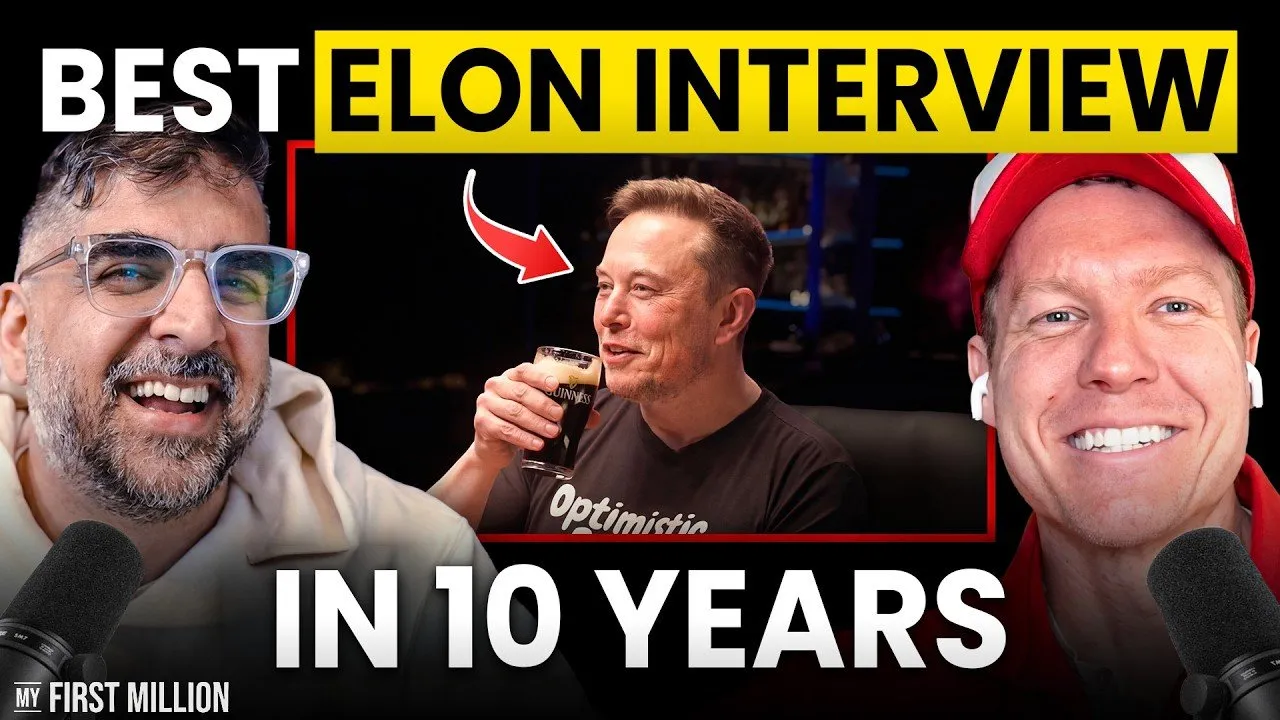
Elon Musk’s recent appearance on the "Cheeky Pint" podcast with Dwarkesh Patel wasn't your standard PR tour. While most interviews skim the surface of his celebrity or political controversies, this conversation offered a rare, technical deep dive into the engineering mindset that powers SpaceX, Tesla, and xAI. From his ruthless hiring algorithms to the terrifying logistics of AI dominance, the interview revealed the specific mental models Musk uses to collapse timelines and achieve the impossible.
In this analysis, we break down the most significant insights from the interview, exploring how Musk identifies bottlenecks, his "infinite money glitch" theory regarding robotics, and the hosts’ reaction to the emerging crisis of human attention spans.
Key Takeaways
- The "Limiting Factor" Framework: Musk’s primary operating system involves identifying the single physical constraint holding a project back—whether it’s voltage transformers or turbine blades—and directing all resources to solve it.
- Execution Over Chemistry: Musk debunks the idea of looking for a "sparring partner." He values pure execution above interpersonal dynamics or intellectual debate.
- Project Macrohard: Inside xAI, Musk is building "human emulators"—AI designed to replicate any task a human can perform on a computer, from executive assistance to podcasting.
- The Decline of Attention: Data suggests a reversal of the Flynn Effect, with Gen Z and Alpha potentially having lower IQs than predecessors due to fragmented attention and "brain rot."
- New Business Opportunities: The crisis of focus is creating a market for "Attention Gyms," digital decluttering services, and educational models similar to Kumon but designed specifically for concentration skills.
The "Limiting Factor" Mental Model
Perhaps the most actionable business lesson from the interview was Musk’s obsession with the "limiting factor." While many entrepreneurs focus on generically good ideas or pet projects, Musk’s strategy is entirely reductive. He scans for the specific bottleneck preventing a mission from succeeding and attacks it with what he calls a "maniacal sense of urgency."
From Gridlock to Space Lasers
Musk provided a granular example regarding AI compute clusters. Initially, the limiting factor was chips (GPUs). Once he secured the chips, the constraint moved to voltage transformers. When that is solved, the constraint will move to power generation.
Musk’s logic flows deeply into the supply chain:
- You can't just plug massive data centers into the grid; there isn't enough power.
- You can't build new power plants fast enough because producers are booked out until 2032.
- The power plants are delayed because specific turbine components (blades and veins) are difficult to manufacture.
Faced with these terrestrial bottlenecks, Musk’s solution is to bypass Earth’s constraints entirely by launching data centers into space. This exemplifies his approach: identify the wall, and then go over, under, through, or—in this case—above it.
Applying the Framework
For business leaders, the lesson is to stop solving problems that aren't the bottleneck. As the hosts noted, companies often waste resources on "generically good ideas"—like improving social media presence when the actual bottleneck is email list growth. Success comes from identifying the specific constraint and accepting that other areas of the business will remain mediocre while you "go ape shit" on the one thing that matters.
Hiring for "Evidence of Exceptional Ability"
With a trillion-dollar valuation at Tesla and a dominating position in aerospace, Musk is often asked how he manages multiple massive organizations. His answer lies in a high-fidelity filter for talent. Having interviewed the first few thousand employees at SpaceX personally, Musk relies on a specific heuristic: evidence of exceptional ability.
The Resume vs. The Conversation
Musk openly admits to disregarding resumes in favor of the interview conversation. He looks for a track record of solving hard technical problems. If a candidate cannot describe the minutiae of a problem they claim to have solved, they likely weren't the one who solved it.
Over time, Musk has treated his own hiring experiences as "training data," refining his neural net to spot talent. He describes this process as Reinforcement Learning (RL) on his own HR instincts.
The "Sparring Partner" Myth
When asked what he looks for in a "sparring partner" or a number two, Musk rejected the premise entirely. He isn't looking for someone to debate ideas with; he is looking for output.
If you get things done, I love you. And if you don't, I hate you.
This binary outlook removes the emotional weight of leadership. Musk doesn't care about idiosyncratic preferences or "vibes"; he cares about the velocity of execution.
The Future of AI: Macrohard and Optimus
The interview shed light on xAI's roadmap, revealing two distinct paths for artificial intelligence: the "human emulator" for software and the Optimus robot for physical labor.
Project Macrohard
Musk jokingly referred to a project called "Macrohard" (the opposite of Microsoft). The goal is to build AI that acts as a human emulator. The logic is that if a human can do a task on a computer—research, booking, coding, podcasting—an AI should be able to execute it autonomously. By training on millions of hours of human computer usage, xAI aims to create agents capable of replacing the "knowledge worker" entirely.
The Infinite Money Glitch
On the hardware side, Musk believes the Optimus robot represents an economic singularity. Labor is the largest asset class in the world. If you can mass-produce a humanoid robot that performs labor better and cheaper than humans—and importantly, if that robot can build other robots—you have achieved an "infinite money glitch."
The Self-Play Warehouse
To train these robots, Tesla is building a massive facility for "self-play." Just as AlphaGo learned to beat human champions by playing millions of games against itself, 10,000 Optimus robots will be placed in a warehouse and left to figure out physical tasks through trial and error. They will act like toddlers, stumbling and failing until they derive the optimal physics for movement and construction.
The "Doomer" Admission
Despite aggressively building these technologies, Musk holds a grim view on human control. When pressed on how humanity maintains dominance over a superintelligence that is a million times smarter than us, Musk dropped the facade of certainty.
If AI is vastly more intelligent... it would be foolish to assume that there's any way to maintain control over that.
He admitted that the best-case scenario is not control, but alignment—hoping the AI finds humans "interesting" enough to keep around. This candid "doomer" perspective is a stark contrast to his usual techno-optimism, suggesting that his drive to merge with AI (via Neuralink) or escape Earth (via SpaceX) is a hedge against the very intelligence he is helping to create.
The Reversal of the Flynn Effect
The conversation shifted from artificial intelligence to the decline of biological intelligence. For over a century, the "Flynn Effect" showed a steady rise in human IQ, roughly 3 points per decade, due to better nutrition and education. However, recent data indicates this trend has reversed. For the first time, Gen Z and Gen Alpha are scoring lower than previous generations.
The Attention Crisis
The hosts attribute this decline to environmental factors—specifically, the pervasive "train noise" of constant connectivity. Just as a study showed students learning near train tracks scored lower due to intermittent noise interruptions, modern brains are subjected to thousands of digital interruptions daily.
We are witnessing a bifurcation of society based on focus. The wealthy are beginning to abstract themselves away from technology. Much like processed food, digital dopamine is becoming a product consumed by the masses, while the elite—like Telegram founder Pavel Durov—opt for a "no-phone" lifestyle to preserve their cognitive clarity.
Business Ideas for the Attention Economy
If focus is the new scarcity, it creates a massive market for solutions. The hosts brainstormed several business concepts that could emerge from this "Attention Inflection Point."
1. The VO2 Max for Attention
Just as we measure cardiovascular health, there is a need for a standardized metric for nervous system regulation and focus. A service that measures your "attention span" and provides a roadmap to fix your "fried" nervous system could be the next big wellness trend.
2. Kumon for Focus
Traditional tutoring focuses on math or reading. A new educational franchise could focus strictly on the skill of concentration. Teaching children (and adults) how to sustain attention on a single task for extended periods is becoming a critical competitive advantage.
3. Digital Hygiene Consultants
Similar to "Lightwork," a service that audits homes for environmental toxins, there is an opportunity for "Digital Marie Kondos." These consultants would audit your digital life—cleaning up notification settings, organizing files, and restructuring your relationship with technology to reduce cognitive load.
Conclusion
The contrast between Musk’s interview and the hosts' reaction highlights a strange paradox. On one hand, humanity is on the brink of creating god-like intelligence and colonizing other planets. On the other, we are struggling to maintain the basic cognitive ability to read a book without checking a notification.
Musk’s philosophy of identifying the "limiting factor" applies to both scenarios. For SpaceX, the limiting factor is physics and energy. For the rest of us, the limiting factor is attention. The winners of the next decade will be those who can leverage Musk’s tools of leverage—AI and robotics—while protecting their biological hardware from the "brain rot" of the modern internet.