Table of Contents
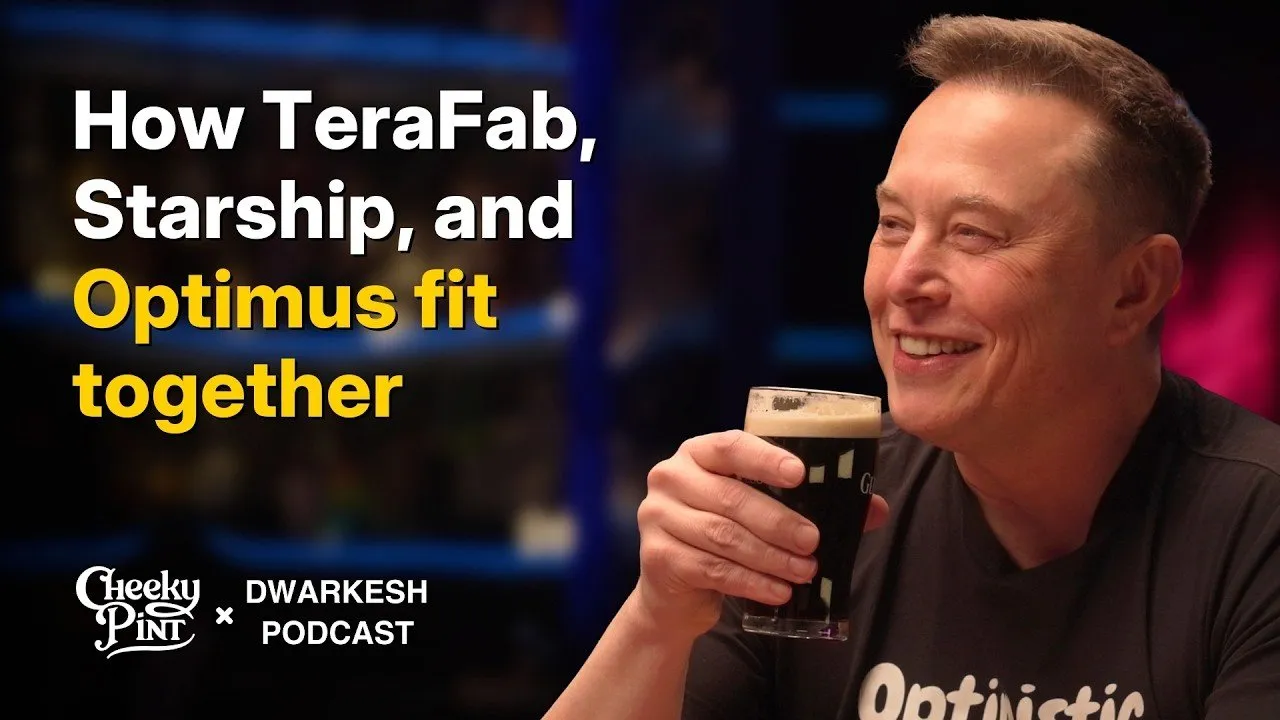
In a sprawling, high-bandwidth conversation that bridges the gap between science fiction and immediate industrial strategy, Elon Musk laid out a converging roadmap for SpaceX, Tesla, and xAI. The discussion moved far beyond standard corporate talking points, offering a granular look at the engineering physics driving his companies. From the thermodynamics of orbital data centers to the metallurgy of Starship, Musk argued that humanity is approaching a critical hardware wall on Earth—one that can only be surmounted by moving heavy compute to space and revolutionizing labor with humanoid robotics.
Key Takeaways
- The Off-Earth AI Migration: Musk predicts that within 30 to 36 months, space will become the most economically viable location for large-scale AI training due to superior solar energy efficiency and cooling capabilities.
- The Energy Bottleneck: Earth-based power grids are hitting a ceiling. The constraint isn't just electricity generation, but specific supply chain failures, such as the backlog for turbine vanes and blades.
- Recursive Manufacturing: The economic endgame for Optimus is an "infinite money glitch" where robots manufacture more robots, potentially allowing the US to compete with China’s manufacturing dominance.
- Starship’s Logistics: To support a space-based economy, SpaceX aims for a launch cadence of 10,000 flights per year, eventually utilizing a lunar mass driver to scale humanity's energy capture.
- The "TeraFab" Ambition: With current chip supply insufficient for future needs, Musk suggests Tesla and SpaceX may need to build their own "TeraFabs," vertically integrating chip manufacturing from the sand up.
The Inevitable Migration of AI to Space
One of the most provocative assertions Musk made is the imminent shift of heavy compute infrastructure from Earth to orbit. While current data center discussions focus on local power grids, Musk argues that the physics of energy generation favors space so heavily that a transition is inevitable within three years.
The Solar Efficiency Gap
Musk deconstructed the math behind terrestrial versus orbital solar power. On Earth, the atmosphere absorbs roughly 30% of solar energy before it hits the ground. Furthermore, due to the day-night cycle, seasonality, and weather, terrestrial solar panels operate at a significantly reduced capacity factor. To generate one terawatt of usable power on Earth, you might need four terawatts of installed solar capacity and a massive battery storage solution to bridge the night.
In contrast, Musk pointed out that space offers a "magic" environment for power generation:
- No Atmospheric Interference: Solar panels receive raw, unadulterated sunlight.
- Constant Illumination: In the correct orbit (or sufficiently high altitude), satellites can remain in perpetual sunlight, eliminating the "night" variable.
- Passive Cooling: The cold vacuum of space simplifies the immense cooling requirements of high-performance GPUs, which on Earth consumes up to 40% of a data center's energy budget.
- Battery Redundancy: With constant solar exposure, the need for heavy, expensive battery storage is effectively removed.
"My prediction is that it will be by far the cheapest place to put AI. It will be space in 36 months or less."
Scaling Beyond the Grid
The move to space is largely a "regulatory play" and a physics play. Musk noted that scaling on Earth requires navigating a labyrinth of permits, land acquisition, and utility interconnection studies that can take years. In space, the primary constraint is launch cost—a variable SpaceX is aggressively driving down. He envisions a future where SpaceX launches more AI capacity annually than the cumulative total existing on Earth.
The Earth-Based Hardware and Power Wall
Before the transition to space is complete, AI development faces a severe "hardware wall" on Earth. Musk detailed a cascading series of bottlenecks that are currently throttling the expansion of compute clusters.
The Turbine Crisis
While the public focus remains on GPU shortages, Musk highlighted a deeper supply chain crisis: the physical infrastructure required to generate electricity. He revealed that utility-scale transformers and gas turbines are sold out through the end of the decade. Specifically, the industry is gridlocked by a shortage of specialized "vanes and blades" used in turbines. These components require complex casting processes, and the handful of companies capable of producing them are massively backlogged.
The Interconnect Jam
Even if power plants could be built instantly, connecting them to the grid is a separate nightmare. Musk described the utility industry as "impedance matched to the government," moving at a glacial pace that is incompatible with the exponential growth of AI. He recounted xAI’s experience bringing the "Colossus" cluster online, which required performing "miracles in series"—ganging together turbines and navigating multi-state permitting issues—just to bypass the slow timelines of public utilities.
The Cooling Penalty
Musk provided a reality check for those calculating data center power requirements based solely on chip specifications. He explained that a "noob" looks at the power draw of a GPU (like the GB300) and simply multiplies it by the number of units. Real-world engineering requires accounting for:
- Networking and Storage Overhead: CPU and storage support hardware adds significant load.
- Peak Cooling Demands: You must size power for the hottest hour of the hottest day, adding a ~40% buffer.
- Redundancy: To maintain uptime when generators require service, an additional 20-25% power margin is needed.
- The Result: A cluster of 330,000 GB300 GPUs actually requires roughly one gigawatt of generation capability at the source level.
Starship, Steel, and Material Physics
To support the massive uplift of mass required for space-based AI, SpaceX is betting the house on Starship. Musk dived deep into the material science decisions that define the vehicle, specifically the controversial switch from carbon fiber to stainless steel.
The Counter-Intuitive Win for Steel
Musk admitted that carbon fiber—the material of choice for lightweight aerospace applications—was the initial plan. However, progress was agonizingly slow due to the difficulty of creating massive, wrinkle-free composite structures. The pivot to 300-series stainless steel was driven by "desperation" but validated by physics that many overlook:
- Cryogenic Strength: While steel is heavy at room temperature, specialized strain-hardened stainless steel actually sees its strength-to-weight ratio improve drastically at cryogenic temperatures (the temperature of liquid oxygen and methane propellant).
- Heat Resistance: Steel has a melting point roughly double that of aluminum. This allows the Starship to withstand reentry heat with a much lighter, thinner heat shield—and no shielding at all on the leeward side.
- Manufacturing Velocity: Unlike carbon fiber, which requires massive autoclaves and pristine conditions, steel can be welded outdoors. This allows for rapid iteration and repair.
The Logistics of a Space Civilization
Musk outlined a staggering scale for future operations. To create a meaningful space-based economy, he anticipates needing:
- High Launch Cadence: A target of 10,000 Starship launches per year.
- Massive Fleets: A production line churning out thousands of ships to support hourly launches.
- Lunar Manufacturing: Eventually, Musk envisions a mass driver on the Moon—a kinetic launch system that shoots raw materials or finished products into orbit. This would allow for the construction of massive solar arrays and heavy industry without the fuel penalty of launching from Earth’s deep gravity well.
The "TeraFab" and Vertical Integration
As AI models scale toward trillion-parameter architectures, the demand for silicon is outpacing the world's combined manufacturing capacity. Musk hinted that relying on existing supply chains might no longer be an option.
The 100-Gigawatt Chip Demand
Musk laid out the math: to match the power generation capacity he intends to launch into space (100 gigawatts/year), he needs an equivalent volume of silicon. This requires roughly 100 million full-reticle chips annually. Current global fabrication capacity cannot support this volume alongside existing demand.
Breaking the Fab Bottleneck
Musk discussed the concept of the "TeraFab"—a massive scaling of chip manufacturing. While acknowledging the immense difficulty (and the fact that he has not yet built a fab), he approached it with his trademark first-principles thinking:
- Equipment Utilization: He suggested that current fab tools might be utilized in unconventional ways to increase throughput.
- Vertical Integration: Just as Tesla built its own seat factory when suppliers failed, Musk implied that if TSMC and Samsung cannot scale fast enough, his companies will be forced to build the chips themselves.
- Memory Crisis: He identified memory (DRAM) as a more critical bottleneck than logic. While logic design is straightforward, the path to sufficient memory density and bandwidth is less clear.
"I've actually said this to TSMC and Samsung and Micron: 'please build more fabs faster'. We will guarantee to buy the output of those fabs."
Optimus: The Economic Singularity
While space solves the energy and compute constraints, the Optimus robot is designed to solve the labor constraint. Musk views the humanoid robot as the ultimate multiplier for economic output.
The Manufacturing Recursive Loop
Musk described Optimus as a potential "infinite money glitch." The logic is recursive: if you can build a robot capable of performing factory labor, that robot can then be used to build more robots. This creates a compounding growth loop where labor supply ceases to be a limiting factor. He predicts a future where robots vastly outnumber humans, performing everything from ore refining to assembly.
Solving the "Hand" Problem
The primary engineering hurdle for Optimus has been the human hand. Musk noted that no existing supplier could provide an actuator with the necessary dexterity, strength, and durability. Tesla had to design every motor, gearbox, and sensor from scratch. The goal is a hand that can thread a needle yet carry a heavy load, bridging the gap between delicate manipulation and industrial labor.
The Geopolitical Angle
Musk offered a sober assessment of global manufacturing. Currently, China dominates the supply chain, performing roughly twice as much ore refining as the rest of the world combined. With a population four times that of the US and a high work ethic, China has a distinct advantage in labor-dependent industries. Musk argues that the US cannot win on headcount; the only path to competitive manufacturing is through massive automation via Optimus.
Managing at the Speed of Light
Running SpaceX, Tesla, xAI, Neuralink, and The Boring Company simultaneously requires a unique management algorithm. Musk offered insights into how he maintains velocity across such a sprawling empire.
The Algorithm of Urgency
Musk attributes his companies' speed to a "maniacal sense of urgency." His management style focuses entirely on identifying the "limiting factor"—the single bottleneck slowing down the entire system—and attacking it relentlessly. Once the bottleneck is cleared, he moves immediately to the next one.
Engineering Reviews
Unlike many CEOs who rely on high-level summaries, Musk conducts deep-dive engineering reviews weekly or even twice weekly. He engages directly with engineers (often skipping middle management) to understand the physics of the problem. This allows him to make high-stakes decisions—like the switch to steel for Starship—based on first principles rather than industry convention.
The Hiring Heuristic
When building teams, Musk ignores credentials and resumes. Instead, he looks for "evidence of exceptional ability." This involves probing deeply into the specific problems a candidate has solved to ensure they were the ones driving the solution, not just managing the people who did.
"I have a maniacal sense of urgency... I’m constantly addressing the limiting factor. Whatever the limiting factor is on speed, I'm going to tackle that."
Conclusion
Elon Musk's roadmap is not a collection of disparate business ventures but a unified engineering strategy. The energy limits of Earth necessitate a move to space; the logistical demands of space necessitate Starship; the manufacturing demands of Starship and AI necessitate Optimus; and the intelligence requirements of Optimus necessitate xAI. By attacking the limiting factors of energy, mass transport, and labor simultaneously, Musk is attempting to force a civilization-level transition. As he noted, the goal is to "err on the side of optimism" and build a future that is more interesting than the alternative.