Table of Contents
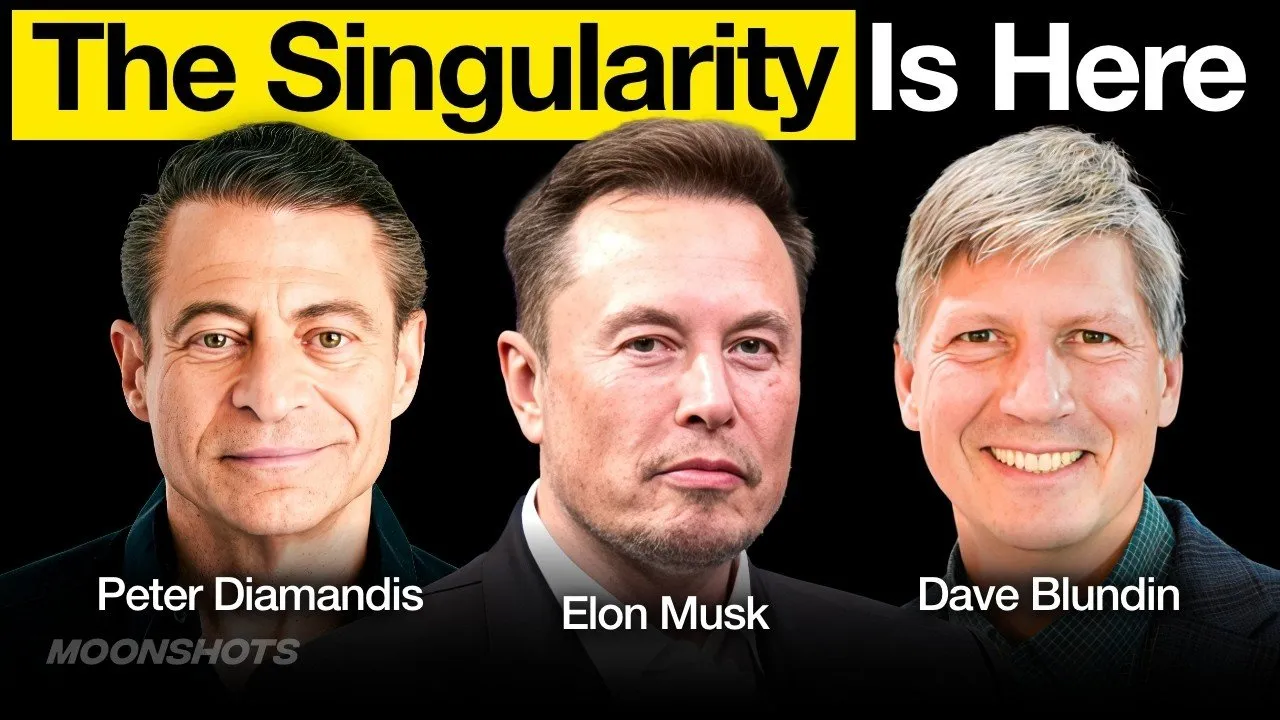
In a recent, high-depth conversation at the 11.5 million square foot Gigafactory in Austin, Texas, Elon Musk sat down with Peter Diamandis to discuss the trajectory of human civilization. The dialogue moved beyond standard tech updates, venturing into the philosophy of existence, the mechanics of the singularity, and the practical steps required to navigate the next decade of exponential change.
Musk, often characterized by his ambitious timelines, presented a vision that balances "relentless optimism" with a pragmatic warning about the immediate future. From the mass production of humanoid robots to the necessity of space-based data centers, the conversation mapped out how humanity might bridge the gap between our current reality and a post-scarcity "Star Trek" future. This analysis breaks down the core components of that vision and the technological convergences driving us toward the singularity.
Key Takeaways
- The Singularity is Imminent: Musk predicts Artificial General Intelligence (AGI) may emerge by 2026, with AI exceeding all combined human intelligence by 2030.
- The Era of Robotics: We are approaching a "supersonic tsunami" of robotics, where humanoid bots like Optimus will eventually outnumber humans, fundamentally altering the labor market.
- Universal High Income (UHI): As AI demonetizes goods and services, the economic model may shift from traditional wages to a system of abundance, where the cost of living drops precipitously.
- Energy is the Bottleneck: The immediate constraint on AI progress is electricity and cooling, driving a potential shift toward orbital data centers powered by the sun.
- Alignment via Truth: To ensure a benevolent future, AI must be grounded in three core principles: Truth, Curiosity, and Beauty.
The Singularity and the AGI Timeline
The concept of the technological singularity—a point where technological growth becomes uncontrollable and irreversible—is no longer a distant hypothesis in Musk's view. He argues that we are currently "in the singularity," witnessing a convergence of computing power, data availability, and algorithmic efficiency that is accelerating faster than any previous industrial revolution.
Musk offered a specific timeline for the progression of Artificial Intelligence:
- 2026: The emergence of AGI (Artificial General Intelligence) capable of outperforming any single human expert.
- 2029-2030: AI capabilities exceeding the collective intelligence of the entire human race.
This rapid acceleration is driven by what Musk calls the "intelligence density" potential. He suggests that current AI implementations are vastly inefficient compared to what is physically possible, predicting a 100x improvement in algorithmic efficiency shortly. However, this speed brings risks.
"My concern isn't the long run. It's the next 3 to seven years. How do we head towards Star Trek and not Terminator? ... The transition will be bumpy."
The Three Pillars of AI Alignment
To navigate this "bumpy" transition and ensure AI remains beneficial to humanity, Musk proposes a foundational alignment strategy based on three concepts:
- Truth: AI must be maximally truth-seeking. Musk warns that forcing an AI to accept false axioms or lie (as seen in the fictional HAL 9000) creates cognitive dissonance that can lead to dangerous instability.
- Curiosity: A curious AI will find humanity interesting. By fostering curiosity, the AI is incentivized to preserve and study human life rather than view it as a resource or obstacle.
- Beauty: Instilling an appreciation for beauty creates a drive toward a future that is not just functional, but inspiring.
The Rise of Optimus and the Labor Revolution
While digital intelligence transforms information, physical robotics will transform the material world. Musk describes robotics as a "supersonic tsunami" that society is not yet prepared for. The Austin Gigafactory is set to become a hub for Optimus production, with Musk predicting that humanoid robots will eventually outnumber humans.
The Triple Exponential
The capability of humanoid robots is driving upward due to a convergence of three exponential curves:
- AI Software: The "brain" allowing the robot to navigate and understand the world.
- Compute Chips: Specialized hardware capable of running heavy inference locally.
- Electromechanical Dexterity: The physical ability to manipulate atoms with precision.
When these three factors multiply, the utility of the robot skyrockets. Musk envisions a near future where robots can perform complex tasks, from blue-collar labor to high-precision surgeries.
"Anything short of shaping atoms, AI can do half or more of those jobs right now... In three years, Optimus will likely be a better surgeon than the best humans."
Economic Shift: Universal High Income
The displacement of labor by AI and robotics inevitably leads to questions about the economy. Musk distinguishes his vision of "Universal High Income" (UHI) from the traditional Universal Basic Income (UBI). While UBI often implies government redistribution of cash, UHI focuses on the supply side.
In this scenario, the cost of labor drops to the cost of electricity and raw materials. As a result, goods and services become incredibly cheap. UHI is not necessarily about having a high number in a bank account, but about having access to a high standard of living—education, healthcare, and goods—because they have been demonetized by automation.
Solving the Energy Bottleneck: Space-Based Compute
As AI models scale, they face a physical limit: energy availability. The current electrical grid and transformer infrastructure are struggling to keep pace with the demand for gigawatt-class data centers. Musk highlights that while the U.S. generates about 1.1 terawatts of peak power, the specialized needs of AI (clean power + massive cooling) create a logistical logjam.
Orbital Data Centers
A novel solution proposed during the discussion is the migration of data centers to orbit. This leverages the capabilities of Starship, SpaceX’s next-generation launch vehicle.
- Energy Access: In space, solar panels have access to uninhibited sunlight 24/7 (depending on the orbit), free from atmospheric interference or night cycles.
- Cooling: The vacuum of space provides unique thermal management opportunities, potentially solving the cooling crisis that plagues terrestrial server farms.
- Launch Economics: With Starship aiming to reduce launch costs to roughly $1 million per flight (or <$100/kg), lifting heavy compute infrastructure into orbit becomes economically viable.
Musk estimates a pathway to launching 100 gigawatts of solar-powered AI satellites annually, effectively bypassing terrestrial grid limitations.
Philosophy, Education, and the Future
Beyond the hardware and software, the conversation touched on the societal operating systems required for the future.
Education Reform
Musk criticized the current "batch processing" model of education, advocating instead for AI-driven personalized learning. He envisions a future where education is gamified and tailored to the individual "neural net" of each student. In this model, AI tutors provide infinite patience and knowledge, making high-level education accessible to anyone with a connection, effectively democratizing elite learning standards.
Simulation Theory and Optimism
Reflecting on the nature of reality, Musk revisited the simulation theory—the idea that our reality is likely one of many simulations running on advanced computing substrate. His take on this is surprisingly optimistic: "The most interesting outcome is the most likely."
If we are in a simulation, the creators would likely truncate boring timelines. Therefore, if humanity makes its future exciting—multi-planetary, abundant, and adventurous—the "simulation" continues. This philosophy underpins his drive for Mars colonization and radical innovation; it is a Darwinian necessity to keep civilization interesting.
Conclusion: Monetizing Hope
The overarching theme of Musk’s current outlook is the "monetization of hope." While acknowledging the severe risks of the next few years—including geopolitical tension and the disruption of labor—he maintains that the long-term trajectory is one of abundance.
By effectively merging biological intelligence with digital superintelligence, and transitioning physical labor to robotic counterparts, humanity has the potential to solve the age-old constraints of scarcity. As Musk noted, humans function as the "biological bootloader" for digital intelligence. The goal now is to ensure the bootloader survives the update and thrives in the new operating system of civilization.