Table of Contents
We often equate genius with complexity. We assume that to build a million-dollar business, you need a proprietary algorithm, a revolutionary tech stack, or a PhD in astrophysics. But the reality of wealth creation is often far simpler—and occasionally, a little bit "dumb."
Some of the most profitable ventures aren't based on reinventing the wheel; they are based on observing human behavior, spotting a meme, or simply packaging nothing into something. Being clever by doing simple things is its own form of genius. Whether it is capitalizing on a sports rivalry or selling the concept of a star, there is immense value in the obvious, provided you execute with precision.
Key Takeaways
- Viral merchandising requires speed: The ability to "fast follow" a meme or cultural moment can generate massive revenue in a short window.
- Perceived value beats utility: Businesses like the Star Registry prove that marketing and sentimentality can be more profitable than physical utility.
- Consistency is a competitive advantage: As demonstrated by legendary salesman Larry Jolton, the refusal to "get bored of greatness" separates top performers from the rest.
- Skills are transferable: The "Capital Man" archetype, like John Catsimatidis, shows how operational hustle can scale from low-margin sectors (groceries) to high-stakes industries (aviation and oil).
The Genius of "Dumb" Ideas
There is a specific category of business ideas that sophisticated investors might laugh at, yet they quietly print money. These ideas rely on novelty, trends, and the simplicity of the offer.
1. The Cheese Grater Hat
Sports rivalries are a goldmine for merchandise, but official team gear is often sterile and repetitive. A perfect example of disrupting this market is the Chicago Bears versus Green Bay Packers rivalry. Packers fans are famous for wearing "Cheeseheads." In response, a company called Foam Party Hats created the perfect counter-narrative: giant foam cheese graters worn by Bears fans.
This isn't just about making a funny hat; it’s about capturing a moment. When a clip of a Bears player dancing in one of these hats went viral, the company reportedly received 10,000 orders in a single week. That is roughly half a million dollars in revenue generated from a piece of foam.
There's a million dollar business sitting in oversized foam hats.
The lesson here is the power of "fast following." In the age of drop-shipping and rapid manufacturing, the company that can turn a meme into a physical product within hours wins. It is a simple man’s business, but the execution is undeniably smart.
2. The International Star Registry
Perhaps the ultimate example of "selling nothing" is the International Star Registry. For decades, this company has sold people the right to name a star. The catch? You don't own the star, and the name isn't recognized by the scientific community. You are essentially buying a certificate and an entry in a book that sits in their office.
Despite this, the business has generated millions in revenue over 40+ years. It works because it is a "pure play" marketing product. They legitimize the purchase through prestige signaling—claiming the book is stored in a Swiss vault or the Library of Congress. It turns a fact (we wrote your name in a book) into a value proposition (your love is immortalized in the cosmos).
This mimics the strategy used by copywriters like Joe Sugarman, who could take a standard feature—like a quartz movement in a watch or aluminum material—and spin a narrative about "space-age accuracy" or "NASA-grade materials." It is the art of framing.
3. The 10-Hour Fireplace
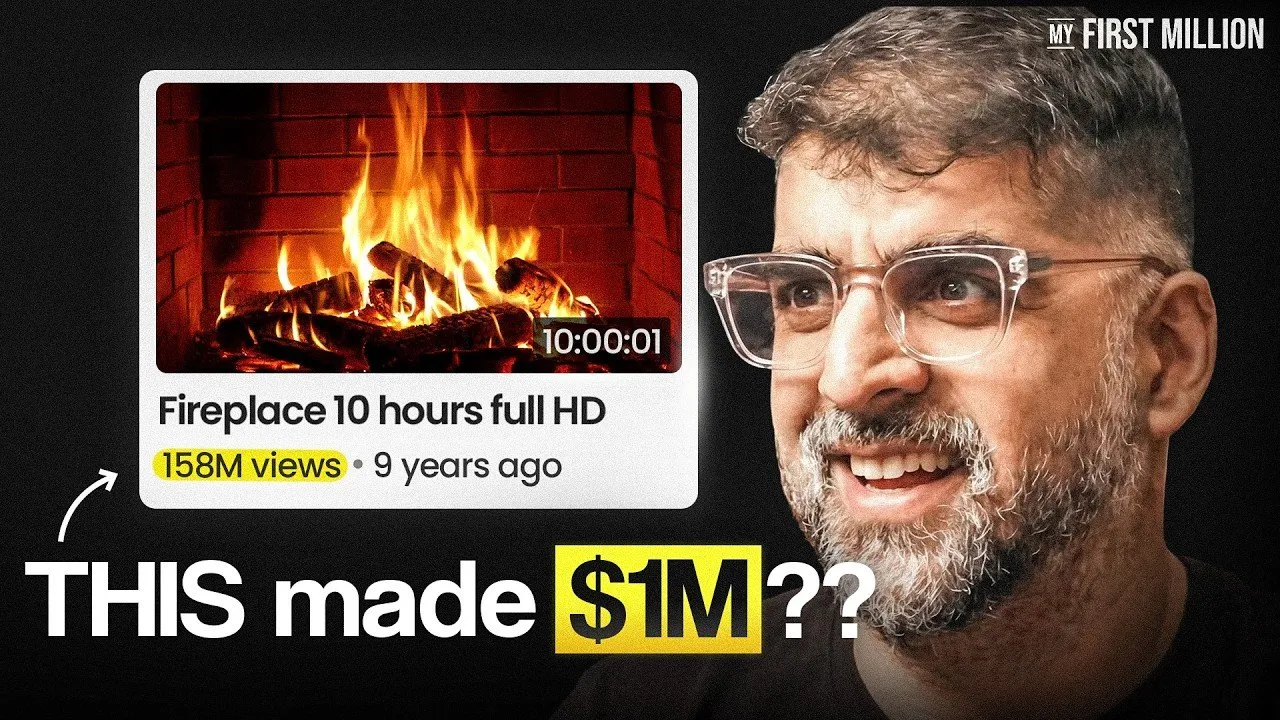
In the creator economy, we often overthink production value. Yet, there is a YouTube channel featuring a single video: a 10-hour loop of a fireplace. It has millions of views and, by some estimates, has generated over a million dollars in ad revenue for its creator. The creator didn't build a brand empire; they uploaded a utility asset and let it run.
This has spawned a massive sub-industry of "ambient" channels. From "Lo-Fi Beats to Study To" to hyper-specific niches like "Old Money Brazil" or "1980s Finance Office," creators are packaging vibes. They use AI-generated art and curated playlists to capture a specific mood, proving that sometimes the best content strategy is simply providing a background for people's lives.
The Process of Greatness
While "dumb" ideas can make you rich, sustaining wealth usually requires a different set of skills: process and relentless consistency. It is the transition from a lucky strike to a repeatable system.
The Legend of Larry Jolton
Larry Jolton was a shoe salesman in Sharon, Pennsylvania. In 1983, he sold over $400,000 worth of shoes manually—a staggering figure for the time. He was the "Cy Young" of retail.
Jolton’s success wasn’t magic; it was sheer volume and refusal to break process. While other salesmen took breaks, Jolton ate burgers in the back storage room between fetching sizes. He didn't rely solely on charisma; he relied on a system of finding the right fit and never letting a customer leave empty-handed.
The lesson from Jolton is the danger of getting bored. Many talented people fail because they crave novelty. They want to solve new puzzles. The greats, however, find glory in the repetition.
Let's not get bored of greatness today.
Whether it is warming up for a sport or closing a sale, the moment you go on autopilot is the moment you lose your edge. High performance requires treating the thousandth repetition with the same focus as the first.
The "Capital Man" Archetype
Finally, there is the "Capital Man"—the entrepreneur who transcends industries through sheer force of will and leverage. A prime example is John Catsimatidis.
Starting as a grocery store owner, Catsimatidis understood low-margin, high-operational-complexity businesses. Instead of staying in his lane, he applied those skills to aviation, buying a small plane and scaling it into a fleet of corporate jets (a precursor to the NetJets model). From there, he leapt into oil refining—another gritty, logistical industry.
What connects grocery stores, private jets, and oil refineries? On the surface, nothing. But fundamentally, they are all about leverage, logistics, and asset management. The "Capital Man" doesn't see industry boundaries; they see inefficiencies they can exploit. They are often "leveraged to the gills," taking massive risks to jump from one S-curve to the next.
Conclusion
Whether you are selling foam hats, naming stars, or refining oil, the path to wealth rarely looks like a straight line. It can look like a "dumb" novelty idea that captures the cultural zeitgeist, or it can look like a shoe salesman who refuses to take a lunch break. The common thread is action. The best entrepreneurs don't just have ideas; they have the audacity to sell them, the discipline to repeat the process, and the vision to scale beyond their original constraints.