Table of Contents
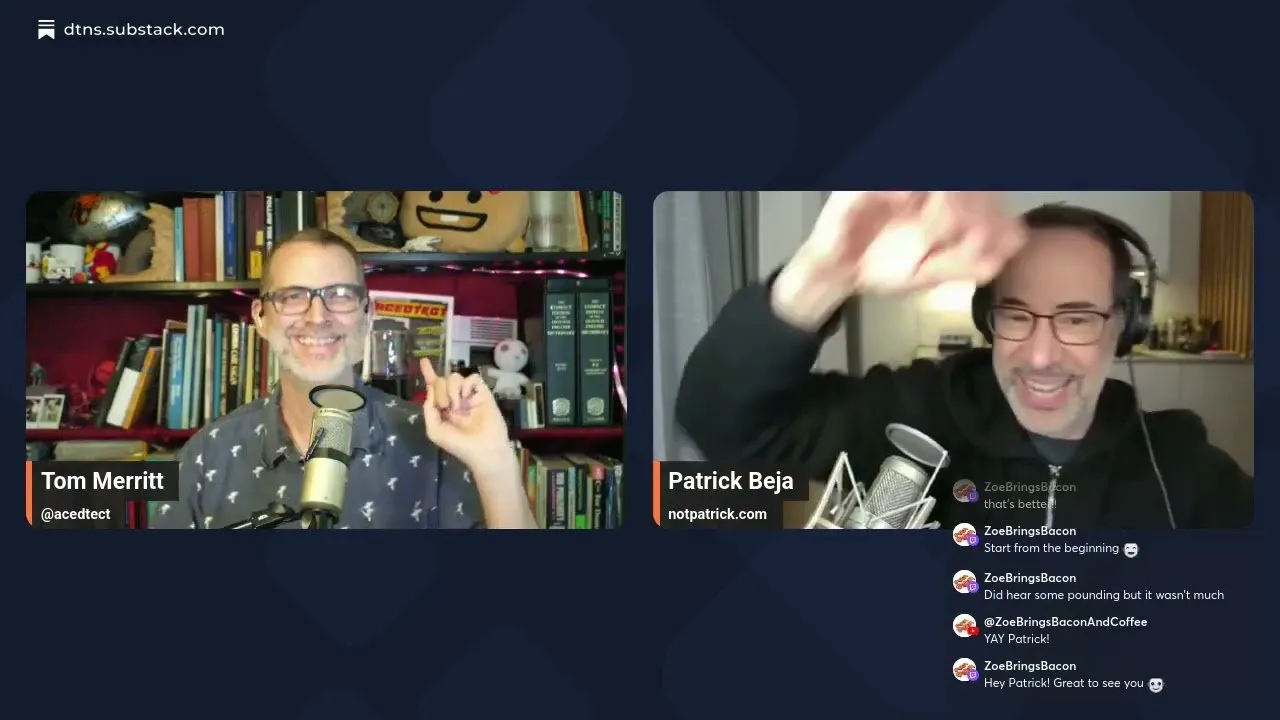
In a wide-ranging conversation on the latest Daily Tech News Show (DTNS) Friday Hangout, hosts Tom Merritt and guest Patrick Beija explored the evolving nature of digital media, the challenges of modern discourse, and the personal realities of navigating a volatile geopolitical landscape. The discussion highlighted a shared concern among long-time podcasters regarding how today's hyper-polarized environment complicates the role of creators in shaping public understanding.
Key Points
- Patrick Beija has relaunched The Phileas Club with a new, intimate format focusing on personal perspectives and community-submitted letters.
- Both creators emphasized the necessity of moving away from social media "doom-scrolling" in favor of curated, measured, and often paid journalistic sources like the Wall Street Journal and Financial Times.
- The dialogue underscored the difficulty of maintaining nuance in an online ecosystem that often prioritizes outrage-driven algorithms over substantive debate.
- The pair acknowledged the "long-term progress" of human society, noting that despite current geopolitical instability, historical metrics on health and living standards remain significantly better than in the 20th century.
The Shift in Independent Media
Reflecting on his return to podcasting with The Phileas Club, Beija discussed his desire to foster genuine connection after struggling with the logistical and ideological difficulties of his show’s previous iteration. His new approach centers on "letters to Phileas," an imaginary figure who serves as a stand-in for the audience. This evolution reflects a broader trend among veteran creators: stepping back from the pressure to provide hot takes on every breaking news event and instead focusing on deeper, more thoughtful commentary.
Merritt, who has navigated the shifting landscape of tech journalism for two decades, noted that he has become increasingly cautious about "speaking out" on political issues. He argued that the current digital atmosphere makes it nearly impossible to hold nuanced positions without being cast into a binary ideological camp.
"The quickest way for someone to shut you off is to tell them they're wrong... when you hear me being careful, I'm being careful to say like, 'Hey, there's a lot of different people with a lot of different opinions across the spectrum listening, and I want them to hear what I'm saying.'" — Tom Merritt
Navigating Information Overload
Both hosts expressed fatigue with the performative nature of social media, with Beija revealing he quit Twitter a year ago in favor of Blue Sky and community-driven platforms like Discord. They agreed that the quality of information found in traditional, paid publications is vastly superior to the free, clickbait-heavy content that dominates social feeds.
Beija pointed to the rise of independent news voices, such as Hugo Décrypte in France, as a hopeful sign that younger generations are seeking journalistic ethics even within fast-paced digital formats. However, he warned that the consolidation of media ownership by wealthy individuals has led to the proliferation of inflammatory content that mimics the polarizing tactics once pioneered by major U.S. cable news networks.
Looking Toward a Sustainable Future
The conversation concluded on a forward-looking note, with both creators questioning whether it is possible to "fix" democracy through the internet alone. Merritt advocated for a focus on local engagement, suggesting that real, durable change comes from strengthening one’s immediate community rather than seeking the dopamine rush of national-level political battles.
Moving forward, the hosts indicated they intend to continue their dialogue away from the immediate heat of news cycles. Beija extended an open invitation for contributors of diverse backgrounds to participate in his platform, emphasizing that his primary goal for The Phileas Club remains the same: to humanize differing perspectives in an increasingly fragmented world.