Table of Contents
The recent military strikes against the Iranian regime have ignited a firestorm of debate across the political spectrum, questioning whether the United States is once again sliding into a "forever war" or executing a calculated strategy of deterrence. Author and social critic Douglas Murray offers a provocative defense of these actions, suggesting that far from being "entanglements," these surgical strikes represent a decisive break from the failed foreign policies of the past several decades. By analyzing the mindset of the Trump administration and the historical context of Iranian aggression, Murray argues that the current moment offers a unique window for the Iranian people to reclaim their sovereignty from a revolutionary government that has repressed them since 1979.
Key Takeaways
- Surgical Precision vs. Entanglement: Murray distinguishes between long-term occupations and targeted military actions designed to achieve specific objectives without ground troop commitments.
- The Failure of "Low-Resolution" Critiques: High-profile figures like Tucker Carlson are criticized for using conspiratorial lenses that Murray argues fail to account for the reality of Iranian state-sponsored terrorism.
- Empowering Internal Change: The primary goal of current U.S. policy is viewed as creating a "window of opportunity" for the Iranian public to overthrow the regime themselves.
- The October 7th Domino Effect: The current collapse of Iranian proxies—from Hamas to Hezbollah—is framed as a direct, catastrophic miscalculation by Yahya Sinwar.
Redefining the Trump Doctrine: Action Over Entanglement
A common critique of recent military actions is that they contradict the "America First" promise of avoiding foreign conflicts. However, Murray contends that this view fundamentally misunderstands the administration's tactical approach. Rather than the sprawling, decade-long "forever wars" that followed 9/11, the current strategy favors sharp, high-impact interventions with clearly defined exit paths.
The "One, Two, Three" Negotiation Style
Murray describes the administration's foreign policy as a "textbook" application of the president's negotiation style. In this framework, deadlines are not mere suggestions but absolute boundaries. When a regime like Tehran attempts to string along American diplomats, the response is not further dialogue, but immediate action. This predictability—that the president will do exactly what he says—serves as a primary tool of deterrence.
Surgical Strikes vs. Ground Wars
By citing previous operations in Venezuela and against Iranian nuclear facilities, Murray illustrates a pattern of "surgical" intervention. These actions are designed to be "swift and successful," aiming to decapitate specific threats rather than embroil the American military in civil administration. The distinction is vital: an entanglement involves staying; a strike involves hitting a target and leaving.
Addressing the "Low-Resolution" Thinking of the New Right
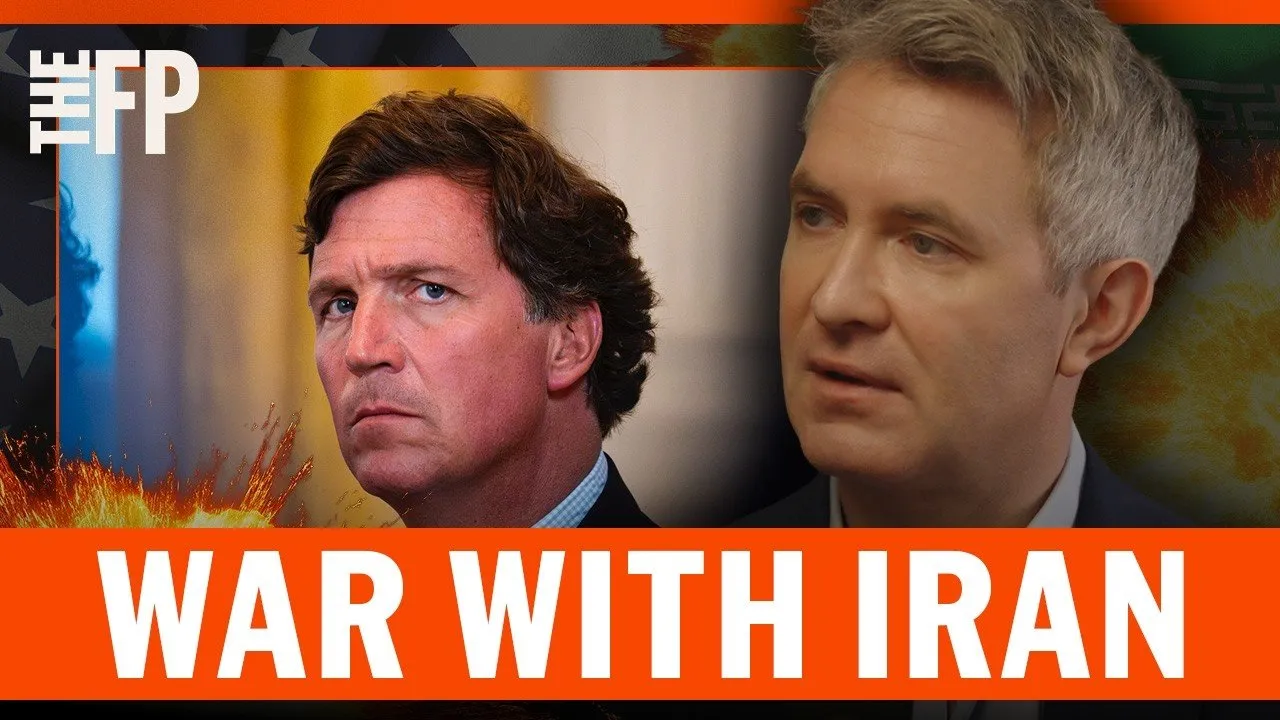
The strikes have also exposed a rift within the conservative base, most notably through the vocal opposition of media figures like Tucker Carlson. Murray dismisses these critiques as "belches of opinion" that lack a fundamental understanding of the geopolitical stakes. He argues that many prominent figures have fallen into a trap of "low-resolution thinking," where complex global events are reduced to a single, often conspiratorial, explanation.
"Tucker Carlson makes outrageous claims... he just has sort of belches of opinion and that’s fine. That’s his right."
Murray specifically calls out the tendency to view every American foreign policy move through the lens of Israeli influence. He argues that this narrative ignores the decades of Iranian aggression against American interests, including the provision of IEDs that killed U.S. service members in Iraq and the sponsorship of terror cells across Europe and the United Kingdom. Notably, even the British government, which is often cautious in its rhetoric, recently admitted to stopping 20 Iranian-linked terrorist plots on its soil in a single year.
The Iranian People and the Prospect of Regime Change
At the heart of Murray's argument is the belief that the Iranian regime is currently at its most vulnerable point since the 1979 revolution. For decades, internal security forces like the Basij militia have used "unbelievable brutal violence" to crush dissent, most notably during the Green Revolution of 2009. The current strikes are seen as a way to weaken these security apparatuses, providing the Iranian public with the space they need to take their country back.
The Role of Reza Pahlavi
Discussions regarding a post-revolutionary Iran often center on the diaspora and the potential for new leadership. Murray highlights Reza Pahlavi not as an imposed monarch, but as a potential "convening figure" who could unify the various factions—monarchists, liberals, and others—that have historically struggled to coordinate their opposition to the Ayatollahs. The goal, Murray insists, is not to impose a leader from the outside, but to facilitate an interim solution that allows the Iranian people to decide their own future.
A History of Repression
It is important to remember that the Iranian regime’s reach extends far beyond its borders. Murray points to hit squads sent to Brooklyn to silence critics and the ongoing execution of protesters within Iran. Critics of U.S. intervention, he argues, often fail to acknowledge the moral imperative of opposing a regime that actively exports death squads to Western cities while "massacreing" its own citizens at home.
The October 7th Miscalculation: A Geopolitical Backfire
The current instability in Tehran can be traced back to the Hamas-led attacks on Israel on October 7, 2023. Murray argues that history will judge Yahya Sinwar's decision as one of the most catastrophic military misjudgments in history. What was intended as a blow to Israel has instead triggered the systematic dismantling of the entire Iranian "octopus."
"Sinwar was just one arm of this octopus, but the head of it in Tehran looks like it could itself now be decapitated."
The sequence of events is striking: the decimation of Hamas's leadership, the destruction of Hezbollah's command structure in Lebanon, the fall of the Assad regime in Syria, and the crippling of Iran's nuclear capabilities. By launching the October 7th attack, the Iranian proxies effectively forced a regional realignment that has left the central revolutionary government in Tehran isolated and exposed.
Conclusion
The strikes against Iran represent more than just a momentary flare-up in the Middle East; they are the culmination of decades of tension and a radical shift in American strategic response. Douglas Murray’s perspective suggests that we are witnessing the "end stages" of a war that began with the 1979 revolution. While skeptics fear another protracted entanglement, the evidence points toward a strategy of surgical decapitation intended to empower a long-oppressed population. Whether this "window of opportunity" results in a free Iran remains to be seen, but the era of tolerating state-sponsored terrorism without consequence appears to have come to a decisive end.