Table of Contents
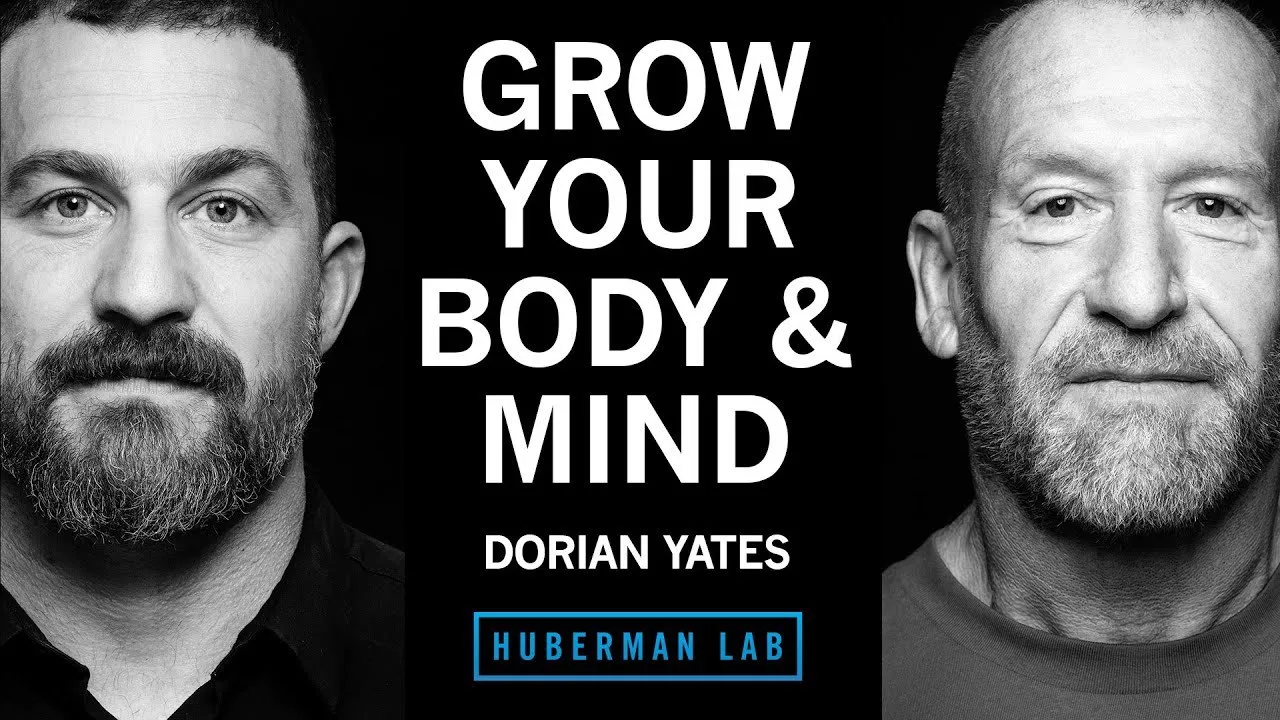
In the pantheon of bodybuilding history, few names carry the weight and mystique of Dorian Yates. A six-time Mr. Olympia winner, Yates revolutionized the sport in the 1990s not just with his unprecedented physical mass, but with a training philosophy that defied the high-volume conventions of the era. Known as "The Shadow" for his tendency to avoid the limelight and focus intensely on his craft, Yates proved that less can indeed be more—provided the intensity is absolute. In a wide-ranging discussion with Dr. Andrew Huberman, Yates deconstructs the methodology behind High-Intensity Training (HIT), offers a candid look at the psychology of a champion, and explores his evolution into longevity, mobility, and spiritual consciousness.
Key Takeaways
- Intensity Over Volume: True muscular growth is stimulated by taking exercises to absolute failure, rather than performing endless sets that merely burn calories without triggering adaptation.
- Recovery is Growth: The body does not grow in the gym; it grows during rest. Training frequency should be low enough (often 2-3 times per week) to allow full systemic recovery.
- Practical Efficiency: For the average individual, profound health and aesthetic changes can be achieved with two 45-minute resistance sessions and highly efficient sprint-based cardio per week.
- Psychological Alchemy: Negative emotions and hardships can be powerful, albeit temporary, fuel for achieving elite performance if channeled correctly ("alchemy of anger").
- Evolution of Identity: Longevity requires pivoting from pure hypertrophy to functional health, including mobility work, yoga, and a willingness to explore consciousness beyond the physical ego.
The Philosophy of High-Intensity Training (HIT)
Dorian Yates is synonymous with the "Blood and Guts" style of training, a hybrid evolution of principles originally championed by Arthur Jones and Mike Mentzer. While the prevailing wisdom of the 1970s and 80s—popularized by figures like Arnold Schwarzenegger—advocated for double-split routines and hours in the gym six days a week, Yates took a logical, evidence-based approach to hypertrophy.
The body does not want to change. It wants to keep status quo. So you got to give it a bloody good reason... to change.
Stimulate, Don't Annihilate
The core tenet of Yates' approach is that exercise is a form of stress designed to trigger an adaptation. Once that trigger is pulled, further stress is counterproductive. His methodology is defined by several distinct characteristics:
- One Set to Failure: After adequate warm-ups, Yates advocates for a single working set taken to true muscular failure—and often beyond, using forced reps or negatives. If the intensity is sufficient, a second set is unnecessary.
- Mind-Muscle Connection: Moving weight is secondary to engaging the muscle. Beginners must master mechanics before attempting high-intensity failure to ensure the stress is placed on the target fibers rather than connective tissue.
- The Myth of the Pump: Yates argues that the "pump" (blood filling the muscle) is transient and not an indicator of growth. Growth comes from micro-trauma and subsequent repair, not temporary blood flow.
- Diminishing Returns: In the first year of training, progress is linear. However, as an athlete advances, the stress required to trigger growth increases, meaning recovery time must also increase. Training more often as you get stronger is often a mistake.
- Systemic Recovery: It is not just the muscle that needs to recover, but the central nervous system (CNS). Heavy compound movements like leg presses or deadlifts tax the CNS heavily, requiring days of rest to restore neurological output.
- Periodization: Yates suggests training with maximum intensity for six weeks, followed by a two-week "deload" phase where intensity is dialed back to allow for deep recovery and injury prevention.
Practical Training for Health and the Average Person
While Yates applied these principles to become the best bodybuilder in the world, he adamantly believes that this efficiency model is even more applicable to the general population. The common excuse of "lack of time" is rendered obsolete by the efficiency of HIT.
The Minimum Effective Dose
For the average person seeking health benefits, metabolic regulation, and improved body composition, Yates outlines a streamlined protocol:
- Frequency: Two to three 45-minute whole-body sessions per week are sufficient to reverse muscle loss (sarcopenia) and improve insulin sensitivity.
- Exercise Selection: A routine consisting of 8-10 compound exercises (presses, pulls, squats) covers the entire musculature. Isolation movements like bicep curls are secondary to multi-joint movements.
- Cardiovascular Efficiency: Rather than 45 minutes of steady-state cardio, Yates recommends high-intensity interval sprints. For example, on an air bike: 20 seconds of all-out effort followed by a minute of recovery, repeated for just a few cycles. This yields similar cardiovascular benefits to long-duration cardio in a fraction of the time (approx. 6 minutes total).
- Reversing Metabolic Disease: Yates cites case studies where diabetic and pre-diabetic individuals normalized their blood sugar and liver enzymes within a month using this low-frequency training combined with a low-carbohydrate diet.
- Structure for Beginners: Novices should spend the first few weeks simply learning form. Intensity should only be ramped up once the neurological pathway of the movement is secured.
- Women's Training: Yates pushes back against the notion that women need vastly different training modalities. To achieve a "toned" look, women must build muscle and lose fat; the physiological requirements for this—progressive overload—are the same as for men.
The Psychology of a Champion
Physical genetics are a prerequisite for the Mr. Olympia stage, but Yates attributes his dominance to his mental fortitude. His ability to compartmentalize and utilize negative emotion set him apart from his peers.
The Alchemy of Anger
Yates utilized what he calls "f*** you motivation." He viewed his training not just as a sport, but as a vehicle to escape his working-class circumstances in Birmingham and prove doubters wrong. This process involves:
- Transmutation of Emotion: Taking destructive feelings—anger, resentment, feelings of inadequacy—and converting them into kinetic energy in the gym.
- Tunnel Vision: Yates was famous for his lack of socialization in the gym. He describes a "tunnel" state where the outside world ceased to exist, allowing for total focus on the physical task.
- Ritualistic Preparation: To trigger this state, Yates employed strict rituals, such as ironing his gym clothes before every session. This mundane act served as a mental transition from his daily life into his "warrior" persona.
- Thick Skin: Whether being an underdog or the favorite, Yates maintained a fatalistic, logical perspective. He focused solely on his own preparation, ignoring the politics and opinions of judges or rivals.
- The Trap of Comfort: Yates noted that many athletes lose their edge once they achieve success. He consciously avoided the glitz of the California bodybuilding scene, staying in the gritty environment of Birmingham to maintain his "hunger."
- Identity Management: While helpful for competing, this extreme focus can be detrimental post-career. Yates admits that finding joy during his reign was difficult, as every moment was calculated for the singular goal of winning.
I use a special type of motivation. It's called 'fuck you' motivation... Whatever you got inside you, anger, negative emotions, use it all. Use it all like fire.
The Truth About Performance Enhancers
In an era of transparency, Yates is candid about the role of chemical enhancement in professional bodybuilding. However, he offers a sobering reality check for young men and recreational lifters obsessed with TRT (Testosterone Replacement Therapy) and anabolics.
Risk, Reward, and Reality
Yates views steroids through a lens of pragmatism and caution:
- The Merry-Go-Round: Steroid gains are temporary. Once a cycle stops, the muscle is lost, and the user often faces hormonal crashes and depression. This creates a psychological dependency where one feels compelled to stay "on" permanently.
- Natural Potential First: Yates trained for years and reached a high level of muscularity before touching performance enhancers. He advises that people should maximize their genetic potential naturally before even considering assistance.
- Health Consequences: While muscle mass itself carries metabolic demands, the real dangers often lie in the ancillaries—diuretics (which can be fatal), high blood pressure, and organ stress.
- The Justification Filter: Yates had a strict rule: if he did not place in the top five of his first pro show, he would quit and stop using drugs. He viewed the health risks as only justifiable if he could be the absolute best in the world.
- Modern Abuse: He criticizes the current culture where recreational lifters use dangerous compounds purely for cosmetic reasons (Instagram photos, beach body) without the career justification or medical monitoring.
- The Mental Toll: Beyond physical side effects, the fluctuation in hormones can wreak havoc on mental stability, a factor often overlooked by young users seeking instant gratification.
Evolution: Mobility, Yoga, and Longevity
Post-retirement, Yates underwent a significant physical and mental transformation. Moving away from the singular goal of mass, he embraced modalities that prioritize function and longevity.
From Mass to Mobility
Yates’ current routine is a stark contrast to his competition days, reflecting an adaptation to aging and injury history:
- Structural Integrity: After years of heavy loading, Yates now utilizes yoga and Pilates. Surprisingly, improved posture from these practices resulted in him regaining lost height, correcting the "hunch" common in bodybuilders.
- Cardiovascular Health: He emphasizes VO2 max and recovery heart rate as key metrics. His resting heart rate and recovery times rival those of men half his age.
- Sunlight and Circadian Biology: Moving to Spain allowed Yates to embrace the benefits of sunlight. He argues that solar exposure is critical not just for Vitamin D, but for mitochondrial function and dopamine regulation.
- Gut Health and Fasting: He has shifted away from the "bodybuilder diet" of eating every two hours. He now practices intermittent fasting and eats lower protein quantities than before to reduce digestive stress and mTOR activation.
- Cannabis for Recovery: Yates discusses his long-term use of cannabis, citing potential neuroprotective benefits and its utility for relaxation in high-drive individuals, though he acknowledges it is highly individual-dependent.
- Injury Management: Training now focuses on maintenance rather than progressive overload. He utilizes isolation movements and machines to work around torn biceps and triceps tendons accumulated during his career.
Consciousness and Psychedelic Exploration
Perhaps the most surprising evolution in Yates' journey is his deep dive into psychedelics, specifically Ayahuasca and DMT. This exploration facilitated a shift from a rigid, ego-driven identity to a more fluid, connected state of being.
The Dissolution of the Ego
Yates describes his psychedelic experiences as a "defragging" of the hard drive, allowing him to process trauma and redefine his place in the world.
- The Ocean and the Drop: Yates uses the analogy that we are all individual drops that are part of the same ocean. Psychedelics shattered the illusion of separation, fostering a sense of universal connection.
- Processing Trauma: The intense introspection allowed him to address unresolved issues, including the loss of his father at a young age, which had been subconsciously driving his need for achievement.
- Identity Beyond Sport: These experiences helped him navigate the difficult transition of retirement. He learned to dissociate "Dorian the Bodybuilder" from his true self, finding peace in simply being.
- Perspective on Reality: He views reality as a subjective construction of the mind. By altering consciousness, one can change their perception of life, reducing stress and increasing gratitude.
- Integration: Yates emphasizes that psychedelics are not recreational toys but tools for learning. Once the lesson is learned ("once you get the message, hang up the phone"), the focus should shift to integrating those insights into daily life.
- Mentorship: His current role is no longer about building the biggest back in the world, but about mentoring others to find balance between physical discipline and mental peace.
We're consciousness having an experience... We're all connected having separate experiences. That's what I got.
Conclusion
Dorian Yates' journey is a testament to the power of logical consistency and intense dedication. He applied a scientific, almost clinical mindset to building one of the greatest physiques in history, and then applied that same rigor to deconstructing it for the sake of health and longevity. His story offers a blueprint not just for muscle growth, but for life: intense effort followed by necessary rest, the transmutation of hardship into fuel, and the wisdom to know when to pivot from conquering the world to mastering the self.