Table of Contents
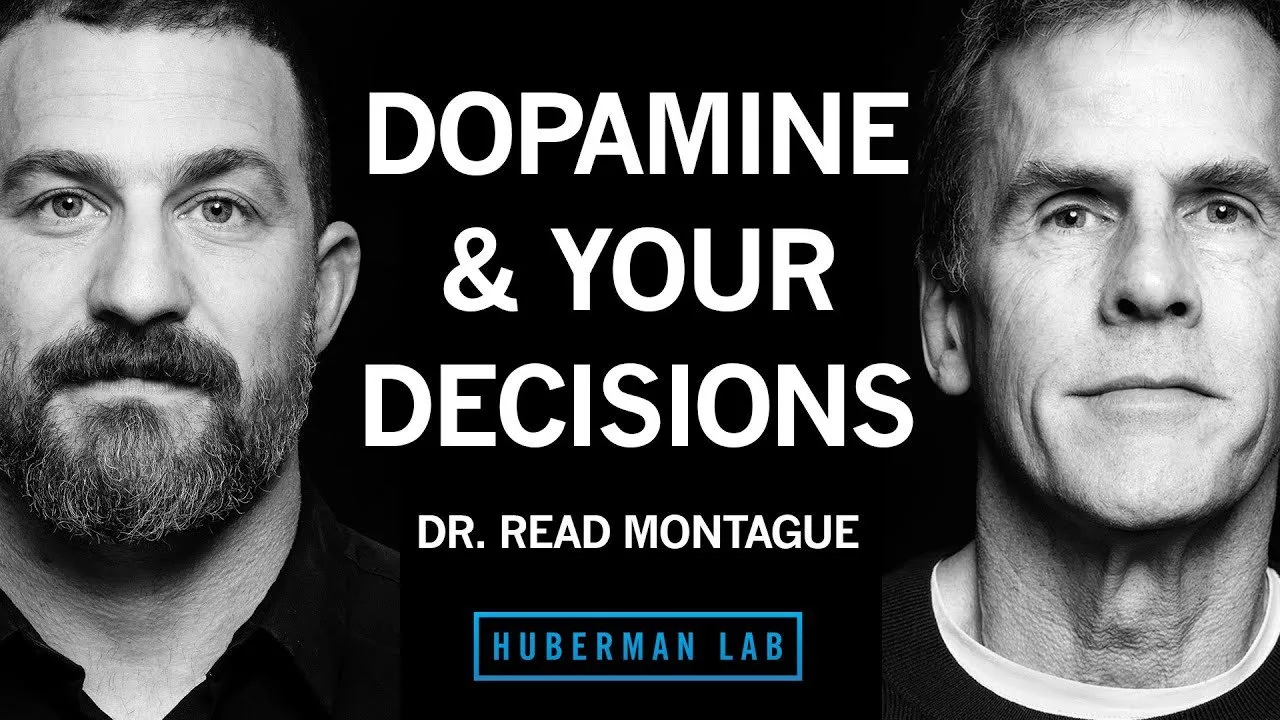
Most popular discussions about dopamine reduce it to a simple "pleasure molecule"—a chemical reward we get when we eat sugar, check social media, or achieve a goal. However, according to Dr. Read Montague, a pioneer in computational neuroscience, this view is scientifically incomplete. Dopamine is not merely about the destination; it is the currency of decision-making, the driver of learning, and the engine of movement. In this deep dive based on a conversation with Dr. Andrew Huberman, we explore how dopamine and serotonin function not just as mood regulators, but as sophisticated algorithms that help us navigate an uncertain world. By understanding the computational logic of these neuromodulators, we can better understand how we learn, why we persist, and how we assign value to our lives.
Key Takeaways
- Dopamine represents "Reward Prediction Error": It is a learning signal that updates your expectations based on the difference between what you predicted and what actually happened.
- The "Sawtooth" Pattern of Motivation: Dopamine levels fluctuate constantly as we "forage" for goals, updating our expectations long before the final reward arrives.
- Serotonin acts as an opponent to Dopamine: While dopamine generally signals "go" and positive expectation, serotonin often signals "wait," inhibition, or the processing of negative outcomes.
- The SSRI Mechanism is more complex than believed: Increasing serotonin via SSRIs may result in serotonin being taken up by dopamine transporters, potentially blunting the "positive" signals of the dopamine system.
- Biological Algorithms mirror AI: The reinforcement learning algorithms discovered in the human brain are remarkably similar to those used in advanced Artificial Intelligence systems like AlphaGo.
The True Function of Dopamine: Learning Through Prediction
For decades, the prevailing wisdom suggested that dopamine equals pleasure—levels go up when you feel good and down when you feel bad. While dopamine does correlate with positive events, its primary biological function is to serve as a learning signal. Dr. Montague explains that dopamine encodes "Reward Prediction Error" (RPE). This is the discrepancy between what you expected to happen and what actually occurred. This mechanism allows the brain to update its model of the world continuously, ensuring that we can adapt to new information without waiting for a final outcome.
This process transforms how we view motivation. Rather than a single spike at the finish line, dopamine creates a dynamic trajectory of expectations.
- Successive Predictions: Your brain doesn't just predict the final result; it predicts the next state. If you expect rain on Saturday, and new data arrives on Wednesday, your dopamine updates the prediction immediately, even though no rain has fallen yet.
- The Foraging Instinct: Humans and animals are built to forage. We move from milestone to milestone. Dopamine levels fluctuate in a "sawtooth" pattern, rising and falling with every piece of new information during the pursuit of a goal.
- Encoding "Better than Expected": When an outcome exceeds expectation, dopamine spikes. This "positive prediction error" tells the brain, "This is valuable; do it again."
- Encoding "Worse than Expected": Conversely, if an outcome falls short, dopamine dips below baseline. This "negative prediction error" teaches the brain to avoid that path or adjust expectations downward.
- Beyond Simple Reward: This system explains why we can chain complex behaviors together. We don't need a treat after every step; the successful completion of an intermediate step (like buying tickets for a vacation) releases dopamine because it confirms we are on the right path.
- Temporal Difference Learning: This is the computational term for how the brain learns continuously across time, updating predictions step-by-step rather than just at the end of a sequence.
If any goal that you achieved... was enough for you, right, then you wouldn't keep living. You want that system to keep tracking and once it gets to one place, you want it to have another place to which it could go.
Dopamine and Serotonin: A Seesaw of Motivation
While dopamine pushes us forward, serotonin is often doing the heavy lifting to hold us back or help us process negative information. Dr. Montague describes these two neuromodulators as an opponent system. In many contexts, they work in a seesaw fashion: when dopamine activity is high (signaling positive expectation), serotonin activity often drops, and vice versa. This biological opposition is essential for a balanced nervous system that knows when to act and when to freeze.
This dynamic plays out in everything from social interactions to basic survival mechanisms.
- The "Go" vs. "Wait" Signal: Dopamine generally facilitates movement and the pursuit of rewards. Serotonin acts as an inhibitor, signaling the organism to "active wait" or pause, especially in the presence of a threat or uncertainty.
- Processing Negative Outcomes: While dopamine learns from positive surprises, serotonin appears to be critical for learning from negative outcomes or "unwanted" events.
- Opponency in Action: In experiments involving economic games, when participants anticipate a win, dopamine rises and serotonin falls. When they anticipate a loss or unfairness, the reverse occurs.
- The Impact of Hunger: Physiological states change these rules. When an organism is starving, the dopamine system may "flip," causing dopamine to encode information about punishments or aversive events to ensure survival.
- Emotional Regulation: This chemical balance helps stabilize brain states. Without the inhibitory, stabilizing effects of serotonin, the "go" signals of dopamine could lead to chaotic, unceasing action or impulsivity.
- Patience as an Active Process: Waiting isn't just doing nothing; it is a serotonergic activity. It requires energy to inhibit the impulse to move, which is why patience can feel effortful.
The Hidden Complexity of SSRIs and Neurochemistry
One of the most startling revelations from Dr. Montague involves the mechanism of Selective Serotonin Reuptake Inhibitors (SSRIs), commonly used to treat depression and anxiety. The standard explanation is that these drugs prevent serotonin from being reabsorbed, leaving more of it available in the synapse to improve mood. However, the biological reality involves "promiscuous" transporters that may alter how we process rewards entirely.
Dr. Montague highlights research suggesting that when serotonin levels are artificially elevated, the brain's "cleanup" mechanisms get overwhelmed, leading to chemical crossover.
- The Reuptake Mechanism: Normally, specific transporters vacuum up neurotransmitters after they are used. Dopamine transporters clean up dopamine; serotonin transporters clean up serotonin.
- Chemical Crossover: Research indicates that dopamine transporters are "promiscuous"—they can also bind to and uptake serotonin. When SSRIs block serotonin transporters, the excess serotonin may get vacuumed up by the dopamine transporters.
- The "False" Signal: If serotonin (the "wait/negative" signal) ends up inside dopamine terminals (the "go/positive" signal), it can later be released when the brain attempts to signal a reward.
- Blunted Rewards: This hypothesis suggests that SSRIs might cause the dopamine system to release a "mixed message" during positive events, potentially reducing the feeling of reward or pleasure (anhedonia) often reported by users.
- Long-Term Adaptation: The brain is plastic; over weeks or months, it attempts to reach homeostasis, changing receptor sensitivity in response to these flooded chemical states.
- Heterogeneous Effects: This mechanism explains why reactions to antidepressants are so varied—working miraculously for some while causing emotional blunting or increased agitation in others.
If you put the negative juice in the positive terminals, then the cells that control the release of that are going to chatter for positive things. You might start negatively conditioning on things that you should actually pursue.
Movement, Urgency, and the Physics of Thought
We often separate "thinking" from "moving," but neurobiologically, they are deeply intertwined. Dopamine is the bridge between the two. The same chemical that motivates you to think about a goal is the chemical that enables your muscles to move toward it. This is most tragically visible in Parkinson’s disease, where the death of dopamine neurons leads not to paralysis, but to a "freezing" of will and movement.
Dr. Montague reframes Parkinson's not just as a motor issue, but as a valuation issue.
- The Noise Floor: In Parkinson’s, as dopamine neurons die, the "signal-to-noise" ratio in the brain drops. The brain can no longer clearly distinguish the value of one action over another.
- Active Freezing: Because the brain cannot calculate that moving is more valuable than staying still, it defaults to inaction. The "freezing" is a rational response to a lack of value data.
- Urgency vs. Motivation: Huberman and Montague discuss "urgency" as a more accurate term than motivation. Urgency implies a friction-filled need to move or act, driven by dopaminergic spikes.
- Thought as Movement: The brain likely uses the same circuitry to move thoughts forward as it does to move limbs. Dopamine stabilizes a "thought state" and then propels the mind to the next state.
- The Energy of Decisions: Dopamine initiates mitochondrial function, literally ramping up energy production (ATP) to power the transition from one state to another.
- Physical Resilience Transfers: Physical challenges (like sports) train these dopaminergic pathways to handle "pain" and high effort, which likely translates to cognitive resilience and the ability to pursue long-term goals.
Biological Algorithms and the AI Revolution
Perhaps the most profound insight Dr. Montague offers is the convergence of biology and artificial intelligence. The algorithms that power modern AI, such as Reinforcement Learning (RL), were not just invented by computer scientists; they were discovered in the brain stem of animals. The "Temporal Difference Learning" algorithm used by AlphaGo to beat the world champion is functionally identical to the learning rules encoded by dopamine neurons in humans, bees, and rodents.
This suggests that our brains are running potent mathematical computations to navigate survival.
- Reinforcement Learning (RL): This is the method of learning by interacting with an environment. An agent takes an action, receives feedback (reward/punishment), and updates its policy.
- The Sutton and Barto Algorithm: A breakthrough in computer science that modeled how to predict future rewards. It turned out to map perfectly onto biological dopamine signals.
- Externalizing the Mind: We have effectively taken the "gremlins in our brain stem" (the algorithms) and written them into code, allowing computers to solve problems (like protein folding) that humans could not.
- Exploration vs. Exploitation: Like AI agents, humans must choose between "exploiting" a known reward (going to the restaurant you know is good) or "exploring" a new one (risking a bad meal for a potentially better one). Dopamine regulates this trade-off.
- Honeybee Parallels: Even honeybees show "ADHD-like" behavior in this context. Some bees are "explorers" (distractible, finding new food), while others are "exploiters" (focused, gathering known food). A healthy hive—and a healthy human mind—needs both modes.
- The Future of Neuroscience: The next frontier is using these computational models to diagnose mental health issues, moving from subjective descriptions to mathematical measurements of how a patient's "learning rate" or "reward sensitivity" has malfunctioned.
Dopamine as Currency: Real-Time Measurement
Dr. Montague’s lab is currently revolutionizing how we study the human brain by measuring neurotransmitters in real-time. Using electrochemical probes implanted in patients (often during epilepsy monitoring) or non-invasive probes placed in the nasal cavity, they can watch dopamine and serotonin fluctuate as people think, trade, and play games.
These experiments confirm that dopamine acts as a universal currency for the brain.
- The Common Denominator: Just as money allows us to trade apples for cars, dopamine allows the brain to compare dissimilar things—a cup of coffee vs. a promotion at work. It assigns a "common value" to all inputs.
- Nasal Recordings: A breakthrough method involves placing sensors on the olfactory epithelium (inside the nose), which is neural tissue connected directly to the brain. This allows for "minimally invasive" measurement of dopamine in healthy populations.
- Breathing and Chemistry: Montague’s data reveals that neurotransmitter fluctuations often synchronize with the breathing cycle, suggesting a deep physiological link between respiration, energy production, and cognitive state.
- Social Exchange: In "Ultimatum Games," where people trade money, dopamine signals track "fairness" and "expected value" with incredible precision, proving these chemicals mediate complex social interactions.
- Sub-Second Precision: Unlike fMRI, which is slow, electrochemical recordings capture the speed of thought, revealing the sub-second computations that drive our lives.
- Personalized Mental Health: The ultimate goal is to use these measurements to create objective "blood tests" for the mind, identifying exactly which chemical systems are dysregulated in conditions like depression or addiction.
Dopamine is the underlying currency. It takes dissimilar objects and assign a common value scheme to them.
Conclusion
Dopamine is far more than a simple pleasure switch; it is the architect of our reality. It teaches us what to value, propels us through hardship, and constantly updates our view of the future. By understanding the dance between dopamine and serotonin, we can begin to see our own behaviors—from our social media habits to our long-term ambitions—not as mysteries, but as the outputs of ancient, sophisticated algorithms. As neuroscience and AI continue to converge, we are approaching a future where we can measure, understand, and optimize these internal signals to lead healthier, more resilient lives.