Table of Contents
Dolby Laboratories unveiled comprehensive details regarding its new Dolby Vision 2 HDR format at CES 2026, demonstrating significant visual improvements across both premium and budget television tiers. The demonstrations highlighted how the new standard utilizes advanced metadata rather than artificial intelligence to preserve creator intent, promising a major upgrade for home cinema enthusiasts and sports fans alike later this year.
Key Takeaways
- Visual Performance: Side-by-side comparisons reveal significant improvements in color depth and motion handling, particularly on budget-friendly displays costing as little as $200.
- Content Intelligence: Unlike AI upscaling, Dolby Vision 2 relies on metadata to map filmmakers' precise data to specific TV hardware capabilities, preserving the original artistic look.
- Hardware Availability: Select existing TV models from Hisense, TCL, and TP Vision (Philips) possess the necessary silicon to support the format via firmware updates in 2026.
- Live Sports Innovation: A partnership with NBC’s Peacock will bring customizable audio mixes to live sports, allowing viewers to adjust the volume balance between commentators and stadium noise.
Performance Across Display Tiers
During private demonstrations at CES 2026, Dolby showcased the efficacy of Dolby Vision 2 across a spectrum of hardware pricing. While a 100-inch premium display boasting 5,000 dimming zones and 5,000 nits of brightness delivered predictable excellence, the most significant revelations occurred in the lower price brackets.
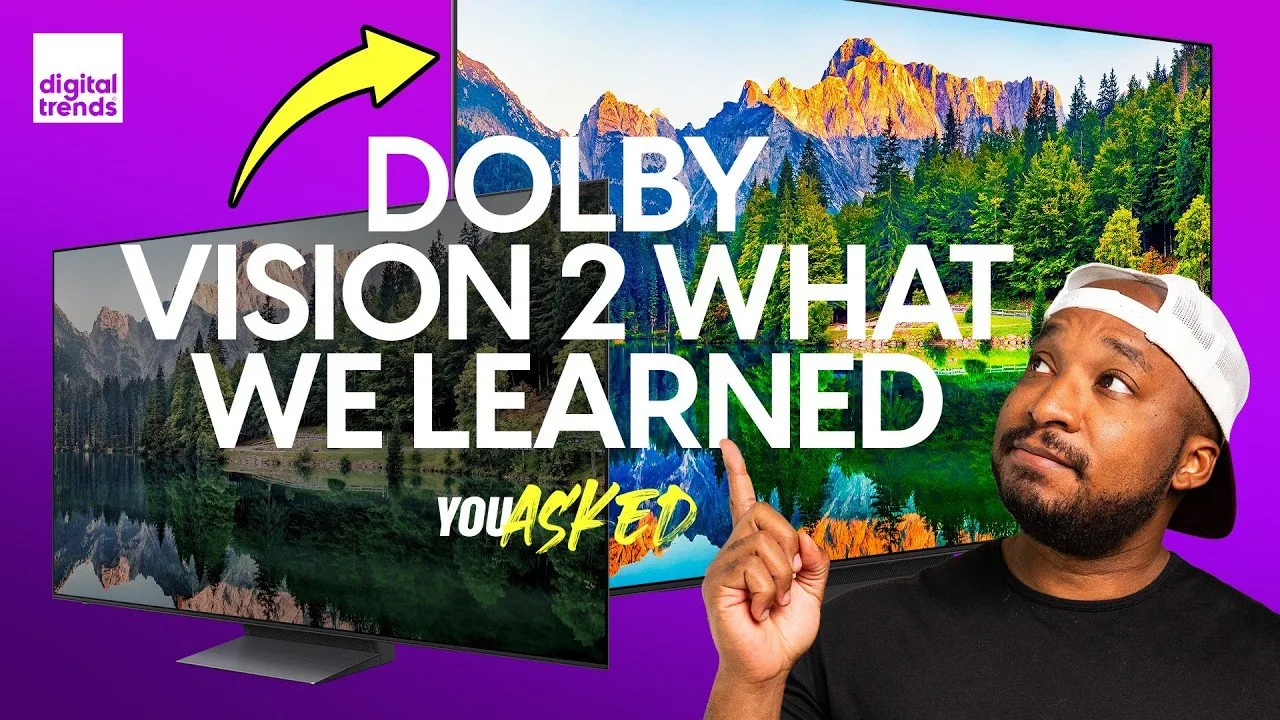
On mid-range models priced around $700, the new format provided noticeable improvements in color depth and realism without appearing over-saturated. However, the technology's impact was most profound on entry-level televisions. On displays costing between $200 and $300—hardware that typically lacks full-array local dimming—Dolby Vision 2 managed to elevate picture quality to levels comparable with significantly more expensive LED units.
"With Dolby Vision, if I didn't tell you that these were budget TVs, I don't think you'd be able to tell... The difference is striking."
This development suggests a democratization of high-fidelity HDR, making premium visual experiences attainable for consumers restricted by budget constraints, provided they have access to supported streaming services.
Defining "Content Intelligence" vs. AI
A primary point of clarification at CES involved the underlying technology driving these improvements. Despite the industry's trend toward generative technologies, Dolby explicitly stated that Dolby Vision 2 is not a form of Artificial Intelligence. Instead, the company describes the system as "Content Intelligence," a metadata-rich communication protocol between the studio and the consumer display.
Preserving Creator Intent
The system allows editors and colorists to embed detailed information regarding highlight and shadow detail directly into the content stream. The receiving television then interprets this data to optimize the image for its specific panel characteristics. This ensures that the specific grade created in the editing suite is translated accurately to the viewer's screen, regardless of the model.
Authentic Motion
This approach extends to motion handling through a feature Dolby calls "Authentic Motion." The format analyzes scenes in real-time to apply judder reduction only when necessary. This targeted approach aims to eliminate the "soap opera effect"—where smoothing is applied indiscriminately—ensuring that filmic motion remains intact while correcting technical artifacts.
User Customization and Control
The shift toward automated optimization raises questions regarding user control. Dolby’s marketing emphasizes a "picture that thinks for itself," which implies a move away from granular manual adjustments. While users can still force manual changes to brightness, contrast, or motion clarity, doing so disables the specific benefits of the Dolby Vision 2 processing.
To bridge this gap, Dolby has introduced an "Intensity Slider." This control does not adjust a single parameter but rather modifies a complex set of variables simultaneously to alter the overall look without breaking the Dolby Vision 2 standard. This design reinforces the company's philosophy of prioritizing the professional content pipeline over end-user calibration.
Hardware Support and Streaming Partnerships
Dolby confirmed that the hardware requirements for Dolby Vision 2 were established prior to the official announcement, meaning several existing television models possess the necessary System on Chip (SoC) architecture to support the format. Manufacturers are expected to roll out over-the-air firmware updates to enable functionality.
Confirmed support for the 2026 roadmap includes:
- Hisense: New RGB TVs and select Mini-LED models.
- TCL: Upcoming XQD Mini-LEDs and C-series televisions.
- TP Vision (Philips): 2026 OLED lineup.
Beyond hardware, Dolby is expanding its footprint in live broadcasting through a deepened partnership with NBC’s Peacock. As the streaming service secures more rights for the NBA and MLB, it plans to implement Dolby Vision and Dolby Atmos for live events. Furthermore, the integration of the Dolby AC4 audio codec will introduce a user-centric audio feature: the ability to balance commentary against ambient stadium noise. This allows viewers to lower the volume of commentators in favor of a more immersive, venue-centric audio experience.
As manufacturers begin deploying these firmware updates throughout 2026, the value proposition for entry-level 4K televisions is likely to shift significantly. By decoupling high-end HDR performance from high-end panel hardware, Dolby Vision 2 represents a strategic pivot toward software-defined visual fidelity in the consumer electronics market.
![Bitcoin Is on Sale [How to Buy It in 2026]](/content/images/size/w1304/format/webp/2026/03/how-to-buy-bitcoin-2026.jpg)