Table of Contents
In the whirlwind of recent technological advancements, a common refrain has emerged among professionals: "I just can’t read enough on AI." The sheer volume of takes, tools, and think pieces is overwhelming. Yet, amidst the noise, a critical question remains unanswered for many: Does artificial intelligence actually save us time?
A recent Harvard Business Review piece suggests a counterintuitive reality—that while AI increases the pace of work, it doesn't necessarily grant us more free time. Instead, it raises expectations. We produce more drafts, iterate faster, and review higher volumes of work. This creates a paradox where productivity tools result in a denser, more demanding workday rather than a shorter one.
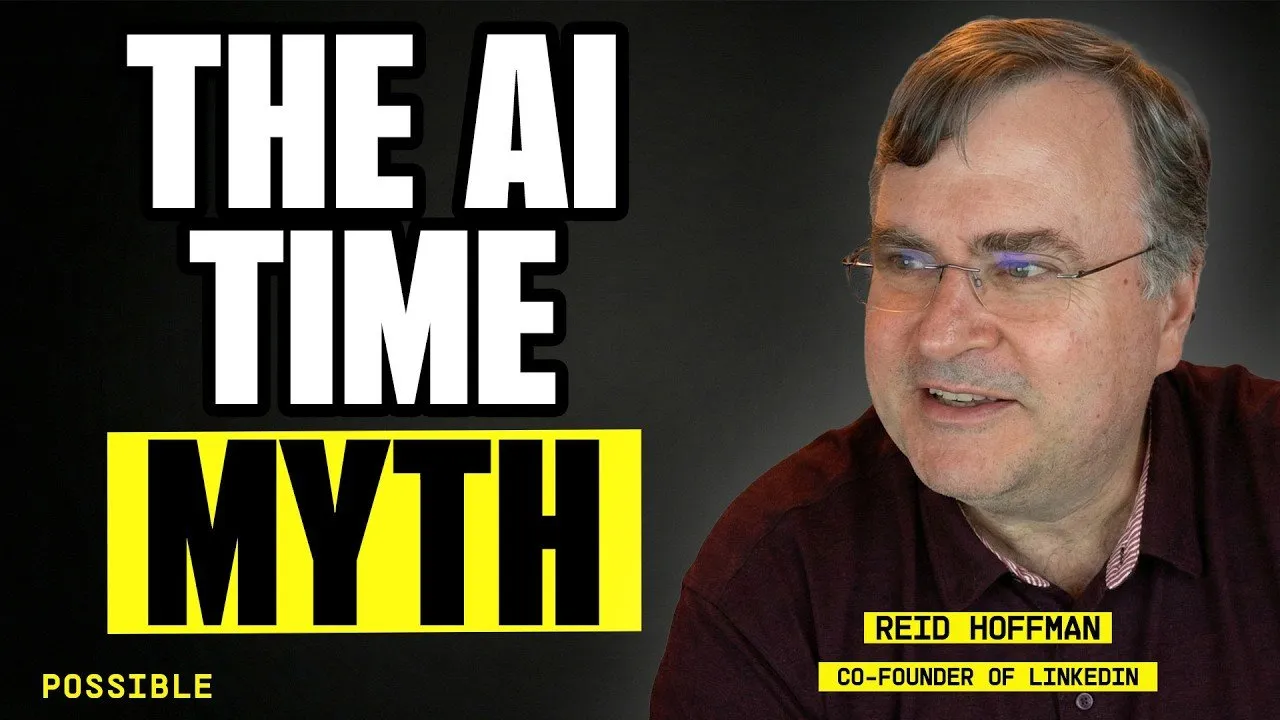
To navigate this complex landscape, we analyze insights from Reed Hoffman regarding the true nature of AI productivity, the competitive dynamics of "tool-shaped objects," and why the human element of metacognition remains irreplaceable.
Key Takeaways
- Expectation Inflation: AI is undoubtedly a time accelerant, but the time saved is often immediately reinvested into higher quality outputs or competitive maneuvering rather than leisure.
- The "S-Curve" Reality: While AI adoption feels exponential (a J-curve) right now, all technologies eventually hit a saturation point (an S-curve), though that plateau may be significantly higher than current human capabilities.
- Competitive Dynamics: In adversarial fields like law or sales, AI won't necessarily simplify processes; it may make them more complex as opposing sides use tools to cover more ground and mitigate more risks.
- Metacognition is Key: The ultimate human advantage is not doing the work, but defining the strategy—knowing what to ask the AI to do and why.
The Accelerant Trap: Speed vs. Expectation
There is a fundamental misunderstanding about what "saving time" means in a professional context. If a task that previously took three days can now be done in 15 minutes, the logical assumption is that the worker gains three days of free time. However, market dynamics rarely allow for this stagnation.
Reed Hoffman argues that AI acts as a massive accelerant, but that acceleration changes the "fitness function" of the work itself. Consider the classic project management triangle: Fast, Good, Cheap—pick two. AI fundamentally disrupts this equation, allowing for new configurations.
If an investor can perform due diligence on a company in 30 minutes using AI—a task that once took days—they typically won't stop working for the rest of the week. Instead, they will likely choose one of two paths:
- Speed Competition: Deliver the term sheet in half the time to beat a rival investor.
- Quality Deepening: Spend the traditional amount of time but conduct an analysis that is twice as deep, covering more competitive substitutes and substitution products than previously possible.
Consequently, the "saved time" is consumed by the drive for higher quality or competitive speed. The volume of output increases, and the expectations for what constitutes a "finished product" rise accordingly.
"Saving time doesn't mean that I would do my work in 15 minutes and then I go have margaritas on the golf course... Because part of the nature of a lot of this work is it's competitive."
The Legal Paradox: Why Efficiency Won't Simplify Bureaucracy
One of the most compelling arguments against the idea that AI will simply "streamline" everything comes from the legal sector. It is tempting to believe that AI will reduce the cost of doing business by shrinking the time required to draft contracts. If an AI can generate a contract in seconds, shouldn't legal fees plummet and contracts become simpler?
Hoffman posits the opposite. Legal contracts are long and dense not because lawyers are slow typists, but because they are optimizing for risk mitigation. They are trying to cover every "corner case" within the budget provided.
The Arms Race of Complexity
When the cost of generating clauses and analyzing risks drops to near zero, opposing legal teams will likely use that leverage to make contracts more comprehensive, not less. If both sides are using AI to generate, analyze, and suggest clauses, contracts might become 5x longer because the tools allow for an exhaustive coverage of edge cases that was previously cost-prohibitive.
This phenomenon extends beyond law into any adversarial or competitive field. If you are using ChatGPT to write marketing copy, but your competitor is using a sophisticated agent workflow to target higher quality outputs and generate 100 variations for A/B testing, simply "using AI" gives you no differential edge. The workload doesn't vanish; it shifts from creation to strategy and management.
Tool-Shaped Objects vs. The Disruption Wave
Current discourse on the internet is dominated by two viral, opposing viewpoints regarding where we stand in the AI adoption cycle.
- Perspective A: "Something Big is Happening." This view compares the current moment to February 2020—the calm before a massive, exponential shift. Proponents argue that we are on a "J-curve" where white-collar work is about to be steamrolled by massive acceleration in model capabilities.
- Perspective B: "Tool-Shaped Objects." This skepticism argues that while we are consuming massive amounts of compute and generating tokens, the actual economic output is marginal. It suggests we are creating dashboards and "busy work" that feels like productivity but lacks substance.
The reality, as is often the case, likely lies in the middle. While the "J-curve" of exponential growth is visible in technical benchmarks, all growth curves in nature eventually turn into "S-curves"—they level off. The constraints of human adaptability, organizational friction, and implementation speeds act as brakes on pure technological acceleration.
However, dismissing AI as merely "tool-shaped objects" ignores the nuance of specialized roles. A kernel engineer working on server architecture might not see immediate daily gains from current LLMs. In contrast, a smartphone app developer or a financial analyst might already be seeing their workflows revolutionized.
The Metacognition Frontier
If AI creates a world where execution becomes commoditized—where code can be written instantly and copy generated on demand—what is left for the human? The answer lies in metacognition.
Metacognition refers to the ability to think about thinking—to understand the strategy, the context, and the "why" behind the task. AI agents are becoming excellent at executing tasks within a closed system (like a game of Chess or Go), where the rules are defined and the goal is clear. Real-world business, however, is not a closed system.
Defining the "Fitness Function"
Consider the task of coding a video game. A basic prompt might be: "Make me a game that people will pay money for." The output will likely be generic and unsuccessful.
A human exercising high-level metacognition would prompt differently: "I have analyzed the market trends of Fortnite and identified a gap. I want to build a series of small prototypes to test specific engagement mechanics. Run an analysis on the demand curves for these mechanics and then roll the successful ones into a larger game concept."
The differential edge in the AI era is not the ability to write the code, but the ability to define the strategy that directs the coding. The human's role shifts from operator to architect.
"One of the things that AI can do is to say, look, I don't need to attend these meetings... And if the AI agent was just listening... and did that, those are all important things. But those will become part of how we're going to shape this to better do our fitness function."
Conclusion
Does AI save time? Technically, yes. It drastically reduces the hours required to perform specific tasks. But broadly, no. In a competitive economy, saved time is a vacuum that is instantly filled with higher expectations for quality, speed, and volume.
The goal should not be to aim for a 4-hour workweek, but to understand that the nature of the work is changing. The competitive advantage belongs to those who use these tools not just to do the same work faster, but to do work that was previously impossible—deeper analysis, broader risk mitigation, and more complex strategy. We are moving from a world of manual execution to a world of strategic orchestration.