
Table of Contents
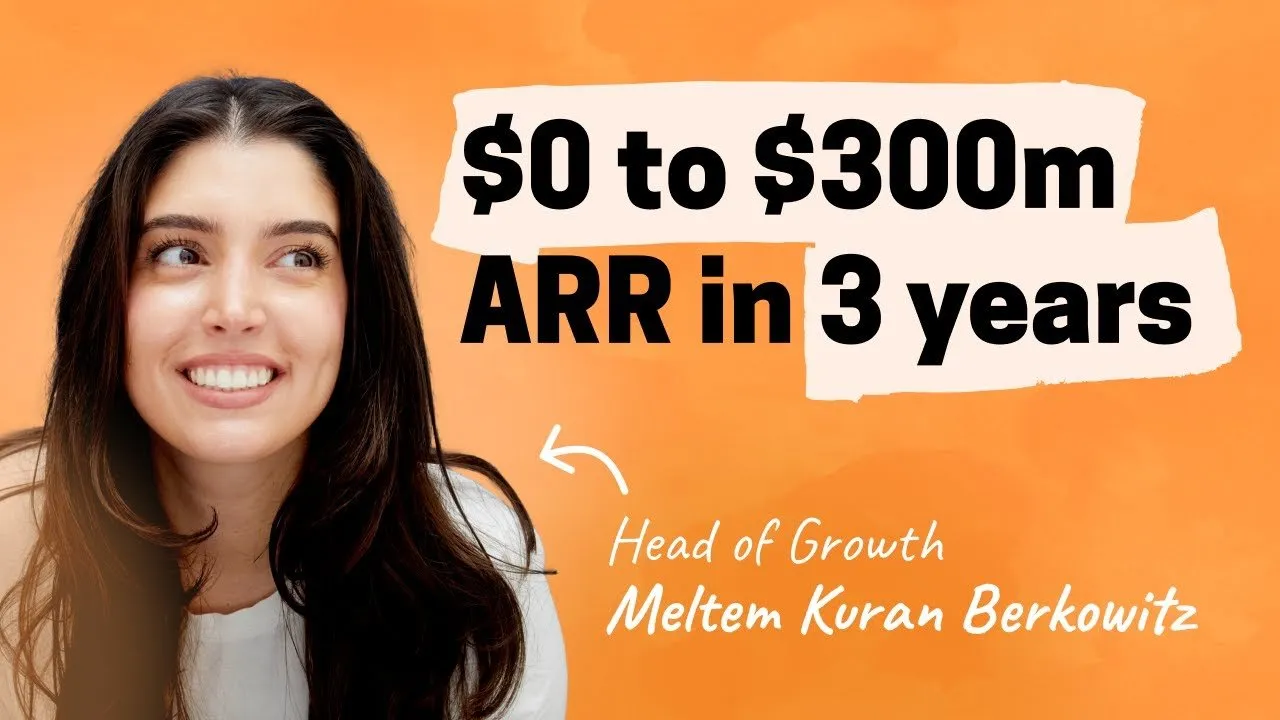
Deel is arguably the fastest-growing SaaS business in history. The company skyrocketed from zero to $295 million in ARR within three years, all while maintaining positive EBITDA. This trajectory surpasses even legendary growth stories like Slack and Ramp. While external observers might attribute this success to the remote work boom of the pandemic, the internal reality is a story of disciplined, fundamental execution led by Meltem Kuran Berkowitz.
As Head of Growth, Berkowitz steered the company from its earliest days through its explosive scaling phase. Her strategy wasn’t built on expensive brand campaigns or "silver bullet" hacks. Instead, she focused on unglamorous basics: site speed, helpful content, and answering customer questions one by one. The result is a playbook for B2B growth that prioritizes utility over sales pitches and discipline over complexity.
Key Takeaways
- Master the skeleton before the makeup: Do not invest in paid acquisition until your website is fast, your positioning is clear, and organic foundations are solid.
- Community growth requires value, not pitches: Success in low-cost channels like Reddit and Quora comes from answering specific questions thoroughly, not pasting links to your product.
- SEO is about ending the search: The primary metric for content success should be whether the user found their answer and stopped searching, not just keyword density.
- Hire for "Little Hands": Early growth hires must be willing to do the unglamorous, nitty-gritty work, regardless of their seniority or previous experience.
- Cultivate "Deel Speed": A culture of urgency and default optimism is a competitive advantage that keeps the team moving faster than competitors.
The "Skeleton Before Makeup" Approach
Founders and growth leaders often feel the pressure to launch paid ads immediately to drive traffic. However, Deel’s philosophy emphasizes a strict order of operations. Before spending a single dollar on advertising, the "skeleton" of the business must be sound.
This back-to-basics approach requires answering three fundamental questions before scaling:
- Is the website functional? It must load quickly and provide a seamless user experience. A site that takes four seconds to load renders any paid traffic strategy inefficient.
- Does the search engine know it exists? Technical SEO foundations ensure that Google can actually crawl and index the site.
- Can people find the answer to their problem? If users cannot organically find the solution you provide, you must write content to bridge that gap.
"You can't run a successful paid ads program if you have a website that's loading in four plus seconds. So really going back to the basics and starting from a good experience at the core... is how I would suggest everybody starts."
Only once these organic foundations are solid should a company layer on the "makeup" of paid advertising. This ensures that when paid traffic finally arrives, it lands on a high-converting, high-performance asset.
Winning Low-Cost Channels Through Radical Helpfulness
In the early days, Deel leveraged "cheap" growth channels not because they were free, but because they allowed the team to directly solve user problems. The strategy revolved around identifying where potential customers were asking questions—specifically on platforms like Reddit, Quora, and niche communities.
The Community Engagement Strategy
Many companies fail at community marketing because they treat it as a broadcast channel. They enter a subreddit or a Slack group and immediately post, "Check out our solution." This approach usually results in being ignored or banned.
Deel’s approach was different. They set up keyword alerts (using simple, sometimes "janky" tools) to notify the team whenever someone asked about international hiring, compliance, or payroll. When an alert triggered, a human—often Berkowitz or the co-founders—would jump in to provide a detailed, value-add answer.
The goal wasn't to sell; it was to solve. If a user asked about hiring a contractor in Germany, the team provided the specific compliance answer first. The pitch for Deel was secondary, offered only if it was a genuine fit. This built trust and ensured that their answers were upvoted and remained visible long after they were posted, creating a compounding effect of organic discovery.
Operationalizing SEO for Search Intent
Deel’s content engine contributes roughly 50% of their growth today. This success is not due to keyword stuffing, but rather a sophisticated operational framework that prioritizes "search intent" above volume.
The Traffic Light Framework
The content team creates a massive list of potential keywords—up to 700 at a time—and ranks them using a "Traffic Light" system based on intent:
- Green Light: High intent. The searcher has an active problem and is looking for a solution like Deel. (e.g., "How to pay a contractor in Brazil").
- Yellow Light: Moderate intent. The searcher might be a potential customer, or they might just be researching. It’s a 50/50 split.
- Red Light: Low intent. The searcher is likely a student or researcher with no intention to buy.
Execution starts with the Green keywords, moving from highest to lowest volume, before ever touching Yellow keywords. Red keywords are almost never touched, regardless of how much traffic they might bring.
The "Is the Search Over?" Metric
The ultimate metric for SEO quality at Deel is simple: Is the Google search over? If a user clicks on a Deel article, reads it, and then goes back to Google to find more information, the content has failed. If the user stops searching because they found the answer, the content is a success.
This requires understanding exactly what the user is looking for. For example, the acronym "EOR" stands for Employer of Record, but it also stands for "Enhanced Oil Recovery." Blindly ranking for "EOR" would attract the wrong audience. By analyzing the "People Also Ask" section of Google, Deel ensures they are answering the specific questions their actual prospects are asking.
Structuring and Hiring a High-Performance Growth Team
Building a team capable of sustaining 300% growth requires specific hiring filters. Deel looks for candidates who possess "Little Hands"—a concept loosely translated from French, meaning a willingness to do the small, unglamorous tasks regardless of one’s title.
The "Little Hands" Philosophy
When interviewing, Berkowitz looks for leaders who are willing to get into the weeds. If a Director of Growth candidate comes from a massive organization where they had abundant resources, the key question is: "When did you join?" If they only operated when the company was already large, they may struggle in a resource-constrained environment.
In a startup, a growth leader must be willing to manually track leads, fix broken links, or answer support tickets on Reddit. If a candidate suggests hiring an agency or building a team as their first solution to every problem, they are likely not a fit for the early stages.
Accountability to Revenue
The growth team at Deel is not measured by vanity metrics like traffic or leads. They are accountable for revenue. During interviews, candidates are asked what KPIs they are willing to commit to. If they only commit to top-of-funnel metrics (like leads generated) but refuse to own the bottom-of-funnel results (like closed-won revenue), it indicates a lack of alignment with business goals.
This alignment ensures that marketing doesn't just toss low-quality leads over the fence to sales. Instead, the growth team tracks the entire journey, optimizing for the actual money the business makes.
Culture: Deal Speed and Default Optimism
Strategies and tactics are powered by culture. Deel’s internal operating system is defined by two core values: "Deel Speed" and "Default Optimism."
Deel Speed
Velocity is the ultimate competitive advantage. Deel Speed is about acting with extreme urgency on behalf of the customer. If a client has a compliance issue, they cannot wait two weeks for a resolution. If the market demands a new feature, Deel aims to build it in one-tenth of the time a competitor would take.
"Deel speed is very, very important for us... If we need to build out a product because many customers are asking for it, that product is going to get built in one tenth the time that any of our competitors will likely build it in."
Default Optimism
Operating in a new market with complex international regulations requires a mindset of possibility. "Default Optimism" means approaching problems with the assumption that they can be solved. Instead of listing reasons why a new market expansion won't work, team members are expected to ask, "How can we make this work?" and then methodically mitigate the risks.
Conclusion
Deel’s rise to $295M ARR wasn't magic; it was the result of executing simple things with extraordinary discipline. By prioritizing value over volume, focusing on high-intent search traffic, and maintaining a culture of extreme speed, they built a machine that converts curiosity into customers.
For founders and growth leaders, the lesson is clear: Don’t overcomplicate the process. Build a solid skeleton, answer your customers' questions genuinely, and move faster than anyone else expects is possible.

)