Table of Contents
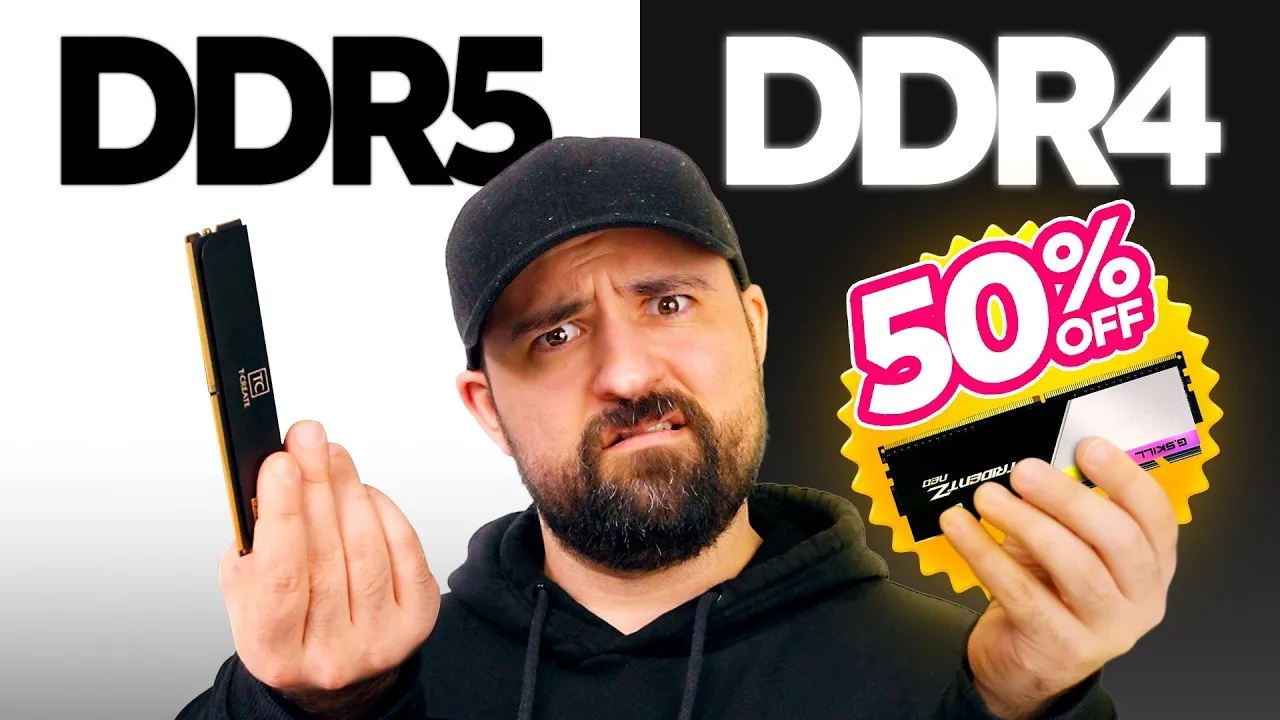
As consumer prices for next-generation DDR5 memory continue to climb, PC enthusiasts and gamers face a critical economic question: does the performance premium of the latest hardware justify the cost, or do older DDR4 platforms remain viable? New performance testing reveals that for high-resolution gaming, previous-generation architecture offers nearly identical average frame rates at a significantly lower entry price, challenging the industry push toward DDR5 standards.
Key Takeaways
- Cost Disparity: Building with Intel’s 12th Gen or AMD’s AM4 platform (DDR4) saved between 15% and 20% compared to a modern AMD AM5 (DDR5) system.
- Performance Parity: At 1440p resolution, average frame rates were statistically tied across generations, with the newer AM5 platform leading by only 9% in 1% low framerates.
- Market Context: With Intel 13th and 14th Gen chips facing stability concerns, the older 12th Gen remains the recommended path for Intel users seeking reliability.
- The Bottleneck Reality: At higher resolutions (1440p and 4K), the graphics card (GPU) remains the primary limiting factor, diminishing the impact of faster system memory.
The Rising Cost of Early Adoption
The memory market is currently experiencing significant volatility. Benchmarking data highlights a stark contrast in pricing between memory generations. During testing, a 16GB kit of high-performance DDR4 memory cost approximately $125, while a comparable DDR5 kit was priced at $225—a $100 premium for the memory alone. When factoring in motherboard and processor costs, the price gap widens significantly.
To evaluate whether this premium translates to real-world benefits, testers compared three distinct configurations:
- The Modern Standard: AMD Ryzen 7 7800X3D with DDR5 memory.
- The Intel Value: Intel Core i7-12700K with DDR4 memory (approximately $260 cheaper).
- The Budget King: AMD Ryzen 7 5800XT on the AM4 platform (approximately $1,500 total build cost).
Notably, the Intel 12th Gen processor was selected over newer 13th and 14th Gen counterparts due to ongoing microcode and instability issues affecting the newer chips, making the older architecture the safer recommendation for stability-focused builders.
Benchmarking Results: The 1440p Equalizer
Contrary to marketing claims suggesting DDR5 is essential for modern gaming, the data indicates that resolution plays a decisive role in component selection. Across a suite of 10 demanding titles—including Cyberpunk 2077 and Kingdom Come: Deliverance 2—the average frame rates were virtually indistinguishable between the expensive DDR5 rig and the affordable DDR4 builds.
The geometric mean of average FPS showed the systems were "neck and neck." While the premium AMD 7800X3D system did hold a measurable lead, it was primarily in "1% low" performance (a metric measuring stutter and consistency), outperforming the older chips by roughly 9%.
"Some of our games didn't care about our CPU RAM combo at all. Oblivion, Resident Evil 4, and Silent Hill F are all so close that I'd call them a tie."
However, the newer architecture demonstrated clear superiority in non-gaming tasks. For example, during shader compilation in Metal Gear Solid Delta, the modern AM5 system finished the task more than a minute faster than the Intel 12th Gen system. This suggests that while gamers may not see a difference, users with productivity workflows will benefit from the newer standard.
Future-Proofing vs. Immediate Value
The dilemma for consumers lies in the "upgrade path." The AMD AM5 platform is currently active and likely to receive future processor generations, theoretically saving the user money on future upgrades. In contrast, the Intel LGA1700 (12th Gen) and AMD AM4 platforms are effectively "end of life," offering no path to newer CPU generations without replacing the motherboard.
However, analysts argue that the "future-proofing" argument is often overstated for the average consumer.
"The sad truth is, while enthusiasts will absolutely tinker with and upgrade your computer over time, the vast majority of people don't. They'll buy a pre-built... and maybe upgrade the GPU a few years later."
For gamers operating on a strict budget, allocating funds toward a better graphics card rather than a newer CPU and RAM architecture yields a higher return on investment. The data suggests that unless a user specifically requires the productivity speed of DDR5 or plans to upgrade their CPU within two years, the older platforms offer superior price-to-performance ratios.
With Intel’s 12th Gen processors nearing the end of their retail availability, consumers looking to maximize value should act quickly. As the market moves toward DDR5 ubiquity, the window to build high-performance, cost-effective DDR4 systems is closing.