Table of Contents
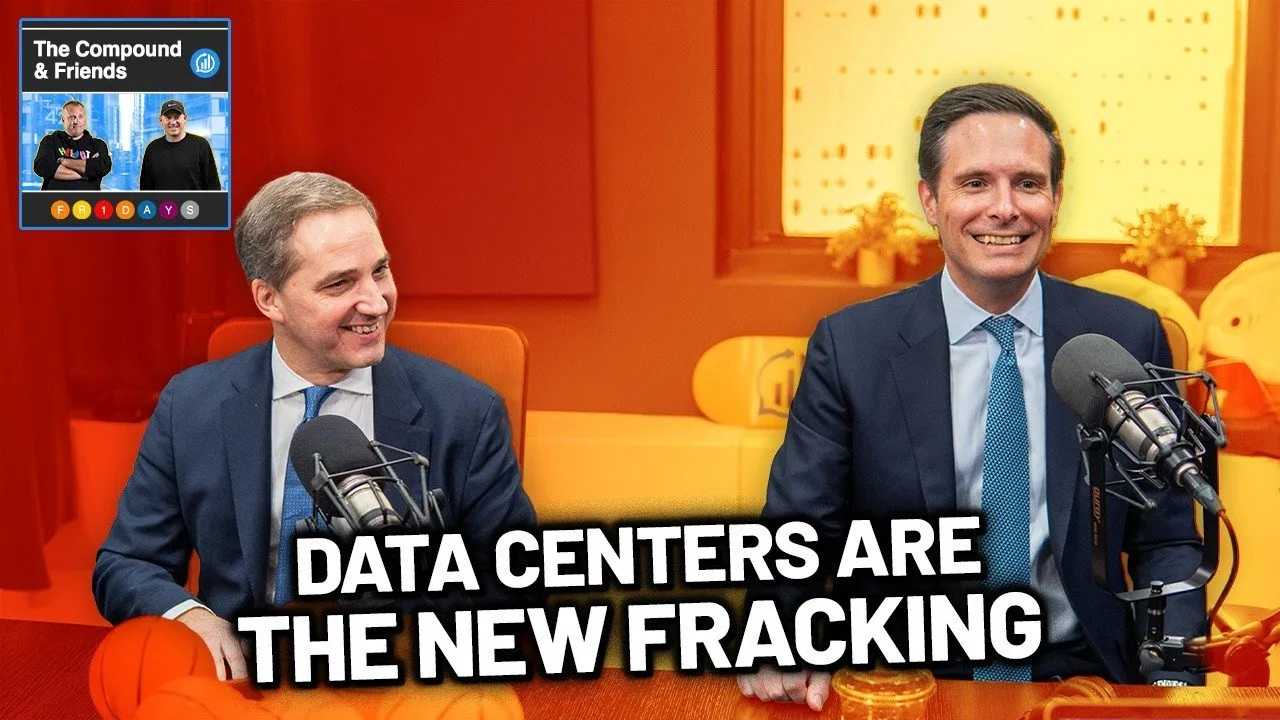
The global investment landscape is undergoing a profound structural shift, moving away from the "asset-light" dominance of the last decade toward a world defined by physical infrastructure, domestic manufacturing, and energy intensive-industries. On a recent episode of The Compound and Friends, Downtown Josh Brown sat down with Daniel Clifton and Chris Veron of Strategas Asset Management to deconstruct why data centers are becoming the focal point of political and social friction, mirroring the fracking debates of the early 2010s. From the nuances of midterm election volatility to the "revenge of the many" in the stock market, the conversation highlighted why the current market regime requires a different playbook than the one used during the post-2008 era.
Key Takeaways
- Data centers are facing "fracking-style" resistance: Local NIMBYism regarding noise, water usage, and electricity costs is creating a significant hurdle for the AI infrastructure boom.
- The market is rotating toward "The Many": While the Magnificent 7 and the NASDAQ show signs of narrowing momentum, equal-weight indices and "old economy" sectors like industrials and energy are showing robust breadth.
- Midterm years are tactical: Historical data suggests that the second year of a presidential term is often the most volatile, though the 12 months following a midterm election have not seen a decline since 1938.
- AI sentiment is souring: Public concern regarding job displacement and societal risks is rising, forcing a shift in how tech leaders communicate the benefits of the technology.
- A regime shift in the US Dollar: We are moving from a unipolar world of globalization to a multipolar world where resources and onshoring drive market cap trends.
Data Centers and the New "Fracking" Resistance
As the race to build AI infrastructure accelerates, the physical reality of data centers is colliding with local politics. Daniel Clifton argues that data centers have become the "new fracking," referring to the massive economic promise that simultaneously triggers intense local opposition. Just as fracking promised energy independence but faced concerns over water contamination and earthquakes, data centers are now being scrutinized for their massive strain on local power grids and water supplies.
The Rise of Data Center NIMBYISM
Across the United States, from Virginia to New Jersey, local communities are beginning to block major projects. In New Brunswick, a proposed 27,000-square-foot data center was recently converted into a public park following intense resident protests. Critics cite the constant hum of cooling fans, the immense water usage for thermal management, and the fear that massive industrial demand will drive up residential electricity bills.
Data centers are the new fracking. The tech industry has been slow to realize they need to tout the benefits—like lower property taxes—to get ahead of the regulation.
The Energy Burden
The tech industry's "asset-light" facade is crumbling as it becomes a major player in the industrial energy sector. In regions like the PJM Interconnection on the East Coast, the intermingling of industrial and residential energy demand is creating political friction. To survive this "fracking moment," tech giants may need to follow the energy industry's old playbook: investing heavily in lobbying and demonstrating tangible local benefits, such as funding for schools and infrastructure, to offset the perceived costs of their presence.
The Shifting Sentiment Around AI and Employment
While the financial markets have been euphoric about Artificial Intelligence, public sentiment is turning increasingly skeptical. Recent polling suggests that 50% of Americans are more concerned than excited about AI, with a significant majority fearing that the technology will eliminate more jobs than it creates over the next decade. This is no longer just a theoretical fear; it is manifesting in the employment data for recent college graduates.
The "Excel Monkey" Displacement
Josh Brown points to a growing divergence between the unemployment rate of recent graduates and the general workforce. There is a growing suspicion that corporations are taking a "wait-and-see" approach to entry-level hiring, testing whether AI can perform the tasks typically assigned to junior analysts and "Excel monkeys." This has created a "vibe shift" where the parents of these graduates—many of whom are voters—are becoming increasingly hostile toward the AI narrative.
The Software Counter-Narrative
In response to this backlash, we are seeing a coordinated shift in messaging from tech leaders. Jensen Huang and other prominent voices have begun emphasizing that AI will not replace software or jobs, but will instead act as an "agent" that enhances existing tools. This pivot is likely an attempt to protect the valuation of SaaS (Software as a Service) companies, which have seen their market caps mauled as investors feared total disruption by generative AI.
Investing in a Midterm Election Year
Politics and markets are inextricably linked, particularly during the second year of a presidential term. Daniel Clifton notes that presidents typically "run the economy hot" into their midterm year, which often leads to a cyclical recovery in the first quarter, followed by significant volatility as the market begins to price in the possibility of a divided government.
The Harris vs. Trump Baskets
Strategas tracks the market through "election baskets" to see how investors are pricing political outcomes. A "Harris Basket" typically includes renewable energy, Medicaid-exposed healthcare providers, and tech companies that benefit from the current regulatory environment. Conversely, a "Trump Basket" focuses on domestic industrials, traditional energy, and companies that stand to benefit from a more aggressive tariff regime. Notably, the "Harris Basket" has recently outperformed, suggesting the market is hedging against a total Republican sweep.
Historical Volatility Patterns
Midterm years are notoriously "consistently ugly" for average returns, often yielding less than 2% compared to the 17% seen in years one and three. However, this volatility often creates a massive entry point for long-term investors. Clifton points out that the "noise" of the midterm year usually resolves into a powerful rally, as the uncertainty of the election is removed from the equation.
The Great Rotation: Moving Beyond the "Mag 7"
Technically, the market is showing a rare phenomenon: "The Revenge of the Many." While the Magnificent 7—specifically Nvidia and Apple—have historically dominated the indices, Chris Veron highlights that breadth is actually improving even as the headline NASDAQ index faces pressure. This is a "populist market," where mid-caps, industrials, and energy stocks are making new 52-week highs while tech remains in a period of consolidation.
The Capex Economy
We are shifting from a consumer-driven economy to a "Capex-driven" economy. For over a decade, the best trade was "owning light"—software and consumer discretionary. Today, the leaders are "asset-heavy" companies. Industrials like Caterpillar and Deere, as well as HVAC and electrical equipment providers, are seeing their multiples expand as the world moves toward onshoring and massive infrastructure build-outs.
Price comes first, then the narrative. The market is telling us we are in a regime shift, moving from asset-light to asset-heavy.
The International Opportunity
For the first time in years, the "rest of the world" is starting to look attractive relative to the S&P 500. Japan, in particular, has seen a 40-year breakout, moving beyond the stagnation of its post-bubble era. As the US dollar enters a potential range-bound period, international markets with heavy manufacturing and banking exposure—sectors that are underweighted in the US—are beginning to outperform.
Conclusion
The current investment environment marks the end of the post-Berlin Wall era of disinflationary globalization. Investors are now navigating a "multi-polar" world where resources, physical infrastructure, and political lobbying are as important as software code. While the "NIMBY" resistance to data centers and the volatility of an election year present short-term risks, they also signal a broader "regime shift" toward a capex-heavy economy. As the market rotates away from the concentrated leadership of the last decade, success will likely belong to those who can identify the "AI-immune" sectors and the "old economy" stocks that are finally having their day in the sun.