Table of Contents
The narrative surrounding American higher education has shifted dramatically in recent years. Between ballooning student debt, questions regarding return on investment (ROI), and intense debates over campus culture and free speech, university leaders face a crisis of confidence. The question is no longer just "where should I go to college?" but increasingly, "should I go at all?"
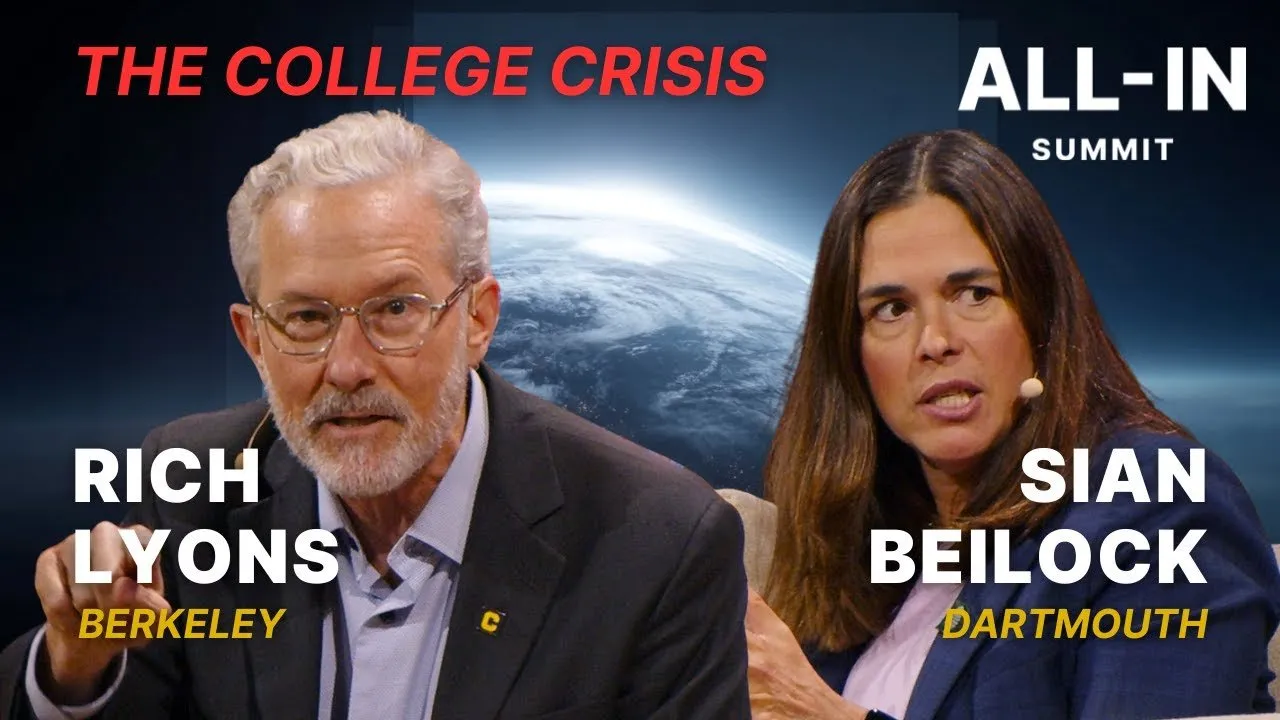
In a candid discussion, Dartmouth President Sian Beilock and University of California, Berkeley Chancellor Rich Lyons addressed these systemic challenges head-on. From the economics of elite degrees to the reintroduction of standardized testing and the role of artificial intelligence, these leaders provided an inside look at how top-tier institutions are attempting to reform from within while maintaining their core mission of creating knowledge and opportunity.
Key Takeaways
- The ROI Responsibility: Both leaders argue that while elite institutions offer significant financial aid, universities must take greater responsibility for student outcomes and clearly demonstrate the economic value of a degree.
- Return to Meritocracy: Dartmouth led the Ivy League in reinstating the SAT, arguing that standardized testing actually serves as a "great equalizer" for identifying talent from low-income backgrounds.
- Institutional Neutrality: There is a strong push toward "viewpoint diversity" and institutional neutrality, moving away from universities taking official stances on social or political issues.
- The AI Factor: While AI will revolutionize knowledge transfer, leaders believe it will heighten the value of "uniquely human skills" like empathy, debate, and face-to-face conflict resolution.
- K-12 Preparedness: A significant challenge facing higher ed is the decline in academic and emotional preparedness of incoming students, exacerbated by pandemic learning gaps.
The Economics of Higher Education: Debt vs. Value
With student loan debt reaching historic highs, the business model of the university is under intense scrutiny. Critics argue that the cost of attendance has outpaced the economic utility of the degree. However, the leaders of Dartmouth and Berkeley suggest that the "sticker price" often obscures the reality of who actually pays.
The Disconnect Between Price and Cost
President Beilock emphasizes that for lower- and middle-income families, the cost of attending an elite private institution is often lower today than it was a decade ago, thanks to massive philanthropic subsidies. At Dartmouth, students from families earning below a certain threshold pay no tuition, and the university packages financial aid without loans.
Chancellor Lyons points out that this economic model relies heavily on the "high-tuition, high-aid" approach or significant state subsidies. However, he acknowledges that the market mechanism—where students vote with their feet based on perceived value—is actively pressuring institutions to prove their worth.
"I do believe the institutions have a responsibility to their students. And I think we have to do a lot more in talking about ROI than we do right now... If you aren't thinking about the ROI and that is part of what you're delivering, it's a fair question to ask." — Sian Beilock
Underwriting Student Outcomes
A radical proposal discussed in modern higher ed reform is whether universities should "underwrite" student loans—essentially bearing the financial risk if a graduate cannot pay off their debt. Beilock argues that by eliminating loans from financial aid packages, schools like Dartmouth are already effectively underwriting the risk. The challenge remains for the broader tier of universities where high debt loads do not correlate with high-earning outcomes, leading to a system-wide crisis of trust.
Campus Culture: Free Speech and Institutional Neutrality
Perhaps no topic has damaged the reputation of universities more than the perception that they have become ideological echo chambers hostile to diverse viewpoints. Both Lyons and Beilock concede that higher education has work to do in restoring a culture of open inquiry.
The Move Toward Neutrality
There is a growing consensus among university leadership that institutions should adopt a posture of "institutional neutrality"—the idea that the university itself should not take collective stands on political issues, as doing so stifles the freedom of individuals within the community to hold dissenting views.
At Berkeley, the home of the Free Speech Movement, Lyons admits that the university has struggled with "viewpoint diversity." To combat this, Berkeley has launched initiatives like the "Berkeley Liberty Initiative" and new coursework designed to teach openness to opposing views.
Merit and the Return of the SAT
One of the most significant recent policy shifts was Dartmouth’s decision to reinstate the SAT requirement for admissions. While many schools dropped testing under the banner of equity, Dartmouth’s data suggested the opposite effect. Beilock explained that test scores often helped admissions officers identify high-potential students from under-resourced high schools who might otherwise be overlooked because they lacked polished transcripts or expensive extracurriculars.
"The reason is we looked at the data and what we found was that it was a great equalizer in finding students from lower income backgrounds... who are succeeding in something that's less actually susceptible to financial input like letters of wreck." — Sian Beilock
This move signals a broader shift back toward objective metrics of merit, separating the concept of diversity from the lowering of academic standards. Both leaders firmly rejected the notion that diversity and merit are mutually exclusive.
Bureaucracy and the Administrative Burden
A common critique of modern universities is "administrative bloat"—the explosion of non-teaching staff relative to faculty. This layer of bureaucracy is often blamed for rising costs and slowing down innovation.
Chancellor Lyons frankly admits that "bureaucratic burden" is a tangible problem at large public institutions like Berkeley. The widening gap between the "clock speed" of the outside world and the slow pace of university governance is a threat to relevance. While some administrative growth is driven by increasing government compliance regulations, both leaders acknowledge the need to streamline operations and direct more resources back toward the academic enterprise.
The Future of Learning: AI and Human Connection
As Artificial Intelligence becomes capable of acting as a personalized tutor, the traditional lecture-based model of education faces an existential threat. If knowledge transfer can happen cheaply via AI, what is the value of a residential university?
The Value of "Brave Spaces"
Beilock and Lyons argue that the rise of AI actually increases the value of the residential college experience. As AI commoditizes information, the premium on "uniquely human skills"—leadership, empathy, debate, and ethical reasoning—will rise.
Beilock distinguishes between "safe spaces" and "brave spaces." The university’s role is not to protect students from uncomfortable ideas, but to provide a supportive environment where they can build the resilience to engage with them. This involves training the "muscle" of civil discourse, a skill that has atrophied in the age of social media and remote schooling.
The K-12 Pipeline Problem
A critical underlying issue is the state of students before they reach campus. University leaders are observing that incoming freshmen are increasingly unprepared, both academically and emotionally.
- Academic Deficits: Basic competencies in math and reading have suffered, largely linked to income inequality in the K-12 system.
- Social Deficits: The COVID-19 pandemic and screen-based socialization have left many young adults without the tools to handle face-to-face conflict.
"We really have to go back. Our students are landing on our campus without having civics, without having practice engaging in difficult conversations... I believe it's like a muscle. You have to train it through practice." — Sian Beilock
Conclusion
Despite the headwinds of debt, political polarization, and technological disruption, the leaders of Dartmouth and Berkeley remain optimistic. They view the university not merely as a job training center, but as a vital engine for economic mobility and democratic health.
By doubling down on research that addresses planetary health, embracing the complexity of AI, and fostering a campus culture that tolerates difference, these institutions aim to prove they remain indispensable assets to society. The path forward, however, requires a willingness to reform from within—prioritizing merit, reducing bureaucracy, and ensuring that the "ivory tower" remains accessible to the best and brightest, regardless of their background.