Table of Contents
It is a rare and melancholic distinction to be one of history’s most famous yet least read authors. Dante Alighieri holds this status; his Divine Comedy is a pop culture touchstone, referenced in everything from hot sauce labels to video games, yet few modern readers actually traverse its 14,000 lines. For many, it is simply a medieval text about punishment and fire.
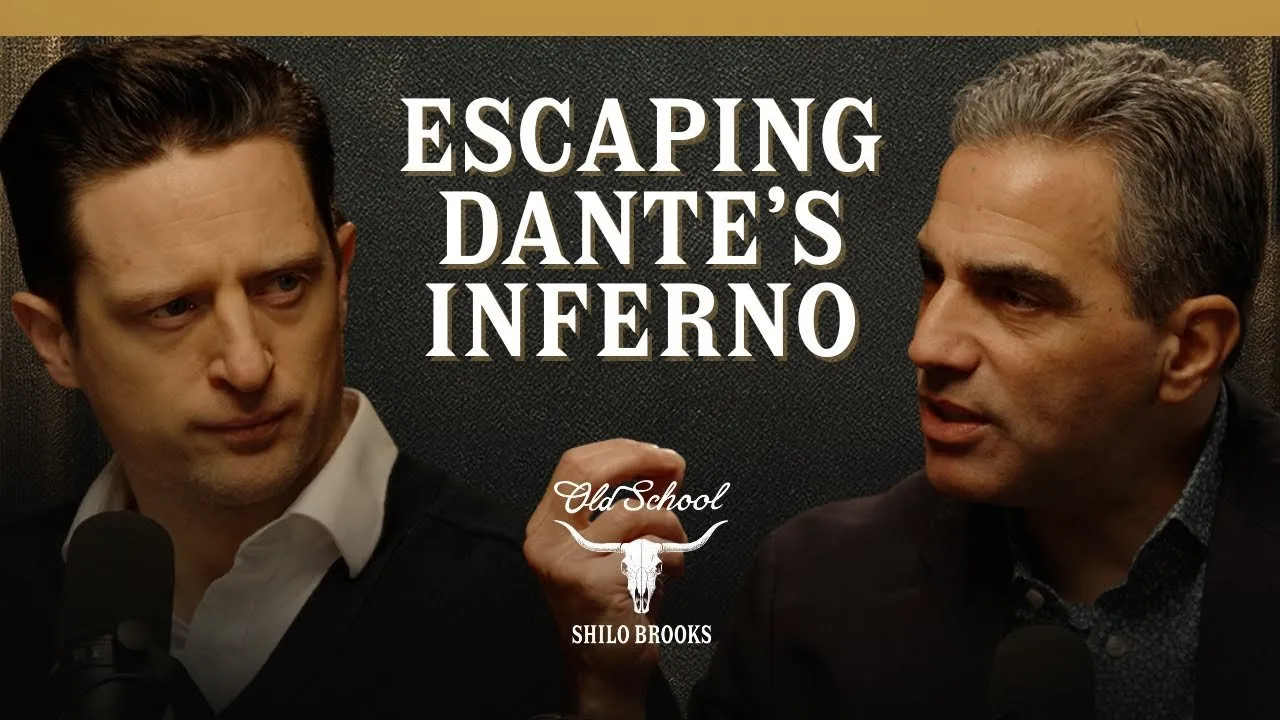
For Joseph Luzzi, a professor of literature and author, Dante was merely his professional specialty—until a sudden, shattering tragedy transformed the 700-year-old poem from a subject of study into a manual for survival. In a profound conversation on the Old School podcast, Luzzi detailed how the structure of the Divine Comedy—Hell, Purgatory, and Paradise—mirrored the trajectory of his own grief, offering a roadmap out of the "dark wood" of despair.
Key Takeaways
- The Divine Comedy is a roadmap for healing: The poem is not merely about the afterlife; it is an epic about the rehabilitation of the human soul from trauma to hope.
- Grief mirrors the Inferno: Luzzi identifies the initial shock of loss as a descent into the underworld—a place of disorientation and "magical thinking" where one is cut off from the living.
- Mourning is the work of Purgatory: Moving from grief to mourning requires the difficult, active labor of climbing the mountain, expiating pain, and choosing to rejoin the world.
- The Humanities face a crisis of accessibility: To survive, academic institutions must pivot from hyper-specialized jargon to storytelling that connects great books to the human condition.
The Day Life Changed Forever
In November 2007, Joseph Luzzi was living what felt like a charmed life. He was a successful professor, happily married, and expecting his first child. On a seemingly ordinary morning, he left for work at 8:00 AM. By noon, he was both a widower and a father.
His wife, Katherine, who was eight and a half months pregnant, was involved in a fatal car accident shortly after leaving the house. While Katherine tragically lost her life, emergency responders were able to deliver their daughter, Isabel, via cesarian section. In the span of four hours, Luzzi’s world was dismantled.
Luzzi found himself thrust into what Dante famously called the "dark wood"—a crisis point where the path forward is lost. Dante wrote the Divine Comedy while in exile, having been banished from his beloved Florence, stripped of his political rank, and cut off from the people he loved. Luzzi realized that Dante’s exile was a spiritual ancestor to his own grief. Both men had fallen through a trapdoor out of their established lives and were forced to reconstruct a broken world from scratch.
Demystifying the Divine Comedy
To understand how a medieval poem can guide a modern griever, one must understand what the Divine Comedy actually is. Written between 1306 and 1321, it is an epic poem describing the soul’s journey through three realms: Inferno (Hell), Purgatorio (Purgatory), and Paradiso (Heaven).
While the Inferno captures the popular imagination with its dramatic punishments and brimstone, Luzzi argues that stopping there provides a radically incomplete picture. The poem is not about damnation; it is about hope. It is arguably the only epic that ends in total joy, with the protagonist achieving a vision of the divine.
Breaking the Barrier to Entry
The barriers to reading Dante are high. The text is dense with references to 13th-century Florentine politics, medieval astronomy, and theology. However, Luzzi emphasizes that Dante wrote in the vernacular (Tuscan Italian) rather than Latin because he wanted the work to be accessible to the people, not just scholars.
For those intimidated by the text, Luzzi offers simple advice: surrender to the poetry. Do not stop to decode every historical reference. Instead, treat it like a piece of classical music—let the sound and the broad narrative wash over you. Focus on the highlights, such as the tragic lovers Paolo and Francesca in Inferno 5 or the Ulysses canto in Inferno 26, and keep sight of the macro-narrative: a man who lost everything trying to find his way back.
Mapping Grief: Inferno, Purgatory, and Paradise
Luzzi’s recovery was not linear, but it followed the distinct tripartite structure of Dante’s masterpiece. He realized he was living the poem in real-time.
Inferno as Grief
Luzzi equates the Inferno with the immediate, visceral experience of grief. Virgil, Dante’s guide, describes the underworld as the melancholic realm of the dead. For Luzzi, this manifested as a fog of disorientation.
Grief, in this stage, is an invisible illness. It is characterized by "magical thinking"—the refusal to accept reality—and a feeling of being frozen. Just as the damned in Dante’s hell are stuck in their specific punishments, the griever is stuck in the moment of loss.
Purgatory as the Work of Mourning
The transition from Hell to Purgatory is the most critical step. In Dante’s theology, Purgatory is the only realm where time matters. It is a place of labor, where souls must climb a mountain to expiate their sins. Luzzi views this as the transition from grief (a passive state) to mourning (an active process).
Mourning is work. It requires the painful decision to dissociate from the dead in order to rejoin the living. It involves the humbling realization that you must rebuild your identity from the ground up.
Paradise and the Return of Hope
While Paradise is the realm of the afterlife, Luzzi found its earthly equivalent in the "second act" of his life. Through the support of his mother and the arrival of his second wife, Helena, he was able to rebuild a family. This stage represents the return of hope—an orientation toward the future.
"Dante taught me that you can love somebody without a body in a certain way, but that you must reserve your truest love for somebody whose breath you can hear and feel... and that you may visit the underworld, but you cannot live there."
The inscription on the gates of Dante’s Hell is "Abandon all hope, ye who enter here." Luzzi’s journey proves this inscription false. Many figures in literature—Aeneas, Odysseus, Dante—enter the underworld and return. The defining characteristic of the human spirit is not the tragedy that lands you in the dark wood, but the labor undertaken to walk out of it.
The Crisis in the Humanities
Luzzi’s experience highlights a broader issue within academia: the decline of the humanities. He notes that while enrollment is dropping and departments are shrinking, the crisis is partly self-inflicted. In a quest for academic legitimacy during the 19th and 20th centuries, literature departments embraced hyper-specialization and technical jargon, distancing themselves from the general public.
Luzzi argues that the solution is a return to storytelling. Academics must learn to write with elegance and clarity, inviting readers into the text rather than barring the door with theory. The "Old School" approach to reading—engaging with books as education for the soul rather than just objects of inquiry—is essential for the survival of the discipline.
Writing for a broader audience is not about "dumbing down" the material. As Luzzi notes, explaining complex ideas in simple, resonant language is often more difficult than writing for a narrow peer group. It requires stripping away the obscure and finding the universal emotional core of the work.
A Cultural Primer: Italian Masterpieces
To close the conversation, Luzzi offered several recommendations for those wishing to explore the richness of Italian culture beyond Dante:
- Film: Journey to Italy (1954) by Roberto Rossellini. A pivotal film that bridges neo-realism and the French New Wave, depicting a marriage unraveling against the backdrop of Naples.
- Literature: The Betrothed by Alessandro Manzoni. Italy’s first great modern novel, covering the unification of Italy, foreign occupation, and class struggle.
- Art: The Cestello Annunciation by Botticelli (Uffizi Gallery). Luzzi highlights the Virgin Mary’s posture—swaying almost like a dancer—as the perfect synthesis of religious devotion and Renaissance beauty.
Conclusion
Joseph Luzzi’s story is a testament to the enduring power of the Great Books. When stripped of footnotes and academic posturing, works like the Divine Comedy reveal themselves as profound reservoirs of human wisdom. They do not merely describe the human condition; they offer companionship through its darkest chapters.
Whether through religious grace or the secular blessing of family and time, the journey out of the dark wood is possible. As Luzzi discovered, we may be forced to visit the underworld, but we are under no obligation to take up residence there.