Table of Contents
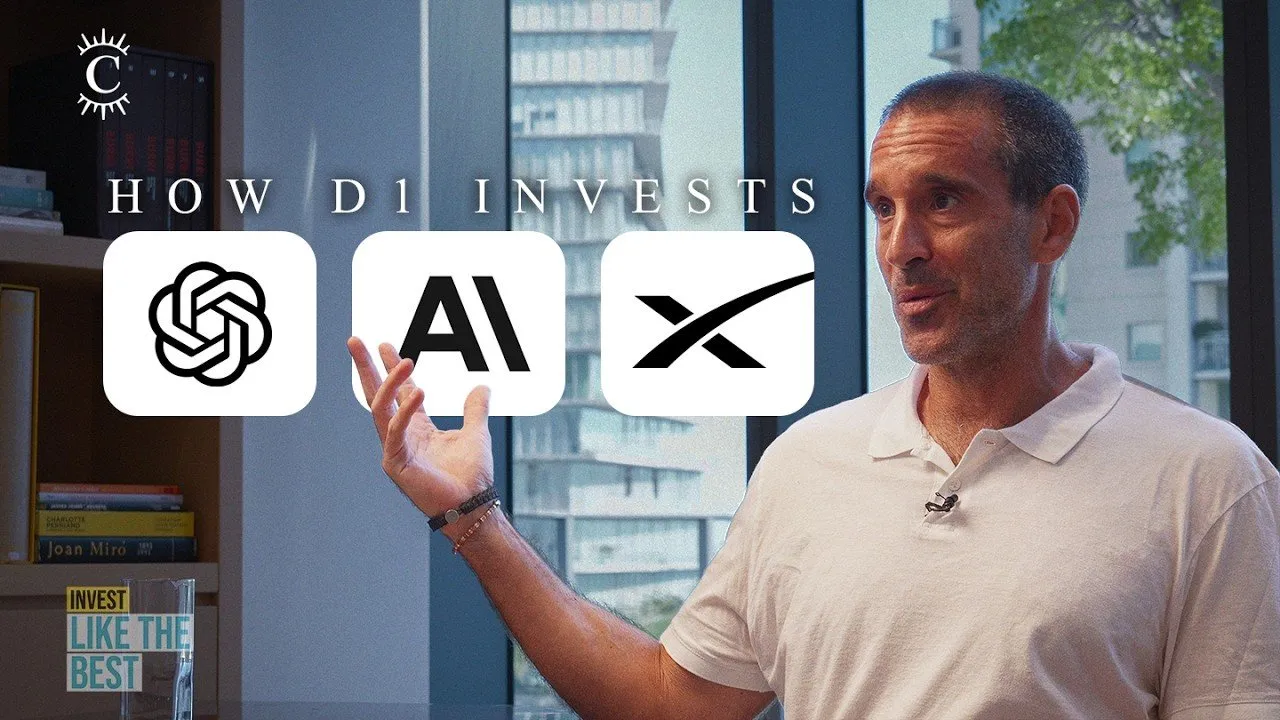
Dan Sundheim, founder and CIO of D1 Capital Partners, operates at the intersection of public and private markets with a level of intensity rarely seen in modern finance. By maintaining significant positions in generational private companies like SpaceX, OpenAI, and Anthropic while simultaneously managing a multi-billion dollar public equity portfolio, Sundheim has developed a unique vantage point on the shifting tectonic plates of technology and market structure. His approach suggests that the most successful investors of the next decade will be those who can bridge the gap between early-stage innovation and large-cap market efficiency.
Key Takeaways
- Information Synergy: Investing in private AI leaders provides an early warning system and a strategic roadmap for assessing public companies across every sector.
- LLM Business Models: Leading AI firms are evolving into a hybrid of Netflix (high fixed-cost content/models) and Spotify (high-retention personalization).
- Hyperscaler Vulnerability: While AWS and Azure are currently benefiting from the AI build-out, the long-term trend points toward major AI players insourcing their own compute and power.
- Market Inefficiency: The rise of passive investing and short-term multi-manager pods has made public markets less efficient, creating fertile ground for fundamental, long-duration stock pickers.
The Convergence of Public and Private Markets
Sundheim argues that the wall between public and private investing is increasingly porous. In the current cycle, some of the world's most innovative and valuable companies are choosing to stay private longer, forcing investors to adapt if they want exposure to the frontier of growth. However, the true value of this dual-market approach is not just in the returns themselves, but in the strategic synergy it provides.
The Edge of Private Exposure
Understanding the roadmap of a company like OpenAI or Anthropic allows an investor to anticipate the disruption of public software or services years before it reflects in quarterly earnings. Sundheim notes that as AI begins to impact every public company, having an informed opinion on where the technology is heading is no longer optional. It is the primary lens through which all public valuations must be viewed.
Competition and Selection
There is a fundamental difference in how value is captured in these two arenas. Public markets are hyper-competitive but often economically irrational in the short term due to retail sentiment and passive flows. Private markets, conversely, are less about out-analyzing the competition and more about being the partner of choice. In the elite tier of private tech, everyone knows the company is good; the challenge is convincing the founder to let you on the cap table.
Deciphering the Business Models of Intelligence
When assessing the "Scaling Laws" of Large Language Models (LLMs), many critics have compared AI to the early airline industry—a massive technological breakthrough that failed to produce durable profits. Sundheim disagrees, arguing that the competitive landscape is already concentrating into four or five dominant players due to the astronomical capital requirements.
The Netflix and Spotify Analogy
Sundheim frames the future of AI companies through the lens of two existing digital giants. Like Netflix, AI firms must spend massive capital upfront to "train" their content (the models), which they then sell at high incremental margins. Like Spotify, their ultimate moat will be personalization. The more a model knows about a user’s history, workflows, and preferences, the stickier the product becomes, regardless of whether a competitor's base model is slightly faster.
"Dario [Amodei] struck me... just the clarity of thought and his understanding of what he wanted to achieve was greater than almost any public CEO I dealt with."
The Importance of Founder Clarity
Sundheim places immense weight on a CEO's ability to communicate complex visions simply. He draws a direct line between the clarity found in Jeff Bezos’s 1997 shareholder letter and the current leadership at Anthropic. In capital-intensive industries where the ultimate return is unknown, the founder's ability to focus and iterate is the most reliable signal of future success.
The Structural Threat to Hyperscalers
A contrarian pillar of Sundheim’s thesis is the potential decline of the traditional hyperscaler business model. While Amazon (AWS), Microsoft (Azure), and Google (GCP) are the immediate beneficiaries of the AI "arms race," their long-term position may be more precarious than the market assumes.
From Fragmentation to Concentration
Historically, hyperscalers thrived by serving thousands of fragmented corporate customers. Today, a massive and growing portion of their workload comes from a handful of AI giants. As these LLM providers scale and achieve massive free cash flow, Sundheim expects them to insource their compute. Meta has already proven that at a certain scale, it makes no economic sense to pay a margin to an external cloud provider.
The Rise of Specialized Compute
Building GPU clusters for AI inference is fundamentally different from managing traditional CPU-based workloads. Sundheim suggests that the AI-native companies and "Neo-Clouds" may actually be more efficient at running these clusters than the legacy giants. If the major AI labs begin securing their own 10-gigawatt power sources and building their own data centers, the "rent" currently paid to hyperscalers could evaporate.
SpaceX and the Reusability Revolution
Beyond digital intelligence, Sundheim remains a high-conviction investor in SpaceX, a company he views as the pinnacle of modern engineering. The thesis here has evolved from a simple bet on launch dominance to a comprehensive play on global connectivity.
"You caught a skyscraper with chopsticks... To buy a company that had achieved the most amazing engineering feat I’d ever seen... the skew was very good."
The success of Starship represents a phase shift in the cost of moving mass to orbit. By proving full reusability, SpaceX is not just lowering costs; they are expanding the Total Addressable Market (TAM) for broadband. Sundheim views Starlink as a direct competitor to the global telecom industry, with a cost curve that will eventually make traditional broadband infrastructure look obsolete.
Market Efficiency and the "Singles and Doubles" Philosophy
Sundheim’s personal journey through the GameStop era and subsequent market volatility in 2021-2022 led to a profound shift in D1 Capital’s portfolio construction. He acknowledges that while the goal is always to deliver top-tier returns, the way those returns are achieved matters for long-term stability.
The Shift in Market Structure
Markets are less efficient today than they were twenty years ago. Sundheim attributes this to the dominance of passive funds and the short-term mandates of multi-manager pods. These participants often act in ways that are fundamentally irrational over a five-year horizon, creating opportunities for those willing to endure short-term volatility for long-term intrinsic value.
Managing Through Adversity
After the drawdown of 2022, Sundheim pivoted to a "singles and doubles" approach—prioritizing steady, methodical compounding over high-variance bets. This transition was as much about firm culture and investor psychology as it was about stock selection. He emphasizes that during periods of extreme stress, a leader's primary job is to maintain team cohesion and transparency with limited partners.
The Geopolitical Horizon: Semiconductors and Sovereignty
Despite his optimism regarding AI-driven productivity, Sundheim remains deeply concerned about the global semiconductor supply chain. He views the concentration of advanced chip manufacturing in Taiwan as a singular point of failure for the global economy.
The potential for a collision between the U.S. and China over Taiwan represents a "Great Depression" level risk. Because advanced semiconductors power everything from consumer electronics to national defense, any disruption to that supply would be catastrophic. Sundheim notes that while the U.S. is attempting to replicate this supply chain domestically, the process will take decades. In the interim, the world remains on a fragile "collision course" that requires delicate geopolitical navigation.
Conclusion
Dan Sundheim’s investment philosophy is built on the belief that passion and curiosity are the ultimate competitive advantages. Whether he is uncovering accounting irregularities in a 2002 short case or betting on the future of Starship, his approach remains evidence-first and fundamentally driven. As the global economy enters a period of exponential technological change, the ability to maintain clarity amidst the noise—and the resilience to survive "black swan" market events—will define the next generation of great investors.