Table of Contents
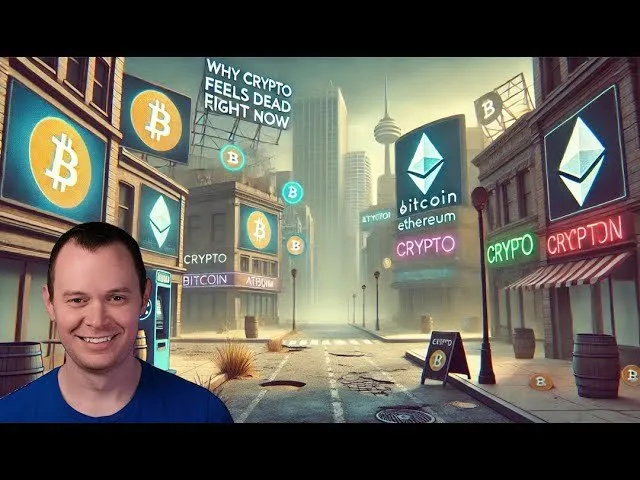
The cryptocurrency market currently presents a fascinating paradox. While Bitcoin has managed to find new highs this cycle, the broader ecosystem feels remarkably empty. We often refer to this phenomenon as the "Crypto Ghost Town." Despite institutional inflows and the launch of ETFs, retail investors remain notably absent. If you look past the price of Bitcoin and analyze the underlying social metrics, it becomes clear that the hysteria of 2021 has been replaced by apathy.
This cycle has been fundamentally different from previous ones. It has been driven by institutions rather than the widespread retail mania that defined the 2017 and 2021 bull runs. Understanding why this is happening requires looking beyond price charts and examining the social behaviors, market structures, and fundamental flaws that have driven retail capital away from the industry.
Key Takeaways
- Retail interest has collapsed: Social metrics across YouTube, Twitter (X), and search trends show engagement is a fraction of what it was in 2021, creating a "ghost town" effect.
- Altcoins are suffering from capital starvation: While Bitcoin thrives on institutional liquidity, altcoins rely on retail investors who have largely exited the market, leaving many assets near their 2022 lows.
- Scam fatigue is real: The proliferation of meme coins and "rug pulls" has eroded trust, causing burned investors to leave the space rather than rotate capital.
- The "Fed Excuse" fails: Blaming high interest rates is insufficient when the stock market and gold are hitting all-time highs; the issue lies within crypto's lack of utility.
- Recovery requires utility: A sustainable retail return depends on the industry shifting from circular economic models to building products with tangible societal value.
The Metrics Behind the Ghost Town
To quantify the lack of interest, we look at "Social Risk"—a metric comparing asset price to social engagement. For years, this data has signaled a divergence. While Bitcoin's price recovered in the post-halving year, social interest did not follow suit. In fact, retail engagement has been trending downward since May 2021 and never posted a higher high during this cycle.
There is a prevailing narrative on platforms like X (formerly Twitter) that algorithmic suppression is to blame for low engagement. However, the data suggests this is a cross-platform phenomenon rather than a specific algorithm change.
YouTube and Social Media Decline
The decline is visible across all major content platforms. Cryptocurrency YouTube channels, which averaged between two to three million combined daily views during the peak of 2021, are now struggling to reach a fraction of that audience. Using a 50-day moving average, viewership has dropped to approximately one-sixth of its bull market peak.
Furthermore, subscriber growth has turned negative. In 2021, top channels were gaining roughly 50,000 new subscribers daily. Today, the average indicates a net loss of subscribers. This trend extends to Twitter as well, where new followers for exchanges, Layer 1 protocols, and influencers have flatlined. For instance, Layer 1 blockchains that once attracted over 100,000 new followers daily are now seeing numbers as low as 5,500.
"It's a ghost town, and it's been a ghost town for a long time. It's just that Bitcoin has been able to hide the fact... because Bitcoin's price has continued to go up while most everything else just bleeds back to it."
The Price-Action Feedback Loop
The relationship between price and interest is cyclical—a classic chicken-and-egg scenario. Do prices drop because people leave, or do people leave because prices drop? The reality is likely a self-reinforcing loop. Retail investors are momentum traders; they arrive for the parabolic upside and vanish when the market turns bearish or stagnates.
While Bitcoin investors celebrate new highs, the experience for the average altcoin investor has been abysmal. Most altcoins are trading closer to their 2022 cycle lows than their 2021 highs. When valuing altcoins against hard assets like silver or even against Bitcoin (the ETH/BTC pair being a prime example), the bleeding has been continuous for years.
The Advance-Decline Index
A critical indicator of market health is the Advance-Decline Index of the top 100 cryptocurrencies. In a healthy bull market, like 2020–2021, this index trends upward, signifying broad participation where most assets are rising together. Since 2021, however, this index has trended down.
This divergence confirms that the rise in the total crypto market cap was driven by a select few assets—primarily Bitcoin—while the majority of the market withered. The anticipated "rotation" of capital from Bitcoin into altcoins never materialized because there was no new retail liquidity entering the system to fuel it.
The Scourge of Dilution and Scams
One of the primary drivers of the retail exodus is the sheer quantity of assets and the quality of those assets. The market is suffering from massive dilution. More altcoins were likely minted in a single day in 2025 than in the entire decade leading up to 2021. Even if liquidity remained constant, spreading it across exponentially more tokens guarantees that individual asset performance dilutes toward zero.
However, the issue is not just mathematical; it is ethical. A significant portion of these new tokens are thinly veiled scams or low-effort meme coins designed solely to enrich founders and insiders. The cycle of influencers "shilling" a token, dumping on their followers, and repeating the process has fundamentally damaged the trust required for a healthy market.
"99.999999% of these tokens that have been minted are just outright scams... They only exist to make the founder rich."
Investors eventually wise up. After being burned multiple times, they do not simply switch to a "better" coin; they leave the asset class entirely. The regulatory ambiguity that allowed this free-for-all, while preferred by some over strict securities laws, opened the floodgates for bad actors, ultimately suffocating legitimate development.
Why the "Fed Excuse" Doesn't Hold Water
It is common for crypto enthusiasts to blame the Federal Reserve for the bear market in altcoins. The argument is that high interest rates and Quantitative Tightening (QT) dried up the liquidity necessary for speculative assets to thrive. While macroeconomic factors play a role, this argument collapses when you look at other asset classes.
If the Fed's policies were solely to blame, we would expect to see weakness across all markets. Instead, we see the opposite:
- The S&P 500 and Dow Jones continue to print all-time highs.
- Gold and Silver are reaching new peaks.
- Tech stocks like NVIDIA have seen parabolic growth.
The Utility Gap: Stocks vs. Crypto
The divergence between the stock market and the altcoin market highlights a fundamental issue: utility and revenue. Investors buy Apple or Google stock because these companies generate profit by selling products and services that society uses daily. Their value is derived from tangible economic activity.
In contrast, many altcoins operate as circular economies. They offer "yield" not through profit generation, but through the inflationary issuance of new tokens—diluting existing holders to pay new ones. When liquidity dries up, these models fail. Investors, sensing uncertainty, prefer the safety of companies with proven revenue streams over speculative tokens that may be rug-pulled tomorrow.
The Path to Maturity and Recovery
For the crypto "ghost town" to become a bustling metropolis again, the industry must mature. We cannot rely on the Federal Reserve to save the market with low interest rates, nor can we rely on the next wave of meme coins to bring sustainable growth. The market has effectively rejected the projects of 2019–2022 that failed to deliver value, leading to the current defensive posturing where Bitcoin reigns supreme.
The outlook for the immediate future—specifically leading into the summer of 2026—leans bearish for the broader altcoin market. We are likely in a period of apathy similar to 2019, where social interest bottoms out and price action remains choppy.
Sustainable recovery will only occur when the industry pivots toward building real utility—technologies that integrate seamlessly into society without the user necessarily knowing they are using crypto. Until the market rewards utility over speculation, and until we purge the bad actors draining liquidity, the ghost town will remain. The investors who return will be the ones who see a matured asset class ready to offer more than just volatility.
Conclusion
The crypto market is currently defined by a stark divide: Bitcoin's institutional success versus a desolate retail landscape. The data on social engagement and market breadth is irrefutable—retail investors have left the building. This exodus is a rational response to years of poor price action against Bitcoin, rampant dilution, and an ecosystem plagued by scams.
While counter-trend rallies are possible, a durable bull market for altcoins requires a fundamental shift in how the industry operates. We need to move away from circular economies and toward genuine value creation. It may take years to rebuild the trust lost during this cycle, but that clearing of the forest is necessary for the next phase of legitimate growth.
For deeper analysis on these charts and to track the social risk metrics yourself, consider joining the premium list at intothecryptoverse.com.
![Bitcoin Is on Sale [How to Buy It in 2026]](/content/images/size/w1304/format/webp/2026/03/how-to-buy-bitcoin-2026.jpg)