Table of Contents
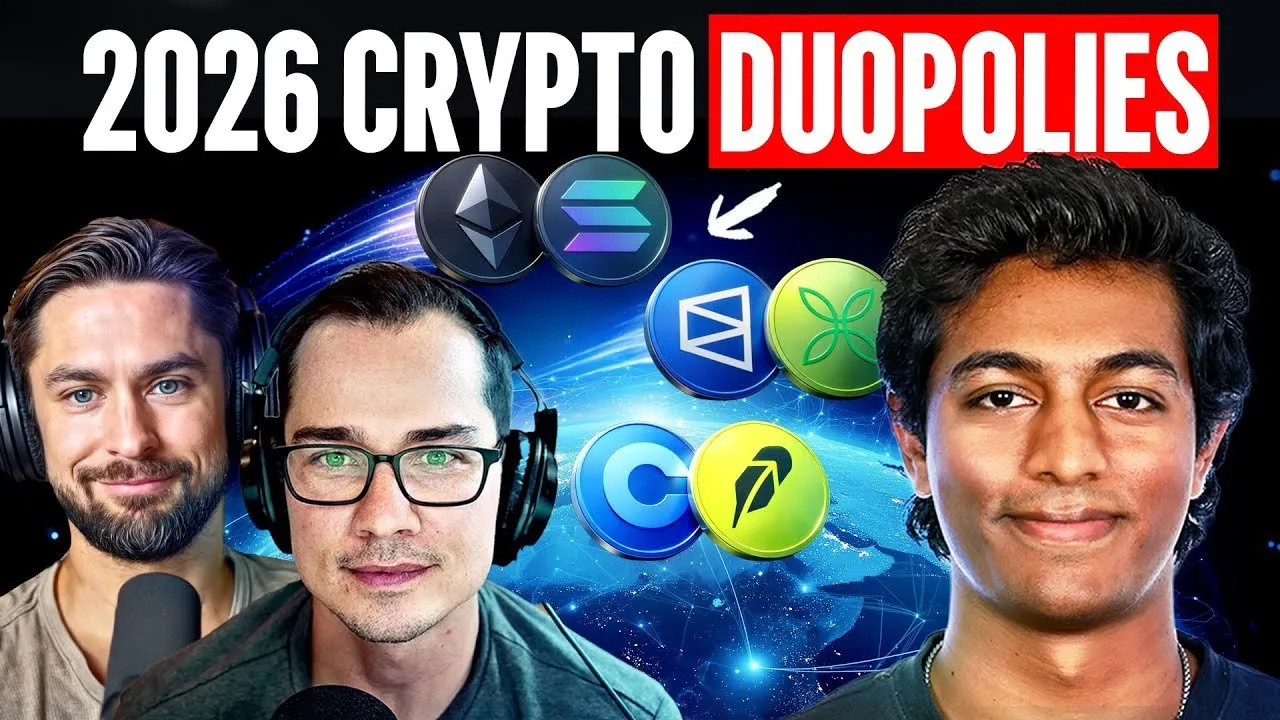
As the crypto industry looks toward 2026, the fog of speculation is lifting to reveal a landscape defined by entrenched duopolies and distinct market winners. The era of infinite infrastructure rotation is ending, replaced by a mature environment where network effects and user experience dictate survival. Based on insights from Bankless Ventures’ Arnav Pagadiala, the coming years will not be about "the next big chain," but rather how established giants solidify their lanes.
This maturation brings clarity to investors and builders alike. We are witnessing the bifurcation of Layer 1s, the intense battle for the retail interface, and a fundamental shift in how capital is formed and managed on-chain. The days of terminally online points farming are fading, making room for ubiquitous infrastructure that powers genuine economic activity.
Key Takeaways
- The L1 Duopoly is set: Ethereum and Solana have effectively captured the market, with Ethereum serving as the slow, secure financial layer and Solana dominating consumer apps and high-frequency activity.
- Super Apps win the interface war: Robinhood is outpacing Coinbase by blending banking with crypto, while the "Fat Wallet" thesis suggests self-custody wallets may eventually displace exchanges entirely.
- Capital formation is evolving: The ICO is returning in a matured form, driven by platforms like MetaDAO, while tokens are finally gaining the legal and structural parity of traditional equities.
- AI reduces the barrier to entry: Advanced AI models will likely birth "sub-five-person unicorns," allowing tiny teams to build massive protocols without heavy venture capital requirements.
The Great Layer 1 Divergence: Ethereum and Solana
For years, the industry speculated on "ETH Killers" and the multi-chain future. As we approach 2026, the data suggests the dice have already been cast. The market has converged on a clear duopoly between Ethereum and Solana, each optimizing for radically different end-states.
Consumer Speed vs. Institutional Settlement
Solana has successfully positioned itself as the "Nasdaq" of blockchains. It is the default home for consumer crypto, DePIN (Decentralized Physical Infrastructure Networks), and retail activity. The network effects here are palpable; founders and consumers gravitate toward Solana for its low latency and superior user experience. Innovations like FireDancer and Alpenglow are further entrenching its lead in market microstructure and spot trading.
Conversely, Ethereum is seeing a reversal in sentiment driven by its strength as the settlement layer for the world. It is the home of "slow DeFi," real-world asset (RWA) tokenization, and money markets. While it may lack the consumer flair of Solana, its institutional bid and total value locked (TVL) remain unmatched. The narrative is no longer about one killing the other, but about two distinct networks thriving in parallel lanes.
"It's become abundantly clear that it's incredibly difficult for an incumbent to disrupt the network effects already achieved by Ethereum and Solana. General purpose Alt-L1s will continue to struggle to attract new liquidity without blasting incentives."
The Trap of Alt-L1s
The dominance of this duopoly poses an existential threat to alternative Layer 1s. The playbook of launching aggressive deposit campaigns to attract nine figures in TVL has proven brittle; the moment incentives dry up, capital flees back to the majors. A prime example is Unichain, which saw significant liquidity contraction once incentives were removed. Unless a chain has a specific application focus, disrupting the ETH/SOL stronghold is becoming statistically improbable.
The Battle for the Retail Interface
While protocols settle into their niches, the war for the customer interface is heating up. The primary gateway to crypto is shifting from pure-play crypto exchanges to integrated financial super apps and sophisticated self-custody wallets.
Robinhood vs. Coinbase
In the battle of the exchanges, Robinhood appears to be gaining the upper hand over Coinbase regarding retail volume and valuation. Robinhood’s strategy focuses on becoming a comprehensive financial home—integrating banking, checking, and credit cards alongside crypto trading. Their UX is seamless, appealing to a younger demographic that demands a unified financial experience.
Coinbase, while still a giant, faces an identity crisis. Their push into "content coins" and social layers contrasts sharply with the need to be a trusted banking replacement. To compete effectively in 2026, Coinbase may need to bifurcate its offerings: a dedicated "degen" app for perps and meme coins, and a pristine, boring financial app for banking and savings.
The Fat Wallet Thesis
A significant threat to both exchanges comes from the "Fat Wallet" thesis. Wallets like Phantom and MetaMask are evolving from passive storage tools into active aggregators. By integrating on-ramps, swaps, and staking directly into the interface, wallets are capturing the user relationship.
The economics favor the interface. While decentralized exchanges operate on razor-thin margins, wallets can charge convenience fees for swaps, potentially capturing more value than the underlying protocols. If wallets successfully become super apps, they could render centralized exchanges obsolete for a large segment of on-chain natives.
Market Structures: Prediction Markets and Perps
The derivatives and prediction landscapes are undergoing their own consolidation, driven by liquidity moats and regulatory positioning.
Polymarket’s Global Moat
In the prediction market arena, Polymarket has established itself as the dominant force. Despite domestic competition from regulated entities like Kalshi, Polymarket wins on mindshare and market variety. Kalshi faces a difficult battle on two fronts: it competes with Polymarket on crypto-native betting and with giants like FanDuel and DraftKings on sports betting.
Polymarket’s advantage lies in being the venue for exotic, long-tail bets. When a unique global event occurs, the immediate reflex of the market is to check Polymarket. This brand entrenchment is difficult to replicate, even for fully regulated US competitors.
Hyperliquid and the DEX Standard
Hyperliquid has emerged as the clear winner in the on-chain perpetuals market. Despite numerous attempts to dethrone it via fee wars or incentive vampires, Hyperliquid’s liquidity and user retention remain superior. The future of perp DEXs will likely bifurcate into premium platforms like Hyperliquid and zero-fee, backend infrastructure used by aggregators. The era of the generic, fork-and-incentivize perp DEX is largely over.
Capital Formation and the AI Multiplier
The way value is created and funded in crypto is fundamentally changing. We are moving toward a model that favors leaner teams, clearer investor rights, and direct-to-community listings.
The Return of the ICO and Investable Tokens
Initial Coin Offerings (ICOs) are making a resurgence, but in a matured, sustainable format. Platforms like MetaDAO are proving that public token sales can act as effective capital formation tools that bypass the gatekeeping of centralized exchanges. This shifts leverage back to founders, who can now build community-owned projects without giving away significant portions of their supply to listing committees.
Simultaneously, the industry is solving the "market for lemons" problem. For tokens to remain competitive with traditional equities, they are adopting standards for reporting, token rights, and on-chain verifiable cash flows. Institutional capital demands this clarity, and 2026 will likely see tokens that offer legal and economic parity with traditional stock.
The Rise of the Sub-Five-Person Unicorn
Perhaps the most disruptive trend is the intersection of crypto and AI. Advanced coding assistants (symbolized by models like "Opus 4.5") are collapsing the technical barriers to entry. Small teams, or even single developers, can now deploy production-grade smart contracts and front-ends that previously required dozens of engineers.
"I expect at least one, if not multiple, sub-five-person unicorns this year. It's almost like the technical moat is diminishing, and distribution becomes a lot more of the edge."
This efficiency allows for "sub-five-person unicorns"—projects that reach billion-dollar valuations with minimal headcount and reduced capital requirements. This shifts the competitive edge from engineering resources to distribution and community building.
Conclusion: The "Boring" Revolution
The overarching theme for 2026 is that crypto is becoming "boring" in the best possible way. The industry is transitioning away from the chaotic, terminally online culture of points farming and rug pulls toward ubiquitous infrastructure. We are entering a phase where successful protocols vanish into the background, powering payments, identity, and finance seamlessly.
While the "Crypto is Dead" narrative may cycle through mainstream media, it signals the death of the speculative casino and the birth of a genuine asset class. With the capital stack moving on-chain and regulatory clarity improving, the stage is set for a cycle defined by utility, structural maturity, and the dominance of the few who have built real moats.