Table of Contents
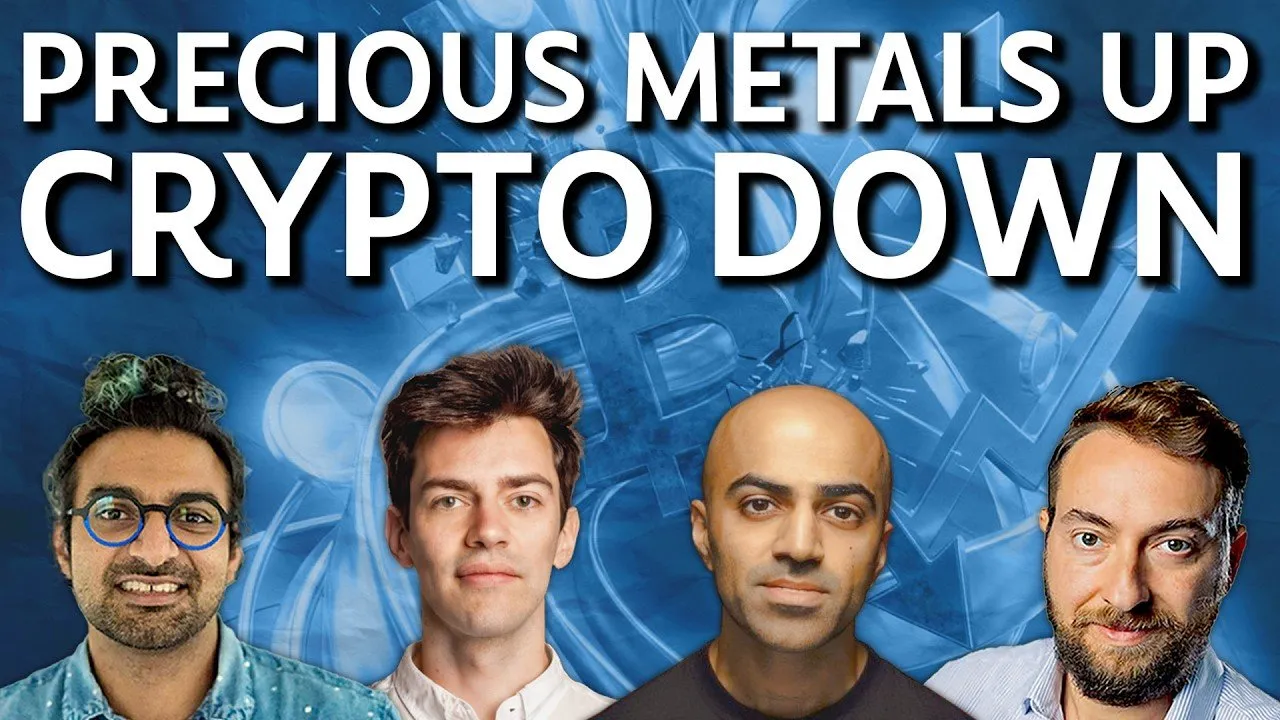
The sentiment in the crypto markets has shifted remarkably in recent weeks. While Bitcoin and Ethereum hover in what many insiders describe as "the doldrums," volatility—and the traders chasing it—has migrated elsewhere. From the parabolic rise of silver and gold to the sudden dominance of AI-driven coding agents, the industry is undergoing a structural transformation that goes beyond simple price action.
In the latest industry roundtable, the partners from Dragonfly, Gauntlet, and Superstate dissected these pivoting trends. Whether it is Wall Street officially moving on-chain or software engineers unlearning a decade of habits to accommodate autonomous AI agents, the message is clear: the ecosystem is evolving rapidly, even if the majors look stagnant.
Key Takeaways
- Superstate’s $82.5M Raise: The firm is doubling down on "issuer-led" tokenization, distinguishing itself from back-office settlement tokens and offshore "bootleg" derivatives.
- The Commodities Pivot: With crypto volatility dampening, traders are flocking to decentralized perpetual exchanges to trade silver, gold, and indices, driving RWA (Real World Asset) volumes to record highs.
- The Aging Trader Cohort: The crypto trading demographic may be maturing, prompting exchanges to expand their offerings into traditional assets to retain users who are "aging out" of meme coins.
- The Rise of Agentic Coding: Tools like Claude Code are fundamentally altering startup economics, turning non-technical staff into builders and forcing senior engineers to transition into "managers of bots."
The Three Models of Tokenization
Following Superstate's announcement of an $82.5 million raise led by Bain Capital Crypto and others, the conversation turned to the fracturing definitions of "tokenization." While the buzzword is ubiquitous, the actual implementations fall into three distinct categories, each serving a different master.
1. The Issuer-Led Model
This is the approach taken by Superstate. The goal is to bring the official shares of a company on-chain. This isn't a derivative; it is the asset itself, integrated into the capital formation process. The primary benefit here is interoperability—assets that can move between traditional brokerage accounts and blockchain wallets, allowing issuers to utilize DeFi liquidity for genuine capital raising.
2. The "Back Office" Token
Major financial institutions like the NYSE and DTCC are exploring tokenization primarily for settlement efficiency. The current stock market settles on a T+1 basis. By utilizing blockchain technology, these entities aim to clear trades instantaneously to free up capital and reduce back-office overhead. However, these tokens are generally not designed for consumer use or DeFi integration; they are purely infrastructure upgrades.
3. The "Bootleg" Model
Perhaps the most controversial yet rapidly growing sector involves third-party entities buying stocks or commodities and issuing permissionless tokens against them. Often referred to as "bootleg" tokenization, these products are popular in offshore markets where access to US equities is restricted. While they lack the regulatory safety rails of issuer-led models, they offer a permissionless user experience that appeals to a global retail base.
Crypto is Boring, So Everyone is Trading Silver
One of the most striking on-chain trends is the surge in volume for commodities on decentralized exchanges (DEXs). Hyperliquid, a leading perpetual DEX, recently saw "HIP-3" assets (real-world asset perps) dominate its top trading pairs. At one point, eight of the top ten markets on the platform were commodities or indices rather than crypto-native assets.
The catalyst appears to be a mix of macroeconomics and boredom. With Gold hitting all-time highs and Silver exhibiting massive volatility, the "degens" of the crypto world are following the action. Crypto traders are, at their core, volatility maximalists. When crypto assets stabilize, these traders do not simply sit on their hands; they migrate to whichever asset class offers the highest variance.
They've completely forgotten about crypto... they're just like that toy. You know the Toy Story meme? They just like threw away the doll. It feels like, 'I don't want to play with you anymore.'
This behavior challenges the assumption that crypto traders are ideologically bound to digital assets. Instead, it suggests that the tools built by the industry—permissionless, high-leverage trading venues—are finding product-market fit as superior substrates for trading traditional assets, regardless of the underlying instrument.
The Generational Shift in Trading
As the industry matures, so does its user base. There is a growing theory that "crypto traders" are not a permanent class of people, but rather a specific generation that entered the market during a unique window of volatility. Just as the online poker boom of the 2010s created a cohort of players who eventually moved on to other careers, the crypto traders of 2017–2021 may be aging out of pure speculation.
This demographic shift explains why platforms like Robinhood and Coinbase are aggressively expanding their suites to become "everything stores." To retain a user base that is getting older and wealthier, these platforms must offer boring assets—municipal bonds, ETFs, and commodities—alongside dog coins. If they fail to adapt, they risk losing their core users to traditional brokerage accounts as those users prioritize wealth preservation over 100x gains.
AI Agents and the "Vibe Coding" Revolution
The intersection of Crypto and AI has historically been filled with vaporware, but the release of Anthropic’s "Claude Code" has marked a tangible shift. The industry is witnessing the rise of "agentic coding," where AI models are not just autocomplete tools but autonomous agents capable of managing entire repositories, writing documentation, and executing complex refactors.
The "Maltbot" Phenomenon
The hype cycle recently peaked with "Maltbot" (formerly ClaudeBot), a tool allowing users to run autonomous agents locally. While the crypto market immediately responded by launching meme coins around these agents, the underlying utility suggests a deeper trend. Non-technical users are beginning to spin up complex software infrastructure simply by conversing with an LLM.
Rewriting the Engineering Org Chart
For startups, the implications are profound. The cost of software production is plummeting, but the skill set required to be an effective engineer is changing. The ability to write syntax is becoming less valuable than the ability to orchestrate AI agents. Startups built today will look fundamentally different from those built two years ago; they will likely have leaner engineering teams, with senior developers acting more as architects and reviewers than code-writers.
If you were a software engineer in the last 10 years, you basically have to unlearn everything you learned... to use these things properly.
There is a growing divergence between companies embracing "vibe coding"—where output is generated via natural language prompts and reviewed by humans—and those sticking to traditional IDEs. Early data from VC portfolios suggests that while adoption is still uneven, the teams utilizing agentic workflows are moving at a velocity that traditional teams cannot match.
Conclusion
The crypto industry is currently in a state of flux, suspended between a quiet market for digital assets and a chaotic explosion of innovation in adjacent fields. While prices for majors like Bitcoin may be stagnant, the infrastructure is finding new life in tokenizing Wall Street and democratizing commodities trading. Simultaneously, the integration of AI agents is redefining how protocols are built, promising a future where the barrier to creating software is lower than ever before. For investors and builders alike, the alpha is no longer just in the charts, but in adapting to these structural shifts.