
Table of Contents
Product vision is often the most elusive skill for product managers to master. It is frequently discussed as a high-level necessity, yet rarely broken down into tactical steps. Without a clear vision, teams function like pilots flying without a destination—busy, operational, but ultimately aimless.
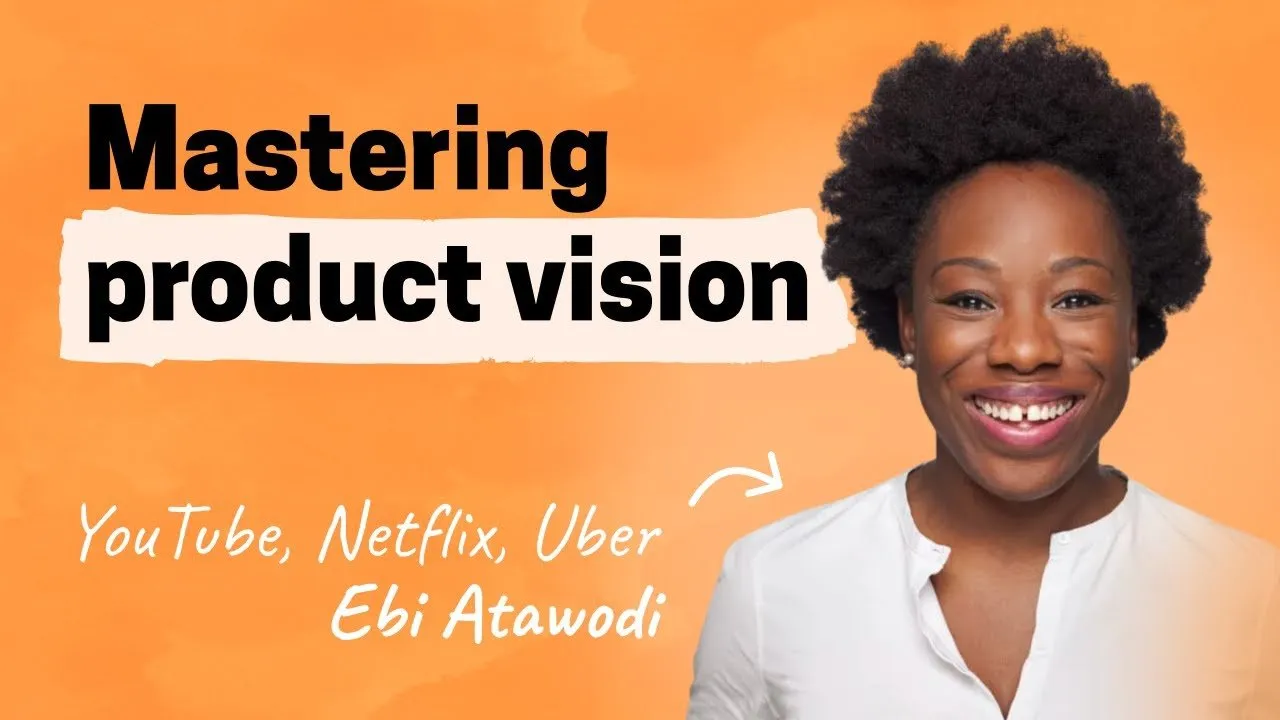
Ebi Atawodi, Director of Product at YouTube and formerly of Netflix and Uber, argues that vision is not merely a soft skill but a structured craft. Drawing from her experience leading products used by millions, Atawodi offers a concrete framework for defining, visualizing, and evangelizing product vision. By shifting focus from "being liked" to "bringing clarity," product leaders can galvanize their teams and navigate even the most complex organizational cultures.
Key Takeaways
- Vision vs. Mission: A mission is your purpose (why you exist), while a vision is a clear, high-fidelity picture of the destination (what the world looks like when you succeed).
- The "Once Upon a Time" Framework: Use narrative structures to simplify complex visions into a story that highlights the problem, the shift, and the resolution.
- The "10 Things" Document: Ground your strategy in reality by maintaining a living document of the top 10 hardest problems your users face.
- Clarity and Conviction: The core craft of product management is not just execution, but the ability to distill noise into clarity and make decisions with conviction.
- Culture as Strategy: Whether it is Uber’s autonomy or Netflix’s context-setting, the culture of a company fundamentally dictates how products are built and evolve.
The Anatomy of a Compelling Product Vision
Many product managers conflate mission and vision, leading to vague strategic direction. Atawodi clarifies this distinction using a travel analogy: The mission is the commitment to fly passengers safely. The vision is the description of the destination—the warm sand and blue water of Miami. One is the operational mandate; the other is the inspiring end-state.
A robust product vision must contain four specific elements:
- Lofty: It must be ambitious enough to scare and excite the team simultaneously.
- Realistic: While ambitious, it must remain within the realm of attainability.
- Grounded in a Problem: It cannot be technology for technology’s sake; it must solve a potent user need.
- Devoid of Current Limitations: A good vision ignores the technical constraints of today to define the necessities of tomorrow.
"The whole point of going to the future and saying I've time traveled five years out is to say, 'Okay, I've come back to tell you what we need to fix in order to get there.'"
Three Frameworks for Communicating Vision
Once the destination is defined, the challenge shifts to communication. Atawodi outlines three tactical methods to translate abstract ideas into tangible assets that align stakeholders.
1. The Narrative Template
Storytelling is the most powerful tool in a PM's arsenal. Atawodi recommends a simple "Mad Libs" style framework to distill the vision into a narrative arc:
- Once upon a time... (The context)
- There was a problem... (The conflict)
- Then one day... (The product intervention)
- And because of that... ( The immediate outcome)
- And finally... (The long-term state of the world)
2. The Future Headline
Adopting the "working backwards" methodology, draft the news headline you want to see five years from now. This is not a press release no one reads, but a mock-up of a TechCrunch article or an App Store update. It forces the PM to identify the single most important value proposition that would capture public attention.
3. Visual Prototyping
A vision becomes real when it is visualized. This does not require a design team; it requires initiative. Whether it is sketching rounded rectangles on a piece of paper to mimic an app interface or creating a low-fidelity storyboard, visual aids bridge the gap between abstract strategy and concrete product changes.
The "Understand Work": Insights Before Strategy
A common pitfall in vision setting is skipping the "empathize" phase. Before writing a strategy, a product leader must deeply understand the current state of the product.
The Living Document of Problems
Atawodi implements a tactic called "10 Things You Should Know." This is a living document where the team logs the most critical user friction points, technical debt, and qualitative insights.
This document serves two purposes:
- Alignment: If you ask engineering, design, and product leadership what the top problems are, their answers should be identical.
- Foundation: You cannot build a skyscraper on a shaky foundation. Technical debt and infrastructure issues are product problems because they limit what can be built in the future.
Insights, Strategy, and Big Rocks
When moving from understanding to planning, Atawodi suggests a "Narrative Structure" over a traditional roadmap. This document, usually no more than two pages, follows a strict hierarchy:
- Insights: What we learned from the "10 Things" doc and user research.
- Strategy: The approach we will take to solve these problems.
- Big Rocks: The 3-5 massive initiatives that will move the needle.
This approach prevents the roadmap from becoming an endless laundry list of features. By focusing on "Big Rocks"—the ice in the cocktail glass—you ensure the most critical items are prioritized before pouring in the liquid (smaller tasks).
Evangelizing the Vision
Creating the vision is only half the battle; the rest is evangelism. To ensure a vision survives contact with the organization, it must be socialized in concentric circles.
- The Core Team: Start with the engineers and designers who will build it. They must feel ownership. Allow them to critique and "polish the rocks" through friction and feedback.
- Stakeholders: Engage marketing, operations, and support early. Use the "10 Things" framework to solicit their input so they feel heard before the strategy is finalized.
- Leadership: Present the vision as high up the chain as possible. When leadership adopts the language of the vision, it signals organizational commitment.
"I believe in being loved, not liked. Love is the choice to extend yourself for the spiritual growth of another... When you're extending yourself, it's not always nice. It is having hard conversations."
The Craft of Product Management: Clarity and Conviction
Beyond frameworks, the "craft" of product management boils down to two attributes: clarity and conviction.
Clarity
Clarity is the removal of noise. It is the ability to look at a mess of data, opinions, and constraints and sift out the pollution to find the core truth. Every email, document, and meeting a PM leads should increase the transparency and simplicity of the problem space.
Conviction
Conviction is the willingness to pick a lane. It is not about having 100% certainty—which is rarely possible—but about having a strong, evidence-based feeling about how the world should be. A lack of conviction manifests as "peanut buttering" resources across too many initiatives. Great PMs must be willing to make the hard choice of what not to do.
How Culture Shapes Product
Having worked at three of the most influential tech companies, Atawodi observes that a company's internal culture is the invisible hand shaping its product.
- Uber: In the early days, Uber valued extreme autonomy and "toe-stepping." This allowed for rapid, localized innovation (like cash payments in Nigeria) because local GMs were empowered to defy headquarters if it served the mission.
- Netflix: Known for "Freedom and Responsibility," Netflix’s culture relies on context over control. Decisions are debated in writing, but ultimately, the "informed captain" (the decision maker) has the final say. This structure allows for major pivots, such as the shift to ad-supported tiers, to happen methodically.
- Google/YouTube: With a culture deeply rooted in consensus and "respecting the user," innovation often happens within micro-cultures. Different products (Cloud vs. YouTube) operate with distinct norms, allowing the massive organization to remain flexible across different domains.
Conclusion
Developing a product vision is an exercise in agency. It requires the product leader to look beyond the daily fires and endless spreadsheets to imagine a better reality. Whether through a simple narrative document or a sketch on a napkin, the act of visualizing the future is the first step toward building it.
As Atawodi reminds us, citing the poem Invictus, a product manager must be the "master of their fate." By combining deep empathy for the user with the courage to articulate a bold future, PMs can transform their role from task managers to true leaders.


)