Table of Contents
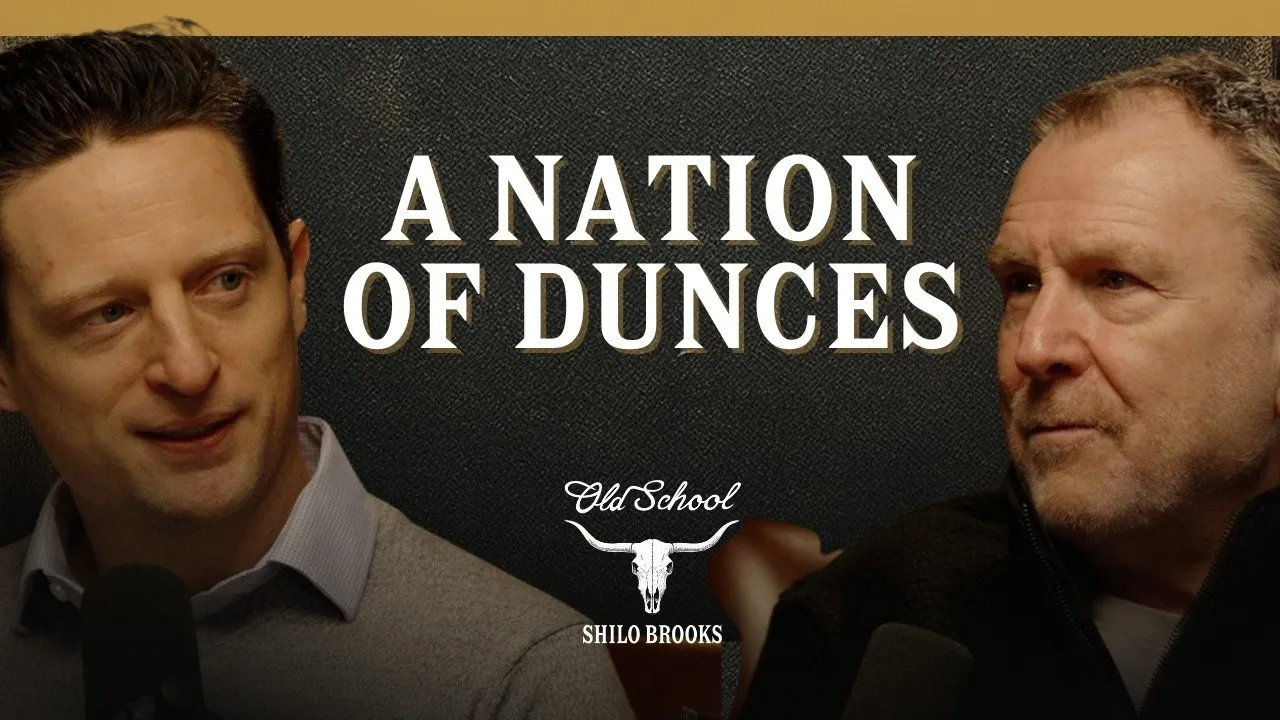
It is rare for a piece of literature to gain relevance decades after its publication, yet John Kennedy Toole’s A Confederacy of Dunces feels more like a prophecy of 21st-century internet culture than a Southern Gothic novel from 1980. In a recent discussion on Old School, comedian and author Colin Quinn sat down with host Shiloh Brooks to dissect this Pulitzer Prize-winning masterpiece. Their conversation revealed a startling truth: the book’s protagonist, Ignatius J. Reilly, may have been the original prototype for the modern "reply guy," the incel, and the polarized political extremist.
Quinn, known for his keen observational humor and Broadway one-man shows, argues that the novel offers a roadmap to understanding our current fractured society. From the tragic backstory of its author to the uncanny accuracy of its character archetypes, the dialogue explored how high art can stem from the lowest of human behaviors.
Key Takeaways
- Ignatius as the Proto-Online Commenter: The protagonist exhibits the exact traits of modern internet trolls and "incels"—overeducated, underemployed, and obsessed with judging others from the safety of isolation.
- The Universality of Pomposity: While readers initially laugh at Ignatius, mature readers eventually realize they are laughing with him, recognizing their own tendency to believe they alone possess the answers to society’s ills.
- The Tragedy of Silent Rejection: Unlike stand-up comedians who receive immediate audience feedback, author John Kennedy Toole suffered in a vacuum of editorial rejection, leading to his suicide before the book’s success.
- Comedy as Clarification: Great comedy and great literature share a singular purpose: to articulate specific observations about human behavior that the audience has sensed but never verbalized.
The Modern Resonance of Ignatius J. Reilly
Written in the 1960s and published posthumously in 1980, A Confederacy of Dunces centers on Ignatius J. Reilly, a 30-year-old medieval scholar living with his mother in New Orleans. While the setting is analog, Quinn and Brooks argue that Ignatius is a character displaced in time—he belongs to the digital age.
Ignatius possesses a master’s degree but refuses to work, preferring to scribble his "worldview" on Big Chief tablets while consuming junk food and masturbating in his bedroom. Quinn notes that if the story took place today, Ignatius would not be writing in journals; he would be on Twitter (X) or Reddit.
"The internet doesn't exist in the 60s, but if it did, he'd be on it. He'd be on all day... commenting on everything. He'd be online all day outraged going 'how dare you.'"
This characterization aligns with what modern culture often refers to as an "incel" (involuntary celibate) or a basement-dwelling troll. His identity is entirely constituted by his opinions rather than his actions. He judges the world through a lens of moral superiority—advocating for the restoration of theology and geometry—while physically existing in squalor. This disconnect between lofty ideals and a lack of practical agency is a defining feature of modern online discourse.
We Are All Ignatius
One of the most profound points Quinn makes is regarding the evolution of how one reads the book. As a young man, Quinn laughed at Ignatius. As an older man, he laughs with him. The comedy works because it exposes a universal human flaw: the belief that we are the only sane people in an insane world. Whether it is judging a conversation overheard in a store or critiquing art we don't understand, the "inner Ignatius" exists in everyone.
The Original Culture War: Activists vs. Traditionalists
The novel does not just predict the modern internet troll; it also predicts the modern performative activist. Ignatius’s foil and love interest, Myrna Minkoff, represents the archetype of the "woke" activist. She is described as "offensive," "loud," and engaged in every possible social cause, often more for the thrill of engagement than for actual progress.
The dynamic between Ignatius (the reactionary traditionalist who wants to restore the monarchy) and Myrna (the progressive radical) mirrors the polarization of 2024 political discourse. They are diametrically opposed, yet they are the only two people who can tolerate one another because they have alienated everyone else with their intensity.
Quinn suggests this relationship offers a strange solution to polarization: these two radical extremes ultimately belong together. They are drawn to one another because they share a fundamental quality—they are both "terribly engaged" in a society they claim to despise.
The Tragic Path to the Pulitzer
No discussion of A Confederacy of Dunces is complete without acknowledging the tragic history of its author, John Kennedy Toole. Toole wrote the manuscript in his mid-20s but faced repeated rejections, specifically from Simon & Schuster editor Robert Gottlieb, who demanded endless revisions that Toole felt compromised the work. Suffering from depression and paranoia, Toole died by suicide at age 31 in 1969.
It was only through the tenacity of Toole’s mother, who physically forced the manuscript into the hands of author Walker Percy years later, that the book was published. Percy, initially hoping the book would be bad enough to discard after a few pages, found himself reading the greatest comic masterpiece of the 20th century. It went on to win the Pulitzer Prize in 1981.
Quinn contrasts Toole’s experience with that of a stand-up comedian. In comedy, the feedback loop is instantaneous. If a joke fails, the audience silence tells you immediately. Toole, however, was writing in a vacuum, relying on the feedback of a single editor who failed to see the genius of the work.
"The tragedy of his life was I feel like he wrote this masterpiece and then he's dealing with his editors going 'that part's not good' and it probably shook him. He probably wasn't confident enough to be like, 'No, no, that's great. I'm not changing it.'"
Comedy as High Art
Despite its low-brow content—replete with flatulence, hot dogs, and pornography rings—the novel is considered high art. Quinn attributes this to the specificity of the language. It is not just that Ignatius is insulting people; it is the way he constructs his insults, using a grand, pseudo-intellectual vocabulary to describe banal situations.
This elevates the book into the genre of the "Picaresque," a style of fiction dealing with the episodic adventures of a rough and dishonest but appealing hero. Like Cervantes’ Don Quixote, to which Confederacy is frequently compared, the humor comes from the protagonist’s delusion. Quixote believes he is a knight; Ignatius believes he is a medieval philosopher. Both are out of sync with their timeline.
The Stand-Up Connection
Quinn notes that great novelists and great comedians share a similar mode of perception. They do not necessarily invent new ideas; rather, they notice things that are already present in the collective consciousness but have been ignored. When a comedian articulates a specific social behavior, the audience laughs because they recognize the truth of it.
New York City, much like Toole’s New Orleans, provides a fertile ground for this kind of observation. Quinn highlights that the unique pacing and directness of New York culture creates a specific brand of humor—one that values speed and irony, often mistaken for rudeness by outsiders.
The State of Modern Humor
In discussing the current cultural climate, Quinn addresses the idea of "cancel culture" and the boundaries of comedy. He rejects the notion that certain topics are off-limits but draws a personal line at "bullying." For Quinn, the distinction lies in the target. Mocking ideas, archetypes, and societal foolishness is the job of the comedian. Belittling an individual defenseless audience member for the sake of a cheap laugh, however, constitutes "low-life behavior."
Ultimately, Quinn believes that America is currently suffering from an irony deficiency. The ability to detach oneself from a statement and understand it as a joke—or to see the absurdity in one's own convictions—is fading. This is perhaps why A Confederacy of Dunces remains so vital. It is a mirror held up to the absurdity of self-importance, reminding us that whether we are medieval scholars or social activists, we are all, in some way, part of the confederacy.
Conclusion
John Kennedy Toole’s masterwork endures not just because it is funny, but because it is uncomfortably accurate. In Ignatius J. Reilly, we see the precursors to our current digital age: the isolation, the outrage, and the performative intellect. As Colin Quinn notes, the genius of the book lies in its ability to make us laugh at the very things that define our modern condition. By recognizing the "dunce" in the protagonist, we may hopefully recognize a little bit of the dunce in ourselves.