Table of Contents
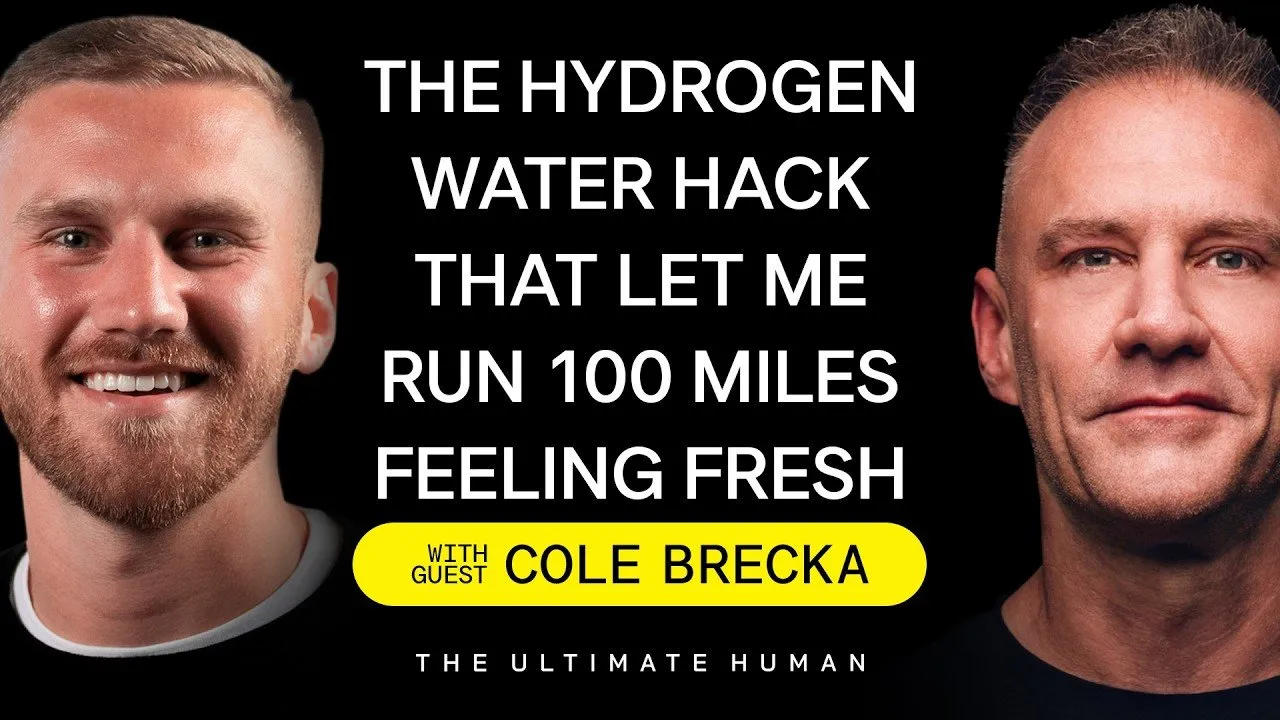
When most people decide to take up running, they might sign up for a local 5K. Cole Brecka, son of human biologist Gary Brecka, took a decidedly different approach. With zero marathon experience and only ten months of training, he attempted the "Great World Race": seven marathons on seven continents in seven days. This feat, followed by a recent 100-mile ultra-marathon through the Nevada desert, serves as a profound case study in human resilience, "going primal," and the cutting-edge science of recovery.
The journey transforms the concept of endurance from a physical challenge into a logistical and biological war. It highlights a critical shift in how we view athletic performance: the move from focusing on training volume to prioritizing cellular recovery. From surviving -28°F temperatures in Antarctica to battling hallucinations in Area 51, this story explores the extreme edges of human optimization.
Key Takeaways
- The "Under-Recovered" Theory: The central thesis of modern optimization is that most athletes are not overtrained; they are under-recovered. Focusing on connective tissue and nervous system recovery is the next frontier of performance.
- The Reality of Global Racing: The Great World Race is less about running and more about sleep deprivation, with participants managing logistics, customs, and extreme climate shifts while averaging less than two hours of sleep.
- "Going Primal": Extreme endurance strips away materialistic concerns. In the "pain cave," the hierarchy of needs simplifies strictly to shelter, water, and food.
- Hydrogen Water as a Recovery Tool: Molecular hydrogen is highlighted as a potent selective antioxidant that may significantly reduce Delayed Onset Muscle Soreness (DOMS) and restore redox homeostasis.
The Great World Race: A Logistical and Physical War
The Great World Race sounds straightforward on paper: run a marathon, fly to the next continent, sleep on the plane, and repeat. The reality is a chaotic battle against logistics and biology. Participants are not merely running; they are navigating customs, time zones, and drastic climate shifts while strapped into economy seats with swelling feet.
Surviving Antarctica
The race began in Antarctica, a research base environment requiring strict adherence to environmental protocols. At -28°F, the margin for error is nonexistent. The primary rule was stark: "If you sweat, you die." Moisture trapped in clothing freezes instantly in such temperatures, leading to rapid hypothermia.
Cole experienced this danger firsthand. After overheating in his initial layers, he attempted to shed gear, only for his extremities to freeze rapidly. He describes a terrifying moment of "tunnel vision" where his senses began to shut down.
"I swear to God it was like something in the movies. Like I felt my vision just like start to narrow and it just starts going like legit tunnel vision... my fingers had gone numb and I was like, best case scenario pass out here."
He was saved only by a videographer who commandeered a snowmobile to bring fresh, dry gear. This near-death experience occurred during the very first of seven marathons.
The Compound Effect of Travel
The transition from Antarctica to Cape Town, South Africa, involved a 60-degree temperature swing and immediate physical trauma. Running on ice and snow in Antarctica—which Cole likens to running in sand—utilizes different stabilizer muscles than road running. By the time he reached the second continent, his body was already reacting with ligament pain and inflammation.
The schedule allowed for almost zero recovery. Between clearing customs, traveling to start lines, and refueling, Cole’s longest consecutive sleep during the entire week was one hour and 50 minutes. This sleep deprivation compounds the physical damage, leading to a state where the body begins to shut down essential functions.
The "Primal" Mindset and Mental Resilience
Endurance events of this magnitude act as a stripping mechanism, peeling away the layers of modern comfort and ego. Cole describes this as "going primal." By the time the race reached Australia and subsequently Cartagena, Colombia, he was battling double stress fractures and a severe stomach bug that left him fasted for four consecutive marathons.
In Cartagena, running in 98°F heat with no food in his system, the mental challenge surpassed the physical one. It is in these moments of total depletion that an athlete discovers their true baseline.
Stripping Away Materialism
The psychological shift that occurs deep in an ultra-endurance event changes one's perspective on value. Material status symbols—cars, watches, brands—become meaningless. The brain reverts to survival mode.
"It was like the most raw and vulnerable and like primal that I'd ever felt ever... Weird how like anything materialistic or anything like that... disappears. Dude, I didn't want anything. I wanted sleep, food, water... and I wanted shelter."
The 100-Mile Ultra Experience
Months after the Great World Race, Cole tackled a 100-mile run in the Nevada desert, specifically through Area 51. Unlike the global race, this was a singular, continuous effort. The mental battle here involved managing the "unknown." Prior to this race, Cole’s longest continuous run was 31 miles. Every step past that marker was uncharted territory for his physiology.
The race emphasized the importance of "Mile 80 training"—the ability to problem-solve when the brain actively tries to convince the body to quit. In the silence of the desert night, the brain becomes creative in fabricating excuses to stop, from feigning injury to exaggerating minor illnesses. Success in ultra-endurance is largely defined by the ability to override these survival signals.
Advanced Recovery Science: Hydrogen Water and Biohacking
A major theme of Cole’s journey is the application of "biohacking" and optimization science to endurance. Gary Brecka posits a theory that defines their approach: "The vast majority of athletes are not overtrained, they're under-recovered."
While strength and conditioning coaching has reached elite levels, recovery protocols—specifically for joints, ligaments, and tendons—lag behind. The goal is to help avascular tissues (connective tissues with poor blood supply) recover as quickly as vascular muscle tissue.
The Role of Molecular Hydrogen
During the Great World Race, Cole utilized hydrogen water tablets (H2) as a primary recovery tool. He noted a distinct lack of muscle soreness despite the extreme volume of running, attributing this to the properties of hydrogen gas.
Gary Brecka explains that hydrogen acts as a selective antioxidant. It helps restore "redox homeostasis"—a balance between oxidation and reduction in the body. By mitigating oxidative stress without blunting the body's necessary adaptive responses, hydrogen water allowed Cole to maintain mobility and reduce Delayed Onset Muscle Soreness (DOMS) significantly.
Protocols for Optimization
For the 100-mile race, the team implemented a rigorous recovery protocol that included:
- Hydrogen Water: High-dose ingestion before and during the race.
- Cold Plunge & Sauna: To manage inflammation and heat shock proteins.
- Hyperbarics: To drive oxygen into tissues.
- Red Light Therapy: For mitochondrial support.
This approach allowed Cole to finish the 100-miler feeling surprisingly capable, reinforcing the idea that science can extend the limits of human endurance.
Conclusion: The Misogi Challenge
Cole’s journey is not just about physical feats; it is an exploration of the "Misogi" concept. Originating from Japanese purification rituals and adapted by modern endurance culture, a Misogi is the idea of doing one thing every year that is so difficult it defines the next 365 days. It is a challenge with a significant chance of failure.
Whether it is running seven marathons on seven continents, completing a 100-mile ultra, or simply committing to a 5K or a business goal, the principle remains the same. By voluntarily entering a "pain cave" and stripping life down to its primal elements, individuals can reset their baseline for gratitude and resilience. As Cole prepares for his next goal—10 Iron Mans in 10 days—the message is clear: humans are capable of far more than they believe, provided they master the art of recovery and the discipline of the mind.