Table of Contents
For years, creators and viewers alike have treated "clickbait" as a dirty word—a synonym for deception and hollow content. Yet, there is a profound difference between misleading an audience and effectively packaging ideas to reach them. The reality of modern digital media is that even the most profound scientific discovery requires a compelling wrapper to find its audience.
The journey from rejecting clickbait to mastering it is not just about chasing views; it is about understanding human psychology and the algorithmic shifts of platforms like YouTube. When a video about the physics of backspin is titled "Strange Applications of the Magnus Effect," it reaches physics enthusiasts. When that same video is retitled "Basketball Dropped From Dam," it reaches the world. This distinction highlights a crucial lesson: optimizing for clicks is not merely a marketing tactic, but a necessary vehicle for mass education.
Key Takeaways
- The Definition Paradox: Not all clickbait is malicious; "Legitbait" uses curiosity to drive traffic to high-value content without misleading the viewer.
- Algorithmic Evolution: YouTube shifted from a subscriber-based "podcast" model to an engagement-based "Reddit" model, necessitating higher click-through rates (CTR) for survival.
- The Power of Packaging: Changing a title and thumbnail can increase a video's reach by 10x without altering a single frame of the actual content.
- Educational Reach: Abstract titles limit audiences to experts, while broad, intriguing titles allow creators to teach complex concepts to the general public.
- The Quality Feedback Loop: Higher views generate the revenue required to fund deeper research, better animations, and higher-quality production.
The Evolution of the YouTube Algorithm
To understand the necessity of clickbait, one must first understand the structural changes of the platform hosting the content. A decade ago, YouTube functioned largely like a podcast application. The primary metric of success was the subscriber count. Users would log in, check their subscription feed, and watch the content creators they had already opted into.
In this ecosystem, virality was often external—driven by Reddit threads or Facebook shares—rather than internal discovery. However, platform engineers identified a flaw in this model: relying solely on subscriptions restricted user engagement. It created a "walled garden" where users only saw what they already knew they liked, eventually leading to boredom and platform exit.
From Subscriptions to Recommendations
YouTube pivoted to become a destination site similar to Reddit, where the most engaging content rises to the top regardless of who posted it. The goal shifted to creating a "rabbit hole" effect—keeping users on the site for hours by serving them videos they didn't know they wanted to watch.
To achieve this, the algorithm began prioritizing two specific metrics over subscriber counts:
- Watch Time: How long users stay on a video.
- Click-Through Rate (CTR): The percentage of people who click a video after seeing the thumbnail.
This shift fundamentally changed the job description of a creator. It was no longer enough to make a great video; one had to make a video that a stranger would feel compelled to click on immediately.
Classifying Clickbait: Type I vs. Type II
The friction surrounding clickbait stems from a lack of shared definition. Generally, clickbait falls into two distinct categories, which we can plot on a graph of "Sensationalism" versus "Withholding Information."
Type II: The Deceptive Trap
This is the definition most people default to when they express disdain for the practice. It involves headlines that are sensationalized, misleading, or outright false. It exploits the "curiosity gap"—giving just enough info to make you click, but leading to content that fails to satisfy that curiosity.
"A defining characteristic of clickbait is that it is sensationalized or misleading... content of dubious value or interest."
Examples include headlines like "9 out of 10 Americans are completely wrong about this," leading to a generic article. This is often referred to as "clicktrap" or "dupechute."
Type I: Legitbait
Conversely, Type I clickbait—or Legitbait—is content designed to attract attention while delivering genuine value. It resides on the boundary of what is allowable without crossing into deception. If a creator does not attempt to attract attention, they are failing to do their job. In an environment of infinite choice, "Legitbait" is the ethical application of marketing psychology. It acknowledges that a video titled "The Collatz Conjecture" serves only those who already know math, whereas "The Simplest Math Problem No One Can Solve" invites the entire world to learn math.
The Science of Packaging and A/B Testing
The impact of a title and thumbnail on a video’s performance is not marginal; it is exponential. Since YouTube introduced real-time metrics, creators have turned packaging into a scientific process involving A/B testing.
The Asteroid Case Study
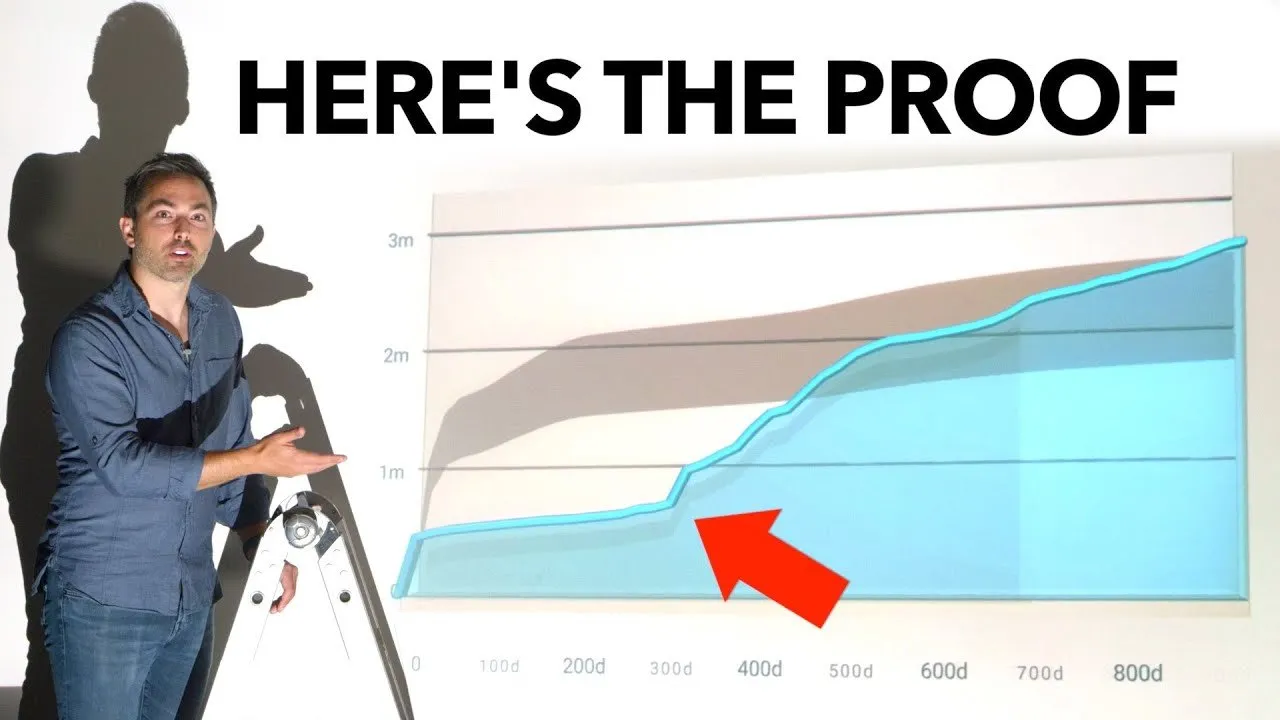
Consider a video regarding the threat of asteroids. Originally titled "Asteroids: Earth's Biggest Threat," the video underperformed, ranking 9th out of the creator's last 10 uploads. The content was scientifically rigorous, but the packaging was generic. By changing the packaging to "These Are the Asteroids to Worry About" on the third day of release, the algorithm's behavior changed instantly.
The video shot from the creator's worst-performing to the best-performing, eventually garnering over 14 million views. Nothing in the video changed—only the text and image string used to sell it. By optimizing the CTR, the creator signaled to YouTube that the content was valuable, prompting the system to show it to millions more people.
The Unpredictability of Human Interest
Even the most successful creators, including MrBeast, admit that predicting human behavior is nearly impossible without data.
"You don't really know. I mean, you could know if you just were an almighty being that could just predict what people would be interested in... usually, we just do both [thumbnails] and see which one interests people a little bit more."
This uncertainty has led to a culture of constant optimization. Creators will launch a video, monitor the click-through rate in real-time, and swap thumbnails until they see a "heartbeat" in the analytics—a spike indicating the new packaging has resonated with a broader audience.
The Educational Imperative
Critics often argue that clickbait represents a "dumbing down" of culture. However, for educational content, effective packaging is arguably the only way to "smart up" the population. There is a moral argument for aggressive optimization in science communication.
If a channel's goal is to increase the total level of knowledge in the world, it must reach people who are not currently seeking that knowledge. A straightforward, academic title acts as a filter, allowing only those with prior interest to enter. A "clickbaity" title removes that filter.
Furthermore, the relationship between views and quality is symbiotic, not adversarial. High view counts generate the revenue necessary to hire researchers, animators, and fact-checkers. This creates a positive feedback loop:
- Better Packaging leads to more views.
- More Views leads to higher revenue.
- Higher Revenue funds superior production and deeper research.
- Superior Production results in better education for the viewer.
Conclusion
The paradox of clickbait is that while users claim to hate it, their behavior consistently rewards it. In a digital landscape where attention is the ultimate currency, "Legitbait" is the bridge between obscurity and impact. By accepting that titles and thumbnails are merely the paper wrapped around the box, creators can focus on ensuring the content inside remains truthful, rigorous, and valuable.
Ultimately, if we want high-quality, scientifically accurate information to compete with mindless entertainment, we cannot begrudge educators the use of the same psychological tools used by viral marketers. If a red arrow or a sensational title is the price of admission for teaching millions of people about physics, mathematics, and engineering, it is a price well worth paying.